Evolution has 101 questions in this archive of official NEET and AIPMT papers, asked between 2006 and 2026. It appeared in 33 of the 33 papers held here (AIPMT 2006 to Re-NEET 2026); the most recent paper with a question from it is Re-NEET 2026. The most-asked topics by tag are Concept of Organic Evolution: Evidence (26), Hardy Weinberg Law (17) and Evolution Prior to Ape Man (8). In the last 10 main papers (2017 to 2026) it had 28 questions.
Evolution practice hub Take the chapter test
Evolution PYQs year by year
| Year | Papers in archive | Questions | By paper |
|---|---|---|---|
| 2026 | 2 | 9 | NEET 2026: 3, Re-NEET 2026: 6 |
| 2025 | 1 | 1 | NEET 2025: 1 |
| 2024 | 3 | 11 | NEET 2024: 4, NEET 2024 Re-exam (1,563 candidates): 5, NEET 2024 (Jhajjar): 2 |
| 2023 | 2 | 2 | NEET 2023: 1, NEET 2023 (Manipur): 1 |
| 2022 | 3 | 6 | NEET 2022: 2, NEET 2022 (Abroad): 2, NEET 2022 (Ganganagar): 2 |
| 2021 | 1 | 2 | NEET 2021: 2 |
| 2020 | 2 | 8 | NEET 2020: 4, NEET 2020 (Covid Re-exam): 4 |
| 2019 | 2 | 7 | NEET 2019: 4, NEET 2019 (Odisha): 3 |
| 2018 | 1 | 3 | NEET 2018: 3 |
| 2017 | 1 | 1 | NEET 2017: 1 |
| 2016 | 2 | 7 | NEET 2016 Phase 1: 3, NEET 2016 Phase 2: 4 |
| 2015 | 2 | 5 | AIPMT 2015: 3, AIPMT 2015 Re-exam: 2 |
| 2014 | 1 | 3 | AIPMT 2014: 3 |
| 2013 | 2 | 7 | NEET 2013: 4, NEET 2013 (Karnataka): 3 |
| 2012 | 2 | 5 | AIPMT 2012: 4, AIPMT 2012 Mains: 1 |
| 2011 | 1 | 1 | AIPMT 2011: 1 |
| 2010 | 1 | 1 | AIPMT 2010: 1 |
| 2009 | 1 | 2 | AIPMT 2009: 2 |
| 2008 | 1 | 6 | AIPMT 2008: 6 |
| 2007 | 1 | 10 | AIPMT 2007: 10 |
| 2006 | 1 | 4 | AIPMT 2006: 4 |
Most-asked topics (top 15 of 27)
| Topic | PYQs |
|---|---|
| Concept of Organic Evolution: Evidence | 26 |
| Hardy Weinberg Law | 17 |
| Evolution Prior to Ape Man | 8 |
| Origin of Life | 6 |
| Natural Selection | 6 |
| Darwin's Theory | 6 |
| Theory of Evolution & Lamarckism | 6 |
| Embryological Evidence of Evolution | 5 |
| Evolution of Homo Sapiens | 5 |
| Mechanism of Evolution | 4 |
| Origin of Life: Chemical Evolution | 4 |
| What is Adaptive Radiation | 3 |
| Palentological Evidences of Evolution | 3 |
| A BRIEF ACCOUNT OF EVOLUTION | 3 |
| Summary of Darwin's Theory | 3 |
Evolution NEET PYQ 2026 (9 questions)
Q1 Re-NEET 2026 What is Adaptive Radiation
- genetic drift
- divergent evolution
- convergent evolution
- founder effect
Show answer
Answer: (3) convergent evolution
Why: Convergent evolution occurs when unrelated or distantly related species evolve similar features because they adapt to similar environments or ecological niches. The placental mammals and Australian marsupials show such similarities through adaptive radiation, which is the case described by the correct option.
Q2 Re-NEET 2026 Introduction to Human Evolution
| Statement I: | Modern Homo sapiens arose in Australia and moved across continents. |
| Statement II: | Homo sapiens arose around 75000 to 10000 years ago. |
In the light of the above statements, choose the most appropriate answer from the options given below :
- Statement I is incorrect but Statement II is correct
- Both Statement I and Statement II are correct
- Both Statement I and Statement II are incorrect
- Statement I is correct but Statement II is incorrect
Show answer
Answer: (1) Statement I is incorrect but Statement II is correct
Why: Modern Homo sapiens originated in Africa, not Australia, and later spread from there to other continents, so the first statement is incorrect. The time range given in the second statement matches the accepted timeline for the emergence of Homo sapiens, so it is correct.
Q3 Re-NEET 2026 Embryological Evidence of Evolution
- Divergent evolution of anatomical structures such as forelimbs
- Convergent evolution of traits like wings of birds and butterflies
- Paleontological evidence from fossil records
- Embryological support for evolution as proposed by Ernst Heckel
Show answer
Answer: (4) Embryological support for evolution as proposed by Ernst Heckel
Why: Embryological support proposed by Ernst Haeckel, the idea that ontogeny recapitulates phylogeny, has been discredited, so it is not valid evidence for evolution. Divergent structures like forelimbs, convergent traits like bird and butterfly wings, and fossil records are all accepted evidence.
Q4 Re-NEET 2026 Hardy Weinberg Law
- 0.99
- 0.01
- 0.02
- 0.10
Show answer
Answer: (2) 0.01
Why: Under Hardy-Weinberg equilibrium, the frequency of the AA genotype equals the square of the frequency of allele A. Squaring the given allele frequency gives the value 0.01, which is the option that matches.
Q5 Re-NEET 2026 Concept of Organic Evolution: Evidence
| Assertion (A): | Forelimbs of human and bats are homologous. |
| Reason (R): | Forelimbs of humans and bats have similar anatomical structure. |
In the light of the above statements, choose the most appropriate answer from the options given below :
- (A) is false but (R) is true
- Both (A) and (R) are correct and (R) is the correct explanation of (A)
- Both (A) and (R) are true, but (R) is not the correct explanation of (A)
- (A) is true but (R) is false
Show answer
Answer: (2) Both (A) and (R) are correct and (R) is the correct explanation of (A)
Why: Human forelimbs and bat wings are homologous because they are derived from a common ancestor, and homology is indicated by their similar underlying anatomical structure of bones arranged in the same pattern. Thus the reason correctly explains why the assertion holds.
Q6 Re-NEET 2026 Hardy Weinberg Law
(a) stabilisation
(b) genetic drift
(c) directional change
(d) disruption
Choose the correct answer from the options given below:
- (a) and (c) only
- (a) only
- (a), (c) and (d) only
- (a), (b), (c) and (d)
Show answer
Answer: (3) (a), (c) and (d) only
Why: Natural selection can produce stabilising selection, which favours intermediate phenotypes, directional change, which shifts the population toward one extreme, and disruptive selection, which favours both extremes. Genetic drift is a random change in allele frequencies that is not driven by natural selection, so it is not a result of selection.
Q7 NEET 2026 (3 May, cancelled) Evolution of Homo Sapiens
- Homo habilis → Homo erectus → Ramapithecus → Neanderthal → Homo sapiens
- Ramapithecus → Homo habilis → Homo erectus → Neanderthal → Homo sapiens
- Homo sapiens → Ramapithecus → Homo habilis → Neanderthal → Homo erectus
- Neanderthal → Ramapithecus → Homo habilis → Homo erectus → Homo sapiens
Show answer
Answer: (2) Ramapithecus → Homo habilis → Homo erectus → Neanderthal → Homo sapiens
Why: The fossil hominin sequence in order of appearance is Ramapithecus, then Homo habilis, then Homo erectus, then Neanderthal, and finally Homo sapiens, which matches the progressive development of brain size and language ability. The option listing this sequence is the only one that follows this order.
Q8 NEET 2026 (3 May, cancelled) Embryological Evidence of Evolution
- Eyes of octopuses and mammals
- Fore limbs of whales and bats
- Wings of butterflies and birds
- Flippers of penguins and dolphins
Show answer
Answer: (2) Fore limbs of whales and bats
Why: The forelimbs of whales and bats are homologous structures inherited from a common ancestor with the same basic bone pattern, so they reflect divergent evolution rather than convergence. The eyes of octopuses and mammals, the wings of butterflies and birds, and the flippers of penguins and dolphins are analogous structures that evolved separately to serve similar functions.
Q9 NEET 2026 (3 May, cancelled) Evolution Prior to Ape Man
| List-I | List-II | ||
| A. | About 65 mya | I. | Jawless fish probably evolved |
| B. | About 500 mya | II. | The dinosaurs suddenly disappeared from the earth |
| C. | About 350 mya | III. | Seaweeds and few plants probably existed |
| D. | About 320 mya | IV. | Invertebrates were formed and became active |
- A-II, B-IV, C-I, D-III
- A-II, B-IV, C-III, D-I
- A-I, B-II, C-III, D-IV
- A-III, B-IV, C-I, D-II
Show answer
Answer: (1) A-II, B-IV, C-I, D-III
Evolution NEET PYQ 2025 (1 question)
Q10 NEET 2025 Palentological Evidences of Evolution
- Homology, convergent
- Analogy, divergent
- Analogy, convergent
- Homology, divergent
Show answer
Answer: (3) Analogy, convergent
Why: Sweet potato is a modified root (tuber) and potato is a modified stem (tuber), so they perform the same storage function but have different origins; this is analogy. Such similar traits evolved independently in unrelated lineages as an adaptation to similar conditions, which is convergent evolution.
Evolution NEET PYQ 2024 (11 questions)
Q11 NEET 2024 (Jhajjar) A BRIEF ACCOUNT OF EVOLUTION
- Fish to Amphibia
- Amphibia to Reptilia
- Reptilia to Bird
- Reptilia to Mammal
Show answer
Answer: (1) Fish to Amphibia
Why: The coelacanth is a lobe-finned fish whose fleshy, limb-like fins and internal features resemble the ancestors of early amphibians, so it is cited as a transitional form between fishes and amphibians. This makes the fish-to-amphibia transition the correct option.
Q12 NEET 2024 (Jhajjar) Hardy Weinberg Law
| Genotypes | AA | Aa | aa |
| Frequency | 22% | 62% | 16% |
- 53% and 47%
- 40% and 60%
- 50% and 50%
- 30% and 70%
Show answer
Answer: (1) 53% and 47%
Why: Under Hardy-Weinberg, the allele frequency of A is p equals the frequency of AA plus half the frequency of Aa, and the frequency of a is q equals the frequency of aa plus half the frequency of Aa. Applying these formulas to the given genotype frequencies gives p and q values that correspond to 53% for A and 47% for a.
Q13 NEET 2024 Re-exam (1,563 candidates) Hardy Weinberg Law
| List-I | List-II | ||
| A. | Gene pool | I. | Stable within a generation |
| B. | Genetic drift | II. | Change in gene frequency by chance |
| C. | Genetic flow | III. | Transfer of genes into or out of population |
| D. | Gene frequency | IV. | Total number of genes and their alleles |
- A-III,B-II,C-I,D-IV
- A-IV,B-II,C-III,D-I
- A-I,B-II,C-III,D-IV
- A-II,B-III,C-IV,D-I
Show answer
Answer: (2) A-IV,B-II,C-III,D-I
Why: The gene pool is the total set of genes and their alleles in a population. Genetic drift is a change in gene frequency due to chance events, and gene flow is the transfer of genes into or out of a population through migration. Gene frequency is the proportion of a given allele in a population and is stable within a generation, so the correct matching is A-IV, B-II, C-III, D-I.
Q14 NEET 2024 Re-exam (1,563 candidates) What is Adaptive Radiation
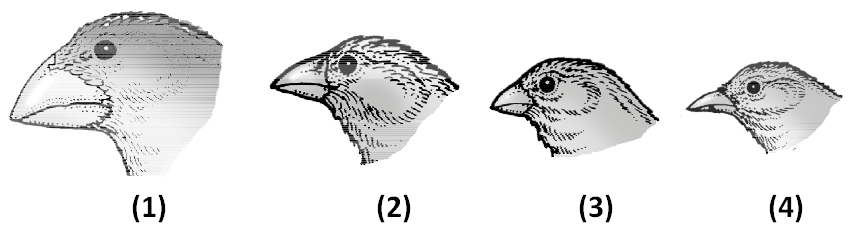
- Artificial selection
- Genetic drift
- Convergent evolution
- Adaptive radiation
Show answer
Answer: (4) Adaptive radiation
Q15 NEET 2024 Re-exam (1,563 candidates) What is Adaptive Radiation
| List-I | List-II | ||
| A. | Lemur | I. | Flying phalanger |
| B. | Bobcat | II. | Numbat |
| C. | Anteater | III. | Spotted cuscus |
| D. | Flying squirrels | IV. | Tasmanian tiger cat |
- A-III,B-IV,C-II,D-I
- A-III,B-II,C-IV,D-I
- A-IV,B-III,C-II,D-I
- A-IV,B-II,C-III,D-I
Show answer
Answer: (1) A-III,B-IV,C-II,D-I
Why: These pairs show convergent evolution, where unrelated animals evolved similar features in similar habitats. The lemur resembles the spotted cuscus, the bobcat resembles the Tasmanian tiger cat, the anteater resembles the numbat, and the flying squirrel resembles the flying phalanger. The correct option gives these matches.
Q16 NEET 2024 Re-exam (1,563 candidates) Concept of Organic Evolution: Evidence
| List-I | List-II | ||
| A. | Living Fossil | I. | Elongated canine teeth |
| B. | Connecting Link | II. | Vermiform appendix |
| C. | Vestigial Organ | III. | Echidna |
| D. | Atavism | IV. | Latimeria |
- A-IV,B-III,C-II,D-I
- A-IV,B-II,C-III,D-I
- A-IV,B-III,C-I,D-II
- A-III,B-IV,C-I,D-II
Show answer
Answer: (1) A-IV,B-III,C-II,D-I
Why: Latimeria is a living fossil, a lobe-finned fish thought to have been extinct for a long time before rediscovery. Echidna, a egg-laying mammal, is a connecting link between reptiles and mammals, the vermiform appendix is a vestigial organ in humans, and elongated canine teeth in humans would be an example of atavism, a reappearance of an ancestral trait.
Q17 NEET 2024 Re-exam (1,563 candidates) A BRIEF ACCOUNT OF EVOLUTION
- Silurian, Devonian, Permian, Carboniferous
- Silurian, Devonian, Carboniferous, Permian
- Permian, Devonian, Silurian, Carboniferous
- Silurian, Carboniferous, Permian, Devonian
Show answer
Answer: (2) Silurian, Devonian, Carboniferous, Permian
Why: The Paleozoic periods in order from oldest to most recent are Cambrian, Ordovician, Silurian, Devonian, Carboniferous and Permian, so the sequence Silurian, Devonian, Carboniferous, Permian is the correct chronological order.
Q18 NEET 2024 Evolution of Homo Sapiens
A. Homo habilis
B. Homo sapiens
C. Homo neanderthalensis
D. Homo erectus
Choose the correct sequence of human evolution from the options given below :
- B-A-D-C
- C-B-D-A
- A-D-C-B
- D-A-C-B
Show answer
Answer: (3) A-D-C-B
Why: Homo habilis is the oldest of these, followed by Homo erectus, then Homo neanderthalensis, and Homo sapiens is the most recent form in the sequence.
Q19 NEET 2024 Hardy Weinberg Law
- Genetic drift
- Gene migration
- Constant gene pool
- Genetic recombination
Show answer
Answer: (3) Constant gene pool
Q20 NEET 2024 Biological Evolution
- Natural selection
- Convergent evolution
- Divergent evolution
- Adaptive radiation
Show answer
Answer: (2) Convergent evolution
Why: Penguin and dolphin flippers are an example of convergent evolution, where unrelated animals develop similar structures for the same function, here paddling and swimming, because they live in similar aquatic environments.
Q21 NEET 2024 Biological Evolution
| List-I | List-II | ||
| A. | Mesozoic Era | I. | Lower invertebrates |
| B. | Proterozoic Era | II. | Fish & Amphibia |
| C. | Cenozoic Era | III. | Birds & Reptiles |
| D. | Paleozoic Era | IV. | Mammals |
- A-III, B-I, C-II, D-IV
- A-I, B-II, C-IV, D-III
- A-III, B-I, C-IV, D-II
- A-II, B-I, C-III, D-IV
Show answer
Answer: (3) A-III, B-I, C-IV, D-II
Why: The Mesozoic Era is known as the age of birds and reptiles, and the Proterozoic Era is characterised by lower invertebrates. The Cenozoic Era is the age of mammals, while the Paleozoic Era saw the rise of fish and amphibia.
Evolution NEET PYQ 2023 (2 questions)
Q22 NEET 2023 (Manipur) Evolution Prior to Ape Man
(A) Brain capacity of 1400 cc
(B) Used hides to protect their body
(C) Buried their dead bodies
In the light of above statements, choose the correct answer from the options given below:
- Homo erectus
- Neanderthal man
- Homo habilis
- Australopithecus
Show answer
Answer: (2) Neanderthal man
Why: Neanderthal man is identified by the combination of a large brain capacity, the use of animal hides to protect the body from cold, and the deliberate burial of the dead. These cultural and physical traits distinguish Neanderthals from the earlier Homo habilis and Homo erectus and from the still earlier Australopithecus.
Q23 NEET 2023 Concept of Organic Evolution: Evidence
- Lemur, Anteater, Wolf
- Tasmanian wolf, Bobcat, Marsupial mole
- Numbat, Spotted cuscus, Flying phalanger
- Mole, Flying squirrel, Tasmanian tiger cat
Show answer
Answer: (3) Numbat, Spotted cuscus, Flying phalanger
Why: Numbat, spotted cuscus and flying phalanger are Australian marsupials that have diversified from a common ancestor into different ecological niches, which is adaptive radiation. The other options include placental mammals or animals that are not marsupials, such as lemur, anteater, wolf, bobcat, flying squirrel and mole.
Evolution NEET PYQ 2022 (6 questions)
Q24 NEET 2022 (Ganganagar) Origin of Life
- Creation of life from dead and decaying matter
- Creation of life from chemicals
- Origin of sperm in human testes
- Transfer of spores as a unit of life from other planets of Earth
Show answer
Answer: (4) Transfer of spores as a unit of life from other planets of Earth
Why: Panspermia is the hypothesis that life or its spores are transferred to Earth from other planets or celestial bodies, so the correct option is the transfer of spores as a unit of life from other planets to Earth. The other options describe spontaneous generation or unrelated ideas.
Q25 NEET 2022 (Ganganagar) Mechanism of Evolution
- This theory was proposed by Alfred Wallace.
- Variations are small directional changes.
- Single-step large mutation is a cause of speciation.
- Large differences due to mutations arise gradually in a population.
Show answer
Answer: (3) Single-step large mutation is a cause of speciation.
Why: The mutation theory, proposed by Hugo de Vries, holds that new species arise through sudden single-step large mutations rather than through gradual accumulation of small variations. So the statement that single-step large mutation is a cause of speciation is the correct one.
Q26 NEET 2022 (Abroad) Hardy Weinberg Law
- Natural selection
- Sudden population migration
- Continuous gene migration
- Mutation
Show answer
Answer: (2) Sudden population migration
Why: Genetic drift is a random change in allele frequencies that is most pronounced in small populations, and a sudden population migration, such as a small group splitting off or a population crash, can cause it. This matches the option describing sudden population migration.
Q27 NEET 2022 (Abroad) Concept of Organic Evolution: Evidence
Select the correct match regarding adaptive radiation of Australian marsupials corresponding to placental mammals
- Numbat-Flying Squirrel
- Tasmanian Wolf - Bobcat
- Marsupial mouse- Mole
- Spotted Cuscus - Lemur
Show answer
Answer: (4) Spotted Cuscus - Lemur
Why: The spotted cuscus is an arboreal marsupial of Australia that occupies an ecological niche similar to that of the lemur, an arboreal placental primate of other continents. This is an example of convergent adaptive radiation, in which unrelated groups evolve similar forms to fill similar roles.
Q28 NEET 2022 Natural Selection
- Random change
- Stabilising change
- Directional change
- Disruptive change
Show answer
Answer: (3) Directional change
Why: Directional selection favours individuals at one extreme of the character range rather than the mean, so the population mean shifts in that direction over generations. This is what the option describing directional change refers to.
Q29 NEET 2022 Concept of Organic Evolution: Evidence
- Flippers of penguins and dolphins are a pair of homologous organs.
- Analogous structures are a result of convergent evolution.
- Sweet potato and potato is an example of analogy.
- Homology indicates common ancestry.
Show answer
Answer: (1) Flippers of penguins and dolphins are a pair of homologous organs.
Why: The flippers of penguins and dolphins are analogous, not homologous, because they have similar function but different basic structural plans and arose through convergent evolution. The sweet potato (a modified root) and potato (a modified stem) are a correct example of analogy, and homologous structures do indicate common ancestry.
Evolution NEET PYQ 2021 (2 questions)
Q30 NEET 2021 Hardy Weinberg Law
- Mutation
- Genetic drift
- Natural selection
- Genetic recombination
Show answer
Answer: (2) Genetic drift
Why: A founder effect arises when a small group splits off from a larger population and establishes a new one, so random changes in allele frequencies occur by chance. This random sampling of alleles is known as genetic drift.
Q31 NEET 2021 Palentological Evidences of Evolution
Match List-I with List-II:
| List-I | List-II | ||
| (a) | Adaptive radiation | (i) | Selection of resistant varieties due to excessive use of herbicides and pesticides |
| (b) | Convergent evolution | (ii) | Bones of forelimbs in Man and Whale |
| (c) | Divergent evolution | (iii) | Wings of Butterfly and Bird |
| (d) | Evolution by anthropogenic action | (iv) | Darwin Finches |
Choose the correct answer from the options given below:
- a-(ii), b-(i), c-(iv), d-(iii)
- a-(i), b-(iv), c-(iii), d-(ii)
- a-(iv), b-(iii), c-(ii), d-(i)
- a-(iii), b-(ii), c-(i), d-(iv)
Show answer
Answer: (3) a-(iv), b-(iii), c-(ii), d-(i)
Why: Darwin's finches show adaptive radiation, where one ancestral species diversified into several forms adapted to different food sources. The wings of butterflies and birds are analogous structures that show convergent evolution, and the forelimbs of man and whale are homologous structures showing divergent evolution. Selection of herbicide- and pesticide-resistant varieties is evolution driven by human activity.
Evolution NEET PYQ 2020 (8 questions)
Q32 NEET 2020 (Covid Re-exam) Embryological Evidence of Evolution
Embryological support for evolution was proposed by:
- Ernst Heckel
- Karl Ernst von Baer
- Charles Darwin
- Alfred Wallace
Show answer
Answer: (1) Ernst Heckel
Q33 NEET 2020 (Covid Re-exam) Examples of Chemical Evolution
- 500 billion years
- 50 million years
- 500 million years
- 50 billion years
Show answer
Answer: (3) 500 million years
Why: Life is believed to have appeared on Earth about 500 million years after the planet formed, which is far shorter than the billion-year scales given in the other options. The 500 million years option is the one consistent with this timeline.
Q34 NEET 2020 (Covid Re-exam) Concept of Organic Evolution: Evidence
The phenomenon of the evolution of different species in a given geographical area starting from a point and spreading to other habitats is called:
- Saltation
- Co-evolution
- Natural selection
- Adaptive radiation
Show answer
Answer: (4) Adaptive radiation
Why: Adaptive radiation is the process in which many different species evolve from a single ancestral species in a particular geographical area and spread out to occupy different habitats. This is the option that matches the description of evolution starting from one point and spreading to other habitats.
Q35 NEET 2020 (Covid Re-exam) Introduction to Human Evolution
A Hominid fossil discovered in Java in 1891, now extinct, having a cranial capacity of about 900 cc was:
- Homo erectus
- Neanderthal man
- Homo sapiens
- Australopithecus
Show answer
Answer: (1) Homo erectus
Why: The Java Man fossil discovered in 1891 by Eugene Dubois belongs to Homo erectus, an extinct hominid whose cranial capacity was around 900 cc. This matches the description given in the question.
Q36 NEET 2020 Darwin's Theory
| (a) | Darwin's Finches of Galapagos islands |
| (b) | Herbicide-resistant weeds |
| (c) | Drug-resistant eukaryotes |
| (d) | Man-created breeds of domesticated animals like dogs |
- (a) and (c)
- (b), (c) and (d)
- only (d)
- only (a)
Show answer
Answer: (2) (b), (c) and (d)
Why: Herbicide-resistant weeds and drug-resistant pathogens have evolved through natural selection under selective pressure created by human use of herbicides and drugs, and man-created breeds of dogs were produced by deliberate human selection. Darwin's finches diversified through natural selection in their island environment, not because of human activity.
Q37 NEET 2020 Examples of Chemical Evolution
- and water vapour at
- and water vapour at
- and water vapour at
- and water vapour at
Show answer
Answer: (4) and water vapour at
Why: Miller's closed flask contained methane, hydrogen, ammonia and water vapour, simulating the early reducing atmosphere, and the mixture was heated and electrically discharged at 800 degrees Celsius. This is the option listing CH4, H2, NH3 and water vapour at 800 degrees Celsius, which yielded amino acids.
Q38 NEET 2020 Concept of Organic Evolution: Evidence
Flippers of Penguins and Dolphins are examples of:
- Convergent evolution
- Industrial melanism
- Natural selection
- Adaptive radiation
Show answer
Answer: (1) Convergent evolution
Why: Penguin flippers and dolphin flippers are analogous structures that look alike and serve the same swimming function, but they evolved independently in birds and mammals from different ancestral limbs. This independent evolution of similar traits in unrelated groups under similar environmental pressures is convergent evolution.
Q39 NEET 2020 Embryological Evidence of Evolution
Ernst Haeckel's embryological support for evolution was disapproved by:
- Alfred Wallace
- Charles Darwin
- Oparin
- Karl Ernst von Baer
Show answer
Answer: (4) Karl Ernst von Baer
Why: Karl Ernst von Baer showed through his laws of embryology that embryos of different animals do not pass through the adult stages of other species, which contradicted Haeckel's embryological argument for evolution. This is why the option naming von Baer is correct.
Evolution NEET PYQ 2019 (7 questions)
Q40 NEET 2019 (Odisha) Theory of Evolution & Lamarckism
In Australia, marsupials and placental mammals have evolved to share many similar characteristics. This type of evolution may be referred to as:
- Adaptive Radiation
- Divergent Evolution
- Cyclical Evolution
- Convergent Evolution
Show answer
Answer: (4) Convergent Evolution
Why: Marsupials in Australia and placental mammals elsewhere are unrelated lineages that independently evolved similar body forms and ecological roles in similar environments. This pattern of unrelated groups developing similar traits is called convergent evolution, which is the option given as correct.
Q41 NEET 2019 (Odisha) Theory of Evolution & Lamarckism
A population of a species invades a new area. Which of the following condition will lead to adaptive radiation?
- Area with a large number of habitats having very low food supply
- Area with a single type of vacant habitat
- Area with many types of vacant habitats
- Area with many habitats occupied by a large number of species
Show answer
Answer: (3) Area with many types of vacant habitats
Why: Adaptive radiation happens when a species colonizing a new area finds many types of vacant habitats or ecological niches, so its descendants can diverge into different forms that each exploit a different one. Areas with few resources or with habitats already fully occupied by many species leave little room for this kind of divergence.
Q42 NEET 2019 (Odisha) Evolution of Homo Sapiens
Which of the following statements is correct about the origin and evolution of men?
- Agriculture came around 50,000 years back.
- The Dryopithecus and Ramapithecus primates existing 15 million years ago, walked like men.
- Homo habilis probably ate meat.
- Neanderthal men lived in Asia between 100000 and 40000 years back.
Show answer
Answer: (4) Neanderthal men lived in Asia between 100000 and 40000 years back.
Q43 NEET 2019 Mechanism of Evolution
- small and directionless
- random and directional
- random and directionless
- small and directional
Show answer
Answer: (3) random and directionless
Why: Hugo de Vries proposed that mutations produce variations that are random and directionless, meaning they arise without regard to what would benefit the organism. Some of these mutations can be large in effect, which is why de Vries also linked them to sudden variations he called saltations.
Q44 NEET 2019 Natural Selection
- Cyclical selection
- Directional selection
- Stabilizing selection
- Disruptive selection
Show answer
Answer: (3) Stabilizing selection
Why: Stabilizing selection favours intermediate phenotypes and selects against both extremes, which matches the survival data where average birth weights survive best while very low and very high weights die. Directional and disruptive selection would instead favour one extreme or both extremes, and cyclical selection involves changes over time.
Q45 NEET 2019 Hardy Weinberg Law
A gene locus has two alleles A, a. If the frequency of dominant allele A is 0.4, then what will be the frequency of homozygous dominant, heterozygous and homozygous recessive individuals in the population?
- 0.16 (AA); 0.36 (Aa); 0.48 (aa)
- 0.36 (AA); 0.48 (Aa); 0.16 (aa)
- 0.16 (AA); 0.24 (Aa); 0.36 (aa)
- 0.16 (AA); 0.48 (Aa); 0.36 (aa)
Show answer
Answer: (4) 0.16 (AA); 0.48 (Aa); 0.36 (aa)
Why: By Hardy-Weinberg principle, if p is the frequency of allele A and q is the frequency of allele a (the complement of p), then homozygous dominant AA is p squared, heterozygous Aa is doubled p times q, and homozygous recessive aa is q squared. Applying this to the given frequency of A gives 0.16 for AA, 0.48 for Aa and 0.36 for aa, which is the option listing those values.
Q46 NEET 2019 Evolution Prior to Ape Man
Match the hominids with their correct brain size:
| Column-I | Column-II | ||
| (a) | Homo habilis | (i) | 900 cc |
| (b) | Homo neanderthalensis | (ii) | 1350 cc |
| (c) | Homo erectus | (iii) | 650-800 cc |
| (d) | Homo sapiens | (iv) | 1400 cc |
Select the correct option.
- a-(iv), b-(iii), c-(i), d-(ii)
- a-(iv), b-(i), c-(iv), d-(ii)
- a-(iii), b-(ii), c-(i), d-(iv)
- a-(iii), b-(iv), c-(i), d-(ii)
Show answer
Answer: (4) a-(iii), b-(iv), c-(i), d-(ii)
Why: Homo habilis is matched with 650-800 cc, Homo neanderthalensis with 1400 cc, Homo erectus with 900 cc and Homo sapiens with 1350 cc. This matching corresponds to the option a-(iii), b-(iv), c-(i), d-(ii).
Evolution NEET PYQ 2018 (3 questions)
Q47 NEET 2018 Concept of Organic Evolution: Evidence
- Homology
- Analogy
- Convergent evolution
- Adaptive radiation
Show answer
Answer: (1) Homology
Why: Homology refers to structures that share a similar basic plan because of common ancestry, even when they perform different functions. The forelimbs of humans, whales, bats and horses have the same underlying bone arrangement for this reason, which is the homology option.
Q48 NEET 2018 Mechanism of Evolution
According to Hugo de Vries, the mechanism of evolution is:
- Multiple-step mutations
- Saltation
- Phenotypic variations
- Minor mutations
Show answer
Answer: (2) Saltation
Why: Hugo de Vries proposed that new species arise through saltation, meaning sudden large heritable mutations rather than gradual accumulation of small changes. This is the option that names saltation as the mechanism of evolution.
Q49 NEET 2018 Concept of Organic Evolution: Evidence
- Forelimbs of man, bat and cheetah
- Heart of bat, man and cheetah
- Brain of bat, man and cheetah
- Eye of octopus, bat and man
Show answer
Answer: (4) Eye of octopus, bat and man
Why: Divergent evolution refers to homologous organs that have the same basic structure but different functions, such as the forelimbs of man, bat and cheetah. The eye of octopus is an analogous structure that evolved independently through convergent evolution, so it does not belong in a divergent evolution set and is the incorrect option.
Evolution NEET PYQ 2017 (1 question)
Q50 NEET 2017 Natural Selection
Artificial selection to obtain cows yielding higher milk output represents:
- Directional, as it pushes the mean of the character in one direction
- Disruptive, as it splits the population into two, one yielding higher output and the other lower output
- Stabilizing followed by disruptive, as it stabilizes the population to produce higher-yielding cows
- Stabilizing selection, as it stabilizes this character in the population
Show answer
Answer: (1) Directional, as it pushes the mean of the character in one direction
Why: Selecting cows with the highest milk yield shifts the population mean of that trait in a single direction over generations. This is the defining feature of directional selection, which is the option describing a push of the mean in one direction.
Evolution NEET PYQ 2016 (7 questions)
Q51 NEET 2016 Phase 2 Hardy Weinberg Law
In Hardy-Weinberg equation, the frequency of heterozygous individual is represented by?
- p2
- 2pq
- pq
- q2
Show answer
Answer: (2) 2pq
Why: In the Hardy-Weinberg expansion of the binomial (p + q) squared, the middle term represents the heterozygous genotype, and its frequency is two times p times q. This is the option written as 2pq.
Q52 NEET 2016 Phase 2 Origin of Life: Chemical Evolution
Which of the following is the correct sequence of events in the origin of life?
| I: | Formation of protobionts. |
| II: | Synthesis of organic monomers. |
| III: | Synthesis of organic polymers. |
| IV: | Formation of DNA-based genetic systems. |
- I, II, III, IV
- I, III, II, IV
- II, III, I, IV
- II, III, IV, I
Show answer
Answer: (3) II, III, I, IV
Why: The correct sequence is synthesis of organic monomers (option II), then their assembly into organic polymers (option III), then formation of protobionts (option I), and finally the emergence of DNA-based genetic systems (option IV). Each stage builds on the one before it, so the polymers must exist before they can be packaged into protobionts.
Q53 NEET 2016 Phase 2 Evolution Prior to Ape Man
The chronological order of human evolution from early to the recent is?
- Australopithecus→Ramapithecus→Homo habilis→Homo erectus
- Ramapithecus→Australopithecus→ Homo habilis→Homo erectus
- Ramapithecus→Homo habilis→ Australopithecus →Homo erectus
- Australopithecus→Homo habilis→Ramapithecus →Homo erectus
Show answer
Answer: (2) Ramapithecus→Australopithecus→ Homo habilis→Homo erectus
Why: The correct chronological order runs from Ramapithecus to Australopithecus to Homo habilis to Homo erectus, as given in option (2). Ramapithecus is the oldest of these forms, and Homo erectus is the most recent.
Q54 NEET 2016 Phase 2 Hardy Weinberg Law
Genetic drift operates in:
- small isolated population
- large isolated population
- non-reproductive population
- slow reproductive population
Show answer
Answer: (1) small isolated population
Why: Genetic drift is a random change in allele frequencies that has its strongest effect in small isolated populations, where chance events can easily eliminate or fix alleles. In large populations these random effects average out and drift is much weaker.
Q55 NEET 2016 Phase 1 Concept of Organic Evolution: Evidence
Analogous structures are results of?
- convergent evolution
- shared ancestry
- stabilizing selection
- divergent evolution
Show answer
Answer: (1) convergent evolution
Why: Analogous structures look alike because unrelated organisms adapted to similar functions or environments, such as the wings of insects and birds. This similarity arises from convergent evolution rather than from a shared ancestral structure.
Q56 NEET 2016 Phase 1 Concept of Organic Evolution: Evidence
- Wing of a moth
- Hind limb of rabbit
- Flipper of whale
- Dorsal fin of a shark
Show answer
Answer: (3) Flipper of whale
Why: Homologous structures share a common embryonic origin and basic bone pattern despite different functions, and the flipper of a whale has the same underlying forelimb bone arrangement as a bird's wing. The wing of a moth is an analogous structure, while the hind limb of a rabbit and the dorsal fin of a shark do not share this forelimb plan.
Q57 NEET 2016 Phase 1 Origin of Life: Chemical Evolution
| I: | The earliest organisms that appeared on the earth were non-green and presumably anaerobes. |
| II: | The first autotrophic organisms were the chemoautotrophs that never released oxygen. |
- II is correct but I is false
- Both I and II are correct
- Both I and II are false
- I is correct but II is false
Show answer
Answer: (2) Both I and II are correct
Why: The earliest organisms on earth were non-green anaerobes, and the first autotrophs were chemoautotrophs that did not release oxygen, so both statements are correct. The option stating that both statements are correct is therefore the right choice.
Evolution NEET PYQ 2015 (5 questions)
Q58 AIPMT 2015 Re-exam Concept of Organic Evolution: Evidence
The wings of a bird and the wings of an insect are:
- Homologous structures, represent divergent evolution
- Analogous structures, represent convergent evolution
- Phylogenetic structures, represent divergent evolution
- Homologous structures, represent convergent evolution
Show answer
Answer: (2) Analogous structures, represent convergent evolution
Why: Bird wings and insect wings perform the same function but have different embryonic origins and structures, so they are analogous. Such similarity arising independently in unrelated groups represents convergent evolution, which matches the option describing analogous structures.
Q59 AIPMT 2015 Re-exam Natural Selection
- Neo Darwinism
- Natural Selection
- Mutation
- Neo Lamarckism
Show answer
Answer: (2) Natural Selection
Why: Industrial melanism, the darkening of moth populations in polluted industrial areas, is a classic case of natural selection in which dark-coloured variants survive better against soot-darkened tree bark and leave more offspring. The darker form becomes more frequent over generations because the environment favours it.
Q60 AIPMT 2015 Hardy Weinberg Law
- Transduction
- Chromosomal aberrations
- Genetic drift
- Recombination
Show answer
Answer: (4) Recombination
Why: Recombination, the reshuffling of alleles through crossing over and independent assortment during meiosis, is the most common source of genetic variation in sexually reproducing populations. Transduction, chromosomal aberrations and genetic drift are much rarer or act differently on populations.
Q61 AIPMT 2015 Hardy Weinberg Law
- individuals mate selectively
- there are no mutations
- there is no migration
- the population is large
Show answer
Answer: (1) individuals mate selectively
Why: Hardy-Weinberg equilibrium requires random mating, so a population in which individuals mate selectively (non-random mating) will not remain in equilibrium. Mutation, migration and a large population size are conditions that are either consistent with or do not break equilibrium, so option (1) is the correct choice.
Q62 AIPMT 2015 Evolution Prior to Ape Man
- Homo erectus
- Homo sapiens
- Homo neanderthalensis
- Homo habilis
Show answer
Answer: (4) Homo habilis
Why: Among the listed hominins, Homo habilis has the smallest brain capacity, which is the reason it is placed earliest in the lineage with a brain smaller than that of Homo erectus, Homo neanderthalensis and Homo sapiens. Its brain is therefore correctly identified in option (4).
Evolution NEET PYQ 2014 (3 questions)
Q63 AIPMT 2014 Hardy Weinberg Law
In a population of 1000 individuals, 360 belong to genotype AA, 480 to Aa and the remaining 160 to aa. Based on this data, the frequency of allele A in the population is:
- 0.4
- 0.5
- 0.6
- 0.7
Show answer
Answer: (3) 0.6
Why: Allele frequency is the number of copies of the allele divided by the total number of allele copies in the population. Each AA individual contributes two copies of A and each Aa individual contributes one, so the frequency of A equals (double the number of AA plus the number of Aa) divided by double the total population size, which gives the value in option (3).
Q64 AIPMT 2014 Concept of Organic Evolution: Evidence
- Analogous organs
- Adaptive radiation
- Homologous organs
- Convergent evolution
Show answer
Answer: (3) Homologous organs
Why: The forelimbs of cat, lizard, whale and bat share the same basic bone arrangement but are modified for walking, swimming and flying. Such organs with a common underlying structure but different functions, arising from divergent evolution, are called homologous organs.
Q65 AIPMT 2014 Concept of Organic Evolution: Evidence
- Wing of Bat and Wings of Pigeon
- Gills of Prawn and Lungs of Man
- Thorns of Bougainvillea and Tendrils of Cucurbita
- Flippers of Dolphin and Legs of Horse.
Show answer
Answer: (2) Gills of Prawn and Lungs of Man
Evolution NEET PYQ 2013 (7 questions)
Q66 NEET 2013 (Karnataka) Hardy Weinberg Law
- Migration
- Natural selection
- Genetic drift
- Mutation
Show answer
Answer: (3) Genetic drift
Why: Genetic drift is the random, non-directional change in allele frequencies caused by chance events, and its effects are strongest in small populations. Migration, natural selection and mutation are different evolutionary forces that do not describe random chance changes in this way.
Q67 NEET 2013 (Karnataka) A BRIEF ACCOUNT OF EVOLUTION
- Coenozoic
- Jurassic
- Mesozoic
- Devonion
Show answer
Answer: (3) Mesozoic
Why: The Mesozoic era, which spans the Triassic, Jurassic and Cretaceous periods, is when dinosaurs dominated terrestrial ecosystems. Jurassic is only one period within this era, Coenozoic is the later Cenozoic era after the dinosaurs disappeared, and Devonian is a much earlier Palaeozoic period.
Q68 NEET 2013 (Karnataka) Concept of Organic Evolution: Evidence
- Carrion
- Insects
- Tree buds
- Seeds
Show answer
Answer: (1) Carrion
Q69 NEET 2013 Hardy Weinberg Law
This is referred to as:
- Genetic drift
- Random mating
- Genetic load
- Genetic flow
Show answer
Answer: (1) Genetic drift
Why: Random changes in allele frequencies in a small population, caused by chance sampling of gametes rather than by selective advantage, are called genetic drift. This is the option 'Genetic drift'.
Q70 NEET 2013 Concept of Organic Evolution: Evidence
The eye of the octopus and the eye of the cat show different patterns of structure, yet they perform a similar function. This is an example of:
- Homologous organs that have evolved due to divergent evolution.
- Analogous organs that have evolved due to convergent evolution.
- Analogous organs that have evolved due to divergent evolution.
- Homologous organs that have evolved due to convergent evolution.
Show answer
Answer: (2) Analogous organs that have evolved due to convergent evolution.
Why: The octopus eye and the cat eye are analogous because they share the same function of vision but did not arise from a common ancestral eye structure; their similar function arose independently through convergent evolution, as the cephalopod and vertebrate lineages evolved camera-type eyes separately.
Q71 NEET 2013 Concept of Organic Evolution: Evidence
Show answer
Answer: option (1)
Q72 NEET 2013 Hardy Weinberg Law
- lack of migration
- lack of mutations
- lack of random mating
- random mating
Show answer
Answer: (3) lack of random mating
Why: Hardy-Weinberg equilibrium is maintained only when mating is random, so lack of random mating (for example, non-random or assortative mating) disturbs the population's tendency to remain in genetic equilibrium. Migration and mutation are factors that change allele frequencies, and random mating itself preserves equilibrium.
Evolution NEET PYQ 2012 (5 questions)
Q73 AIPMT 2012 Mains Mechanism of Evolution
The idea of mutations was brought forth by:
- Gregor Mendel, who worked on Pisum sativum
- Hardy Weinberg, who worked on allele frequencies in a population
- Charles Darwin, who observed a wide variety of organisms during sea voyages
- Hugo do Vries, who worked on evening primrose
Show answer
Answer: (4) Hugo do Vries, who worked on evening primrose
Why: Hugo de Vries proposed the mutation theory of evolution after working on the evening primrose, Oenothera, where he observed sudden heritable variations. Mendel worked on inheritance in pea plants, and Hardy and Weinberg described allele frequencies, while Darwin's ideas rested on natural selection and variation rather than on mutations.
Q74 AIPMT 2012 Evolution of Homo Sapiens
- Shortening of jaws
- Binocular vision
- Increasing cranial capacity
- upright posture
Show answer
Answer: (3) Increasing cranial capacity
Why: The most significant trend in the evolution of modern man from his ancestors was the progressive increase in cranial capacity, reflecting the enlargement of the brain. The other features mentioned, such as upright posture and binocular vision, appeared as well but are not regarded as the main trend.
Q75 AIPMT 2012 Concept of Organic Evolution: Evidence
Evolution of different species in a given area starting from a point and spreading to other geographical areas is known as:
- Adaptive radiation
- Natural selection
- Migration
- Divergent evolution
Show answer
Answer: (1) Adaptive radiation
Why: When many species arise from a common ancestor in one area and spread into different habitats, each adapting to a different way of life, this is called adaptive radiation. Natural selection and migration are mechanisms or movements, not the pattern described, and divergent evolution is a broader term, so adaptive radiation is the correct option.
Q76 AIPMT 2012 Concept of Organic Evolution: Evidence
Which one of the following options gives one correct example of convergent evolution and divergent evolution?
- Eyes of octopus and mammals — Bones of forelimbs of vertebrates
- Thorns of Bougainvillea and tendrils Cucurbita — Wings of butterflies and birds
- Bones of forelimbs of vertebrates — Wings of butterfly and birds
- Thorns of Bougainvillea and tendrils of Cucurbita — Eyes of Octopus and mammals
Show answer
Answer: (1) Eyes of octopus and mammals — Bones of forelimbs of vertebrates
Why: Convergent evolution produces similar structures in unrelated organisms, as with the camera-type eyes of octopus and mammals, while divergent evolution produces different structures from a common ancestor, as with the homologous bones of vertebrate forelimbs. The correct option pairs eyes of octopus and mammals with forelimb bones of vertebrates.
Q77 AIPMT 2012 Evolution Prior to Ape Man
- Homo habilis
- Neanderthal human
- Cro-Magnon humans
- Ramapithecus
Show answer
Answer: (2) Neanderthal human
Why: The Neanderthal human was a extinct species that lived in Europe, Asia and parts of Africa, and had a short, stocky body, heavy brow ridges, a receding forehead, large jaws with heavy teeth and a stooped posture. Homo habilis was an earlier toolmaker, Cro-Magnon humans were early modern humans, and Ramapithecus was an ancient ape-like primate.
Evolution NEET PYQ 2011 (1 question)
Q78 AIPMT 2011 Evolution of Homo Sapiens
- Shortening of jaws
- Binocular vision
- Increasing brain capacity
- Upright posture
Show answer
Answer: (3) Increasing brain capacity
Why: The most significant trend in human evolution from ancestral hominids was the expansion of brain size, which is reflected in increasing cranial capacity. A larger brain supported advances such as tool making, language and complex social behaviour, so increasing brain capacity is the most important trend among the options.
Evolution NEET PYQ 2010 (1 question)
Q79 AIPMT 2010 Concept of Organic Evolution: Evidence
- industrial melanism
- connecting link
- adaptive radiation
- convergent evolution
Show answer
Answer: (3) adaptive radiation
Why: Darwin's finches of the Galapagos Islands descended from a common ancestor and diversified into many species with different beak shapes, each adapted to a different food source. This divergence from one ancestral form into several adapted forms in new habitats is the defining feature of adaptive radiation.
Evolution NEET PYQ 2009 (2 questions)
Q80 AIPMT 2009 Natural Selection
In the case of peppered moth (Biston betularia), the black-coloured form became dominant over the light-coloured form in England during the industrial revolution. This is an example of:
- natural selection, whereby the darker forms were selected
- appearance of the darker coloured individuals due to very poor sunlight
- protective mimicry
- inheritance of darker colour character acquired due to the darker environment
Show answer
Answer: (1) natural selection, whereby the darker forms were selected
Why: This is natural selection: in soot-darkened industrial England, the dark-coloured moths were better camouflaged on blackened trees, so they were less often eaten by predators and survived and reproduced more, which made the dark form dominant.
Q81 AIPMT 2009 Palentological Evidences of Evolution
- Ctenophora and Plantyhelminthes
- Mollusca and Echinodermata
- Annelida and Arthropoda
- Coelenterata and Poriphera
Show answer
Answer: (3) Annelida and Arthropoda
Why: Peripatus, also called the velvet worm, has segmented, unjointed limbs and a body structure resembling annelids, while its tracheal respiration, open circulatory system and claws reflect arthropod features. This mixture of characters makes it a connecting link between Annelida and Arthropoda, as in option (3).
Evolution NEET PYQ 2008 (6 questions)
Q82 AIPMT 2008 Other Theories of Origin of Life
- Weismann - Theory of continuity of germplasm
- Pasteur -- Inheritance of acquired characters
- de Vries -- Natural selection
- Mendel -- Theory of pangenesis
Show answer
Answer: (1) Weismann - Theory of continuity of germplasm
Why: August Weismann proposed the theory of continuity of germplasm, which holds that the germ cells carry hereditary material continuously from one generation to the next. The other pairings are wrong because Pasteur disproved spontaneous generation, the inheritance of acquired characters is associated with Lamarck, de Vries proposed the mutation theory, and the theory of pangenesis is associated with Darwin.
Q83 AIPMT 2008 Darwin's Theory
Darwin's finches are an excellent example of:
- adaptive radiation
- seasonal migration
- brood parasitism
- connecting links
Show answer
Answer: (1) adaptive radiation
Why: Darwin's finches on the Galapagos Islands evolved from a common ancestor into several species with differently shaped beaks suited to different food sources, which is a classic case of adaptive radiation. This describes divergence of many species from one ancestor into varied ecological niches.
Q84 AIPMT 2008 Theory of Evolution & Lamarckism
Thorn of Bougainvillea and tendril of Cucurbita are examples of:
- analogous organs
- homologous organs
- vestigial organs
- retrogressive evolution
Show answer
Answer: (2) homologous organs
Why: The thorn of Bougainvillea and the tendril of Cucurbita are both modified stems that have a common basic structure but different functions. Such structures are homologous organs, showing divergent evolution from a common ancestral form.
Q85 AIPMT 2008 Population Genetics
What is true about the isolated small tribal populations?
- There is a decline in population as boys marry girls only from their own tribe
- Hereditary diseases like colour blindness do not spread in isolated populations
- Wrestlers who develop strong body muscles in their lifetime pass this character
on to their progeny - There is no change in population size as they have a large gene pool
Show answer
Answer: (1) There is a decline in population as boys marry girls only from their own tribe
Why: When small tribal populations marry only within the tribe, close inbreeding increases the chance that harmful recessive alleles pair up in homozygous form. This inbreeding depression lowers fertility and survival, which leads to a decline in population size.
Q86 AIPMT 2008 Definition & Types of Evolution
Which one of the following pair of items correctly belongs to the category of organs mentioned against it?
- Thorn of Bougainvillea and tendrils of Cucurbita – Analogous organs
- Nictitating membrane and blind spot in the human eye – vestigial organs
- Nephridia of the earthworm and Malpighian tubules of cockroach - Excretory organs
- Wings of a honey bee and wings of crow - Homologous organs
Show answer
Answer: (3) Nephridia of the earthworm and Malpighian tubules of cockroach - Excretory organs
Why: Nephridia of the earthworm and Malpighian tubules of the cockroach both perform excretion, so they are correctly grouped as excretory organs even though they arise separately in the two animals. Thorns and tendrils are analogous, the nictitating membrane is not vestigial, and honey bee and crow wings are analogous rather than homologous.
Q87 AIPMT 2008 Origin of Life: Chemical Evolution
Which one of the following is incorrect about the characteristics of protobionts (coacervates and microspheres) as envisaged in the abiogenic origin of life?
- They could separate combinations of molecules from the surroundings
- They were able to reproduce
- They were partially isolated from the surroundings
- They could maintain an internal environment
Show answer
Answer: (2) They were able to reproduce
Why: The incorrect statement is that protobionts were able to reproduce. Coacervates and microspheres could separate a set of molecules from their surroundings, were partially isolated by a boundary, and could maintain an internal chemical environment, but they lacked nucleic acids and heredity, so true self-replication was not yet possible.
Evolution NEET PYQ 2007 (10 questions)
Q88 AIPMT 2007 Concept of Isolation
- no change in the isolated fauna
- preventing speciation
- speciation through reproductive isolation
- random creation of new species
Show answer
Answer: (3) speciation through reproductive isolation
Why: Geographical isolation separates populations so that gene flow stops, and over time the isolated groups diverge genetically until reproductive isolation arises, leading to speciation. This is the classic allopatric mode of speciation, and the other options describe outcomes that isolation does not produce.
Q89 AIPMT 2007 Evolution Prior to Ape Man
- Homo neaderthalensis
- Homo erectus
- Ramapithecus
- Homo habilis
Show answer
Answer: (1) Homo neaderthalensis
Why: Homo neanderthalensis had a brain size more than 1000 cc, which is comparable to or larger than modern humans. Ramapithecus, Homo habilis and Homo erectus had smaller brains than this.
Q90 AIPMT 2007 Origin of Life: Chemical Evolution
The concept of chemical evolution is based on:
- crystallization of chemicals
- interaction of water, air, and clay under intense heat
- effect of solar radiation on chemicals
- possible origin of life by a combination of chemicals
under suitable environmental conditions
Show answer
Answer: (4) possible origin of life by a combination of chemicals
under suitable environmental conditions
Why: Chemical evolution, as proposed by Oparin and Haldane, holds that simple inorganic molecules combined under the conditions of early Earth to form organic molecules, which eventually led to the origin of life. This is the idea captured by the option describing the combination of chemicals under suitable environmental conditions.
Q91 AIPMT 2007 Natural Selection
Industrial melanism as observed in peppered moths proves that:
- The true black melanic forms arise from a recurring natural selection
- The melanic form of the moth has no selective advantage over the lighter form in an industrial area
- The lighter-form moth has no selective advantage either in polluted industrial areas or non-polluted areas
- Melanism is a pollution-generated feature
Show answer
Answer: (1) The true black melanic forms arise from a recurring natural selection
Why: In polluted industrial areas soot darkens tree bark, so dark melanic moths survive better and their frequency rises, while in clean areas the light form is favoured and returns. The repeated rise and fall of the black form in response to these changing conditions shows that natural selection acts again and again on the same variation.
Q92 AIPMT 2007 Darwin's Theory
- special creation
- evolution due to mutation
- retrogressive evolution
- biogeographical evolution
Show answer
Answer: (4) biogeographical evolution
Why: The different beak shapes of the Galapagos finches, each adapted to a different food source on separate islands, show how populations that spread to different geographical areas diverged, which supports biogeographical evolution.
Q93 AIPMT 2007 Darwin's Theory
Select the correct statement from the following:
- Darwin variations are small and directionless
- fitness is the end result of the ability to adapt and gets selected by nature
- all mammals except whales and have seven cervical vertebrae
- Mutations are random and directional
Show answer
Answer: (2) fitness is the end result of the ability to adapt and gets selected by nature
Why: In the modern evolutionary sense, fitness refers to an organism's ability to survive and reproduce in its environment, so the fitter individuals are the ones that adapt better and are favoured by natural selection. Darwin's variations are not directionless, and mutations are random rather than directional.
Q94 AIPMT 2007 Definition & Types of Evolution
- divergent evolution
- microevolution
- co-evolution
- convergent evolution
Show answer
Answer: (4) convergent evolution
Why: When unrelated or distantly related species evolve similar traits because they face similar environmental pressures and occupy similar ways of life, the process is called convergent evolution. Divergent evolution produces differences from a common ancestor, microevolution refers to small genetic changes within a population, and co-evolution involves reciprocal evolutionary changes between interacting species.
Q95 AIPMT 2007 Definition & Types of Evolution
- Seasonal migration
- Thick subcutaneous fat
- Convergent evolution
- Homeothermy
Show answer
Answer: (3) Convergent evolution
Why: Whales, seals and sharks live in water and have evolved similar body forms, fins and streamlined shapes despite belonging to unrelated groups, which is the hallmark of convergent evolution. This shared trait arose from adaptation to a similar aquatic environment rather than from common ancestry.
Q96 AIPMT 2007 Embryological Evidence of Evolution
Which one of the following statements is correct?
- Stem cells are specialized
- There is no evidence of the existence of gills during embryogenesis of mammals
- All plant and animal cells are totipotent
- Ontogeny repeats phylogeny
Show answer
Answer: (4) Ontogeny repeats phylogeny
Why: Ontogeny repeats phylogeny is the correct statement, a idea of Haeckel's recapitulation theory that the developmental stages of an individual animal reflect the evolutionary history of its ancestors. The other statements are incorrect because stem cells are unspecialized, mammalian embryos do show transient gill-like structures, and not all plant and animal cells are totipotent.
Q97 AIPMT 2007 Theory of Evolution & Lamarckism
Adaptive radiation refers to:
- adaptations due to geographical isolation
- evolution of different species from a common ancestor
- migration of members of a species to different geographical areas
- power of adaptation in an individual to a variety of environments
Show answer
Answer: (2) evolution of different species from a common ancestor
Why: Adaptive radiation is the evolution of many different species from a single common ancestor, each adapting to a different ecological niche. This is typically seen when a group colonises new or diverse habitats.
Evolution NEET PYQ 2006 (4 questions)
Q98 AIPMT 2006 Urey & Miller Experiment
Which one of the following amino acids was not found to be synthesized in Miller’s experiment?
- Glycine
- Aspartic acid
- Glutamic acid
- Alanine
Show answer
Answer: (3) Glutamic acid
Why: Miller's experiment produced glycine, alanine and aspartic acid among the amino acids, but glutamic acid was not reported as one of its synthesized products. The option describing glutamic acid is therefore the one that was not found.
Q99 AIPMT 2006 Concept of Speciation
- King crab
- Sphenodon
- Archaeopteryx
- Peripatus
Show answer
Answer: (3) Archaeopteryx
Why: Archaeopteryx is an extinct transitional fossil showing features of both reptiles and birds, not a living fossil. King crab, Sphenodon and Peripatus are living fossils because they have survived almost unchanged from ancient lineages to the present day.
Q100 AIPMT 2006 Concept of Organic Evolution: Evidence
- homologous and vestigial organs
- analogous and vestigial organs
- homologous organ only
- analogous organ only
Show answer
Answer: (1) homologous and vestigial organs
Why: Homologous organs, which share a common ancestral origin but may differ in function, and vestigial organs, which are reduced remnants of functional structures in ancestors, both provide evidence for organic evolution. Analogous organs arise from convergent adaptation rather than common descent, so they are not evidence of shared ancestry.
Q101 AIPMT 2006 Concept of Speciation
Jurassic period of the Mesozoic era is characterised by:
- gymnosperms, adminant plants, and first birds appear
- radiation of reptiles and the origin of mammal-like reptiles
- Dinosaurs become extinct and angiosperms appear
- flowering plants and the first dinosaurs appear
Show answer
Answer: (1) gymnosperms, adminant plants, and first birds appear
Why: During the Jurassic period, gymnosperms were the dominant land plants and the first birds appeared, as represented by fossils such as Archaeopteryx. This is the option that names gymnosperms and the first birds, not the option about reptile radiation or flowering plants.
Frequently asked questions
How many Evolution questions have been asked in NEET?
This archive holds 101 Evolution questions from 33 of 33 official NEET and AIPMT papers, 2006–2026. It counts every paper held here, including re-exam and regional papers.
Which topics of Evolution are asked most often?
By topic tag: Concept of Organic Evolution: Evidence (26), Hardy Weinberg Law (17), Evolution Prior to Ape Man (8), Origin of Life (6) and Natural Selection (6).
When was Evolution last asked?
The most recent paper in this archive with a question from this chapter is Re-NEET 2026.
Where do the answers come from?
Each answer is the option recorded as correct in the official answer key for that paper. Where a short explanation is shown, it was written separately and checked against the key; it is not part of the official paper. Questions marked NEET 2026 (3 May, cancelled) are from the cancelled first sitting: NTA issued no final key for it, so their answers are the key on record and have not been matched to an official key.
More Biology chapter-wise PYQs
← Reproductive Health Human Health and Disease →
Botany, Class 11
- The Living World (25)
- Biological Classification (90)
- Plant Kingdom (88)
- Morphology of Flowering Plants (120)
- Anatomy of Flowering Plants (83)
- Cell: The Unit of Life (125)
- Cell Cycle and Cell Division (84)
- Photosynthesis in Higher Plants (69)
- Respiration in Plants (42)
- Plant Growth and Development (71)
Old syllabus (archive)
- Transport in Plants (39)
- Mineral Nutrition (49)
- Reproduction in Organisms (22)
- Environmental Issues (80)
- Digestion and Absorption (45)
Botany, Class 12
- Sexual Reproduction in Flowering Plants (118)
- Principles of Inheritance and Variation (155)
- Molecular Basis of Inheritance (172)
- Strategies for Enhancement in Food Production (36)
- Microbes in Human Welfare (66)
- Organisms and Populations (86)
- Ecosystem (87)
- Biodiversity and Conservation (86)
Zoology, Class 11
- Animal Kingdom (109)
- Structural Organisation in Animals (90)
- Biomolecules (100)
- Breathing and Exchange of Gases (56)
- Body Fluids and Circulation (68)
- Excretory Products and their Elimination (54)
- Locomotion and Movement (58)
- Neural Control and Coordination (53)
- Chemical Coordination and Integration (76)
Zoology, Class 12
- Human Reproduction (109)
- Reproductive Health (67)
- Human Health and Disease (100)
- Biotechnology: Principles and Processes (118)
- Biotechnology and its Applications (101)
Want more than past papers? Practise all 2,173 Evolution questions on NEETprep.