Human Reproduction has 109 questions in this archive of official NEET and AIPMT papers, asked between 2006 and 2026. It appeared in 33 of the 33 papers held here (AIPMT 2006 to Re-NEET 2026); the most recent paper with a question from it is Re-NEET 2026. The most-asked topics by tag are Fetal Development & Parturition (16), Seminiferous Tubules & Spermatogenesis (15) and Embryonic Development till Gastrulation (14). In the last 10 main papers (2017 to 2026) it had 33 questions.
Human Reproduction practice hub Take the chapter test
Human Reproduction PYQs year by year
| Year | Papers in archive | Questions | By paper |
|---|---|---|---|
| 2026 | 2 | 7 | NEET 2026: 3, Re-NEET 2026: 4 |
| 2025 | 1 | 5 | NEET 2025: 5 |
| 2024 | 3 | 13 | NEET 2024: 5, NEET 2024 Re-exam (1,563 candidates): 4, NEET 2024 (Jhajjar): 4 |
| 2023 | 2 | 5 | NEET 2023: 3, NEET 2023 (Manipur): 2 |
| 2022 | 3 | 9 | NEET 2022: 3, NEET 2022 (Abroad): 3, NEET 2022 (Ganganagar): 3 |
| 2021 | 1 | 3 | NEET 2021: 3 |
| 2020 | 2 | 6 | NEET 2020: 3, NEET 2020 (Covid Re-exam): 3 |
| 2019 | 2 | 3 | NEET 2019: 2, NEET 2019 (Odisha): 1 |
| 2018 | 1 | 4 | NEET 2018: 4 |
| 2017 | 1 | 1 | NEET 2017: 1 |
| 2016 | 2 | 7 | NEET 2016 Phase 1: 4, NEET 2016 Phase 2: 3 |
| 2015 | 2 | 6 | AIPMT 2015: 3, AIPMT 2015 Re-exam: 3 |
| 2014 | 1 | 3 | AIPMT 2014: 3 |
| 2013 | 2 | 5 | NEET 2013: 3, NEET 2013 (Karnataka): 2 |
| 2012 | 2 | 6 | AIPMT 2012: 4, AIPMT 2012 Mains: 2 |
| 2011 | 1 | 3 | AIPMT 2011: 3 |
| 2010 | 1 | 9 | AIPMT 2010: 9 |
| 2009 | 1 | 7 | AIPMT 2009: 7 |
| 2008 | 1 | 3 | AIPMT 2008: 3 |
| 2007 | 1 | 2 | AIPMT 2007: 2 |
| 2006 | 1 | 2 | AIPMT 2006: 2 |
Most-asked topics (top 15 of 19)
| Topic | PYQs |
|---|---|
| Fetal Development & Parturition | 16 |
| Seminiferous Tubules & Spermatogenesis | 15 |
| Embryonic Development till Gastrulation | 14 |
| Menstrual Cycle: Luteal Phase | 11 |
| Oogenesis | 9 |
| Female Reproductive System | 9 |
| Menstrual Cycle | 9 |
| Fertilization | 9 |
| Male Reproductive System | 8 |
| Spermiogenesis/Sperm Structure/Hormonal Regulation | 8 |
| Menstrual Cycle: Pre Ovulatory Phase | 7 |
| Introduction to Menstrual Cycle | 7 |
| Male Reproductive Duct System | 4 |
| Ovary | 4 |
| Mammary Gland & Lactation | 3 |
Human Reproduction NEET PYQ 2026 (7 questions)
Q1 Re-NEET 2026 Oogenesis
- chorion
- endometrium
- zona radiata
- zona pellucida
Show answer
Answer: (4) zona pellucida
Why: At ovulation the ovum is surrounded by a thick, transparent glycoprotein layer called the zona pellucida, which is then enclosed by the corona radiata. Chorion is an embryonic membrane, endometrium is the uterine lining, and zona radiata is not the term used for this covering in this context.
Q2 Re-NEET 2026 Male Reproductive System
- Infundibulum
- Rete testis
- Epididymis
- Vasa efferentia
Show answer
Answer: (1) Infundibulum
Why: The infundibulum is the funnel-shaped opening of the fallopian tube, which is part of the female reproductive system. Rete testis, epididymis and vasa efferentia are all ducts or structures of the male reproductive system.
Q3 Re-NEET 2026 Menstrual Cycle
| Statement I: | Ovulation is caused by LH surge leading to rupture of Graafian follicles. |
| Statement II: | Graafian follicle remaining after ovulation transform into corpus luteum and secretes large amount of estrogen. |
In the light of the above statements, choose the most appropriate answer from the options given below:
- Statement I is incorrect but Statement II is correct
- Both Statement I and Statement II are correct
- Both Statement I and Statement II are incorrect
- Statement I is correct but Statement II is incorrect
Show answer
Answer: (4) Statement I is correct but Statement II is incorrect
Why: The first statement is correct because the LH surge triggers ovulation by rupturing the mature Graafian follicle. The second statement is incorrect because the corpus luteum formed after ovulation secretes mainly progesterone, not a large amount of estrogen.
Q4 Re-NEET 2026 Embryonic Development till Gastrulation
- LH
- hCG
- Estrogen
- Progesterone
Show answer
Answer: (1) LH
Why: The placenta secretes hCG, estrogen and progesterone to maintain pregnancy. LH is produced by the anterior pituitary gland, not by the placenta, so the option LH is the hormone not secreted by the placenta.
Q5 NEET 2026 (3 May, cancelled) Embryonic Development till Gastrulation
| List-I | List-II | ||
| A. | The foetus movement starts and hair appears on the head | I. | 24 weeks of pregnancy |
| B. | The foetus develops limbs and digits | II. | 20 weeks of pregnancy |
| C. | The foetus develops external genital organs | III. | 8 weeks of pregnancy |
| D. | The foetus body is covered with fine hair; eyelids separate and eyelashes are formed | IV. | 12 weeks of pregnancy |
- A-III,B-II,C-IV,D-I
- A-II,B-IV,C-III,D-I
- A-IV,B-II,C-III,D-I
- A-II,B-III,C-IV,D-I
Show answer
Answer: (4) A-II,B-III,C-IV,D-I
Q6 NEET 2026 (3 May, cancelled) Seminiferous Tubules & Spermatogenesis
| A. | Spermatogonia always undergo meiotic cell division |
| B. | Primary Spermatogonia divide mitotically to produce secondary Spermatocytes. |
| C. | Secondary Spermatocytes, through their second meiotic division, produce haploid spermatids |
| D. | Spermatids produce spermatozoa through mitosis. |
| E. | Spermatids transform into spermatozoa by spermiogenesis. |
- C and E only
- A, C and E only
- B, C and D only
- A and E only
Show answer
Answer: (1) C and E only
Why: Only statements C and E are correct: secondary spermatocytes complete the second meiotic division to form haploid spermatids, and spermatids are transformed into spermatozoa by spermiogenesis. Spermatogonia divide mitotically, primary spermatocytes undergo meiosis, and spermatids change into sperm without dividing, so statements A, B and D are wrong.
Q7 NEET 2026 (3 May, cancelled) Female Reproductive System
A. Zona pellucida
B. Perivitelline space
C. Corona radiata
D. Plasma membrane of ovum
Choose the correct answer from the options given below:
- C,A,D,B
- C,A,B,D
- D,B,A,C
- A,C,B,D
Show answer
Answer: (2) C,A,B,D
Why: Moving from outside to inside around the female gamete, the corona radiata is the outermost layer, followed by the zona pellucida, then the perivitelline space, and finally the plasma membrane of the ovum, which is the order C, A, B, D in the correct option.
Human Reproduction NEET PYQ 2025 (5 questions)
Q8 NEET 2025 Menstrual Cycle
- Diapause
- Ovulation
- Menopause
- Menarche
Show answer
Answer: (4) Menarche
Why: The first menstrual period in a girl's life is called menarche, which marks the onset of reproductive capability. Ovulation is the release of an egg, menopause is the permanent end of menstruation, and diapause is a state of developmental arrest in animals.
Q9 NEET 2025 Fetal Development & Parturition
| A. | In human pregnancy, the major organ systems are formed at the end of 12 weeks. |
| B. | In human pregnancy, the major organ systems are formed at the end of 8 weeks. |
| C. | In human pregnancy, the heart is formed after one month of gestation. |
| D. | In human pregnancy, limbs and digits develop by the end of the second month. |
| E. | In human pregnancy, the appearance of hair is usually observed in the fifth month. |
- B, C, D and E only
- A, C, D and E Only
- A and E Only
- B and C Only
Show answer
Answer: (2) A, C, D and E Only
Q10 NEET 2025 Spermiogenesis/Sperm Structure/Hormonal Regulation
| List-I | List-II | ||
| A. | Head | I. | Enzymes |
| B. | Middle piece | II. | Sperm motility |
| C. | Acrosome | III. | Energy |
| D. | Tail | IV. | Genetic materials |
- A-III, B-IV, C-II, D-I
- A-III, B-II, C-I, D-IV
- A-IV, B-III, C-I, D-II
- A-IV, B-III, C-II, D-I
Show answer
Answer: (3) A-IV, B-III, C-I, D-II
Q11 NEET 2025 Menstrual Cycle
| A. | The reductive division for the human female gametogenesis starts earlier than that of the male gametogenesis. |
| B. | The gap between the first meiotic division and the second meiotic division is much shorter for males compared to females. |
| C. | The first polar body is associated with the formation of the primary oocyte. |
| D. | Luteinizing Hormone (LH) surge leads to disintegration of the endometrium and onset of menstrual bleeding. |
- B and D are true
- B and C are true
- A and B are true
- A and C are true
Show answer
Answer: (3) A and B are true
Why: In humans, female gametogenesis (oogenesis) begins during embryonic development, well before male gametogenesis (spermatogenesis), which starts at puberty. The gap between the first and second meiotic divisions is much shorter in males than in females, where it can extend over many years.
Q12 NEET 2025 Fertilization
- The were conceived through in vitro fertilization.
- They have 75% identical genetic content.
- They are monozygotic twins.
- They are fraternal twins.
Show answer
Answer: (4) They are fraternal twins.
Why: A boy and a girl cannot develop from a single zygote, so these twins must come from two separate eggs fertilized by two separate sperm, which makes them fraternal (dizygotic) twins. Fraternal twins share only about half of their segregating genes, not 75 percent, and they are not necessarily conceived by in vitro fertilization.
Human Reproduction NEET PYQ 2024 (13 questions)
Q13 NEET 2024 (Jhajjar) Male Reproductive System
| A. | Vas deferens | B. | Rete testis |
| C. | Seminiferous tubules | D. | Vasa efferentia |
| E. | Urethra | F. | Epididymis |
Show answer
Answer: (4)
Why: Sperms form in the seminiferous tubules, pass into the rete testis, then move through the vasa efferentia into the epididymis where they mature. From the epididymis they travel through the vas deferens and finally exit the body through the urethra, which is the sequence given in the correct option.
Q14 NEET 2024 (Jhajjar) Embryonic Development till Gastrulation
| List-I (No. of weeks) |
List-II (Major features) |
||
| A. | After 4 weeks of pregnancy | I. | Eye-lids separate and eyelashes are formed |
| B. | After 12 weeks of pregnancy | II. | Heart is formed |
| C. | After 24 weeks of pregnancy | III. | Limbs and digits are developed |
| D. | After 8 weeks of pregnancy | IV. | External genital organs are well developed |
- A-III, B-IV, C-I, D-II
- A-II, B-I, C-III, D-IV
- A-II, B-IV, C-I, D-III
- A-III, B-IV, C-II, D-I
Show answer
Answer: (3) A-II, B-IV, C-I, D-III
Why: The heart begins to form by the fourth week of pregnancy, and external genital organs are well developed by the twelfth week. Limbs and digits are developed by the eighth week, while eyelids separate and eyelashes form by the twenty-fourth week.
Q15 NEET 2024 (Jhajjar) Embryonic Development till Gastrulation
A. Estrogens
B. Progestogens
C. Relaxin and Inhibin
D. hCG
E. hPL
Choose the correct answer from the options given below:
- D and E only
- C only
- B only
- A and C only
Show answer
Answer: (2) C only
Why: Estrogens, progestogens, hCG and hPL are all secreted by the placenta. Inhibin is produced by the gonads rather than the placenta, so the option pairing relaxin and inhibin is the one that does not describe placental hormones.
Q16 NEET 2024 (Jhajjar) Menstrual Cycle: Luteal Phase
| Statement I: | Degeneration of corpus luteum in the absence of fertilization is the cause for disintegration of endometrium. |
| Statement II: | Cyclic menstruation indicates normal reproductive phase in human females and extends between menarche and menopause. |
- Both Statement I and Statement II are True.
- Both Statement I and Statement II are False.
- Statement I is True but Statement II is False.
- Statement I is False but Statement II is True.
Show answer
Answer: (1) Both Statement I and Statement II are True.
Why: Degeneration of the corpus luteum when fertilization does not occur reduces progesterone levels, which causes the endometrium to break down, so Statement I is true. Cyclic menstruation is a normal feature of the reproductive phase that lasts from menarche to menopause, so Statement II is also true.
Q17 NEET 2024 Re-exam (1,563 candidates) Menstrual Cycle: Luteal Phase
| Assertion (A): | During menstrual cycle, the ovulation takes place approximately on 14th day. |
| Reason (R): | Rapid secretion of LH in the middle of menstrual cycle induces rupture of Graafian follicle and thereby the release of ovum. |
- (A) is True but (R) is False.
- (A) is False but (R) is True
- Both (A) and (R) are True and (R) is the correct explanation of (A).
- Both (A) and (R) are True but (R) is not the correct explanation of (A).
Show answer
Answer: (3) Both (A) and (R) are True and (R) is the correct explanation of (A).
Why: Ovulation typically occurs around the middle of the menstrual cycle, and a sudden surge of LH at that time causes the Graafian follicle to rupture and release the ovum. Both statements are true, and the reason correctly explains the assertion. The correct option says exactly this.
Q18 NEET 2024 Re-exam (1,563 candidates) Mammary Gland & Lactation
A. Mammary duct
B. Lactiferous duct
C. Mammary alveolus
D. Ampulla
E. Mammary tubule
Choose the correct answer from the options given below:
- D→C→E→A→B
- C→E→B→A→D
- C→E→A→D→B
- A→C→E→D→B
Show answer
Answer: (3) C→E→A→D→B
Why: Milk is formed in the mammary alveoli, flows through the mammary tubules into the mammary ducts, then into the ampulla, which is a dilated sac where milk is stored, and finally out through the lactiferous ducts. This sequence follows the route of milk ejection.
Q19 NEET 2024 Re-exam (1,563 candidates) Female External Genitalia
| List-I (Structures) |
List-II (Features) |
||
| A. | Mons pubis | I. | A fleshy fold of tissue surrounding the vaginal opening |
| B. | Clitoris | II. | Fatty cushion of cells covered by skin and hair |
| C. | Hymen | III. | Tiny finger-like structure above labia minora |
| D. | Labia majora | IV. | A thin membrane-like structure covering vaginal opening |
- A-II, B-III, C-IV, D-I
- A-IV, B-III, C-II, D-I
- A-I, B-IV, C-III, D-II
- A-II, B-III, C-I, D-IV
Show answer
Answer: (1) A-II, B-III, C-IV, D-I
Why: The mons pubis is a fatty cushion of cells covered by skin and hair, and the clitoris is a tiny finger-like structure above the labia minora. The hymen is a thin membrane-like structure covering the vaginal opening, and the labia majora are fleshy folds of tissue surrounding the vaginal opening.
Q20 NEET 2024 Re-exam (1,563 candidates) Mammary Gland & Lactation
| List-I | List-II | ||
| A. | Parturition | I. | Several antibodies for new-born babies |
| B. | Placenta | II. | Collection of ovum after ovulation |
| C. | Colostrum | III. | Foetal ejection reflex |
| D. | Fimbriae | IV. | Secretion of the hormone hCG |
- A-III,B-IV,C-I,D-II
- A-I,B-IV,C-II,D-III
- A-II,B-III,C-IV,D-I
- A-III,B-IV,C-II,D-I
Show answer
Answer: (1) A-III,B-IV,C-I,D-II
Why: Parturition is triggered by the foetal ejection reflex, the placenta secretes the hormone hCG, colostrum is the first milk rich in antibodies for the new-born, and fimbriae are finger-like projections that collect the ovum after ovulation. Matching these pairs gives the option A-III, B-IV, C-I, D-II.
Q21 NEET 2024 Female Reproductive System
- Isthmus
- Infundibulum
- Ampulla
- Uterine fundus
Show answer
Answer: (4) Uterine fundus
Why: The fallopian tube (oviduct) consists of the infundibulum, the ampulla and the isthmus, with the interstitial part passing through the uterine wall. The uterine fundus is the upper rounded part of the uterus itself, not a part of the fallopian tube.
Q22 NEET 2024 Male Reproductive System
| Assertion (A): | FSH acts upon ovarian follicles in female and Leydig cells in male. |
| Reason (R): | Growing ovarian follicles secrete estrogen in female while interstitial cells secrete androgen in human males . |
In the light of the above statements, choose the correct answer from the options given below:
- Both (A) and (R) are True but (R) is not the correct explanation of (A).
- (A) is True but (R) is False
- (A) is False but (R) is True
- Both (A) and (R) are True and (R) is the correct explanation of (A).
Show answer
Answer: (3) (A) is False but (R) is True
Why: The assertion is false because FSH acts on ovarian follicles in females but on Sertoli cells, not Leydig cells, in males, since Leydig cells are stimulated by LH. The reason is true because growing ovarian follicles secrete estrogen and interstitial (Leydig) cells secrete androgens in males.
Q23 NEET 2024 Female Reproductive System
| Statement I: | The presence or absence of hymen is not a reliable indicator of virginity. |
| Statement II: | The hymen is torn during the first coitus only. |
In the light of the above statements, choose the correct answer from the options given below:
- Both Statement I and Statement II are False
- Statement I is True but Statement II is False
- Statement I is False but Statement II is True
- Both Statement I and Statement II are True
Show answer
Answer: (2) Statement I is True but Statement II is False
Why: Statement I is true because the presence or absence of the hymen cannot reliably indicate virginity, since it can be damaged by many causes other than sexual intercourse. Statement II is false because the hymen is not always torn during the first coitus and may remain intact or be torn on later occasions.
Q24 NEET 2024 Fetal Development & Parturition
| Assertion (A): | Breast-feeding during initial period of infant growth is recommended by doctors for bringing a healthy baby. |
| Reason (R): | Colostrum contains several antibodies absolutely essential to develop resistance in the new born baby. |
In the light of the above statements, choose the most appropriate answer from the options given below:
- Both (A) and (R) are True but (R) is not the correct explanation of (A)
- (A) is True but (R) is False.
- (A) is False but (R) is True.
- Both (A) and (R) are True and (R) is the correct explanation of (A).
Show answer
Answer: (4) Both (A) and (R) are True and (R) is the correct explanation of (A).
Why: Both statements are true, and the reason explains the assertion: colostrum, the first milk, is rich in antibodies such as IgA that provide passive immunity to the newborn, which is why breast-feeding in the early period is recommended.
Q25 NEET 2024 Seminiferous Tubules & Spermatogenesis
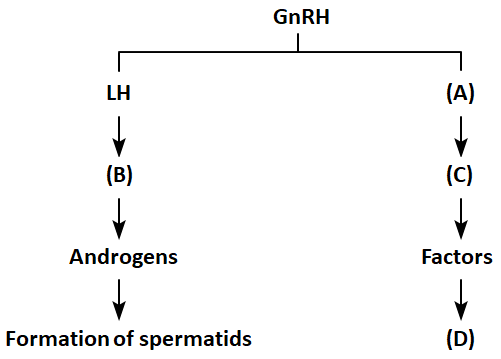
- ICSH, Interstitial cells, Leydig cells, spermiogenesis.
- FSH, Sertoli cells, Leydig cells, spermatogenesis.
- ICSH, Leydig cells, Sertoli cells, spermatogenesis.
- FSH, Leydig cells, Sertoli cells, spermiogenesis
Show answer
Answer: (4) FSH, Leydig cells, Sertoli cells, spermiogenesis
Human Reproduction NEET PYQ 2023 (5 questions)
Q26 NEET 2023 (Manipur) Seminiferous Tubules & Spermatogenesis
| A. | Gonadotropin LH stimulates synthesis and secretion of Androgen |
| B. | Gonadotropin releasing hormone from hypothalamus |
| C. | Androgen stimulates spermatogenesis |
| D. | Gonadotropin FSH helps in the process of spermiogenesis |
| E. | Gonadotropins from anterior pituitary gland |
- (E), (A), (D), (B), (C)
- (C), (A), (D), (E), (B)
- (B), (E), (A), (C), (D)
- (D), (B), (A), (C), (E)
Show answer
Answer: (3) (B), (E), (A), (C), (D)
Why: The sequence begins with gonadotropin releasing hormone from the hypothalamus, which stimulates the anterior pituitary to secrete gonadotropins. LH then stimulates the Leydig cells to synthesize androgens, which drive spermatogenesis, and FSH supports the later transformation of spermatids during spermiogenesis.
Q27 NEET 2023 (Manipur) Oogenesis
| I: | The primary follicles get surrounded by more layers of granulosa cells, a theca and shows fluid filled cavity antrum. Now it is called secondary follicle. |
| II: | Graafian follicle ruptures to release the secondary oocyte from the ovary by the process called ovulation. |
- Statement I is True but Statement II is False
- Statement I is False but Statement II is True
- Both Statement I and Statement II are True
- Both Statement I and Statement II are False
Show answer
Answer: (2) Statement I is False but Statement II is True
Why: Antrum formation, the appearance of a fluid-filled cavity, marks the transition to the tertiary (Graafian) follicle, not the secondary follicle, so the first statement is incorrect. The secondary follicle has more granulosa layers and a theca but no antrum yet. The second statement is correct because the mature Graafian follicle ruptures to release the secondary oocyte during ovulation.
Q28 NEET 2023 Male Reproductive System
| Statement I: | Vas deferens receives a duct from seminal vesicle and opens into urethra as the ejaculatory duct. |
| Statement II: | The cavity of the cervix is called cervical canal which along with vagina forms birth canal. |
- Statement I is incorrect but Statement II is correct.
- Both Statement I and Statement II are correct.
- Both Statement I and Statement II are incorrect.
- Statement I is correct but Statement II is incorrect.
Show answer
Answer: (2) Both Statement I and Statement II are correct.
Why: The vas deferens receives a duct from the seminal vesicle and joins it to form the ejaculatory duct, which opens into the urethra. The cavity of the cervix is the cervical canal, and together with the vagina it forms the birth canal, so both statements are correct.
Q29 NEET 2023 Menstrual Cycle: Pre Ovulatory Phase
| A. | In non-primate mammals, cyclical changes during reproduction are called oestrus cycle. |
| B. | First menstrual cycle begins at puberty and is called menopause. |
| C. | Lack of menstruation may be indicative of pregnancy. |
| D. | Cyclic menstruation extends between menarche and menopause. |
- A, C and D only
- A and D only
- A and B only
- A, B and C only
Show answer
Answer: (1) A, C and D only
Why: The oestrus cycle is the cyclical reproductive change in non-primate mammals, and a lack of menstruation can indicate pregnancy. Cyclic menstruation occurs between menarche, the first menstrual cycle at puberty, and menopause, the end of cycles. The statement that the first menstrual cycle is called menopause is incorrect, because the first cycle is menarche.
Q30 NEET 2023 Introduction to Menstrual Cycle
| Assertion (A): | Endometrium is necessary for implantation of blastocyst. |
| Reason (R): | In the absence of fertilization, the corpus luteum degenerates that causes disintegration of endometrium. |
- (A) is False but (R) is True.
- Both (A) and (R) are True and (R) is the correct explanation of (A).
- Both (A) and (R) are True but (R) is not the correct explanation of (A).
- (A) is True but (R) is False.
Show answer
Answer: (3) Both (A) and (R) are True but (R) is not the correct explanation of (A).
Human Reproduction NEET PYQ 2022 (9 questions)
Q31 NEET 2022 (Ganganagar) Mammary Gland & Lactation
(a) Mammary duct
(b) Lactiferous duct
(c) Alveoli
(d) Mammary ampulla
(e) Mammary tubules
Choose the most appropriate answer from the options given below :
- (c) → (a) → (d) → (e) → (b)
- (b) → (c) → (e) → (d) → (a)
- (c) → (e) → (a) → (d) → (b)
- (e) → (c) → (d) → (b) → (a)
Show answer
Answer: (3) (c) → (e) → (a) → (d) → (b)
Why: Milk is produced in the alveoli (c), which open into the mammary tubules (e); these join into the mammary duct (a), which expands into the mammary ampulla (d) for temporary storage before the lactiferous duct (b) carries milk out. So the proximal-to-distal order is c, e, a, d, b.
Q32 NEET 2022 (Ganganagar) Seminiferous Tubules & Spermatogenesis
- 50 million
- 100 million
- 200 million
- 400 million
Show answer
Answer: (3) 200 million
Why: Each primary spermatocyte gives two secondary spermatocytes, and each secondary spermatocyte gives two spermatozoa through meiosis II. Therefore the number of secondary spermatocytes needed is half the number of spermatozoa, giving 200 million for 400 million sperm.
Q33 NEET 2022 (Ganganagar) Fetal Development & Parturition
| Assertion (A): | Pregnancy is characterised by metabolic changes in the mother. |
| Reason (R): | During pregnancy, the level of thyroxine is increased in the maternal blood. |
- Both (A) and (R) are True and (R) is the correct explanation of (A).
- Both (A) and (R) are True but (R) is not the correct explanation of (A).
- (A) is True but (R) is False.
- (A) is False but (R) is True.
Show answer
Answer: (1) Both (A) and (R) are True and (R) is the correct explanation of (A).
Q34 NEET 2022 (Abroad) Oogenesis
How many Y-chromosomes are present in the 2nd polar body in human beings?
- 01
- 00
- 23
- 02
Show answer
Answer: (2) 00
Why: The second polar body is produced from a secondary oocyte, which has only X chromosomes, so it contains no Y chromosome. The option stating zero Y chromosomes is therefore correct.
Q35 NEET 2022 (Abroad) Fetal Development & Parturition
Which of the following hormones are secreted in women only during pregnancy?
| (a) | Relaxin | (b) | Oxytocin |
| (c) | hCG | (d) | hPL |
| (e) | Progesterone |
Choose the most appropriate answer from the options given below:
- (c), (d) and (e) only
- (b) and (e) only
- (b), (c) and (d) only
- (a), (c) and (d) only
Show answer
Answer: (4) (a), (c) and (d) only
Why: Relaxin, human chorionic gonadotropin (hCG) and human placental lactogen (hPL) are secreted in women only during pregnancy, whereas oxytocin is released during labour and lactation and progesterone is also present outside pregnancy in the menstrual cycle. The option naming relaxin, hCG and hPL is therefore the correct combination.
Q36 NEET 2022 (Abroad) Male Reproductive Duct System
Arrange the following male sex accessory ducts in the correct sequence for the transport of sperms from the testis:
| (a) | Epididymis | (b) | Ejaculatory duct |
| (c) | Vasa efferentia | (d) | Rete testis |
| (e) | Vas deferens |
Choose the most appropriate answer from the options given below:
- (d), (a), (c), (e), (b)
- (d), (c), (e), (a), (b)
- (d), (c), (a), (e), (b)
- (d), (e), (a), (c), (b)
Show answer
Answer: (3) (d), (c), (a), (e), (b)
Why: Sperms move from the rete testis into the vasa efferentia, then into the epididymis, then into the vas deferens, and finally out through the ejaculatory duct. This sequence matches option (3), which lists rete testis, vasa efferentia, epididymis, vas deferens, and ejaculatory duct in that order.
Q37 NEET 2022 Seminiferous Tubules & Spermatogenesis
| Statement I: | The release of sperms into the seminiferous tubules is called spermiation. |
| Statement II: | Spermiogenesis is the process of formation of sperms from spermatogonia. |
- Statement I is incorrect but Statement II is correct.
- Both Statement I and Statement II are correct.
- Both Statement I and Statement II are incorrect.
- Statement I is correct but Statement II is incorrect.
Show answer
Answer: (4) Statement I is correct but Statement II is incorrect.
Why: Statement I is correct because spermiation is the release of mature sperm from Sertoli cells into the lumen of the seminiferous tubules. Statement II is incorrect because spermiogenesis is only the transformation of spermatids into sperm, whereas the full formation of sperm from spermatogonia involves meiosis and spermiogenesis together.
Q38 NEET 2022 Seminiferous Tubules & Spermatogenesis
| (a) | It results in the formation of haploid gametes. |
| (b) | Differentiation of gamete occurs after the completion of meiosis. |
| (c) | Meiosis occurs continuously in a mitotically dividing stem cell population. |
| (d) | It is controlled by the Luteinising hormone (LH) and Follicle Stimulating Hormone (FSH) secreted by the anterior pituitary. |
| (e) | It is initiated at puberty. |
- (b), (c), and (e) only
- (c) and (e) only
- (b) and (c) only
- (b), (d) and (e) only
Show answer
Answer: (1) (b), (c), and (e) only
Why: Spermatogenesis is a continuous process that starts at puberty from mitotically dividing stem cells, and the gametes differentiate only after meiosis is complete. Oogenesis differs on all three points: it begins during embryonic development, meiosis is arrested for long periods, and differentiation of the egg is not confined to the post-meiotic stage in the same way.
Q39 NEET 2022 Oogenesis
- Adult
- Puberty
- Embryonic development stage
- Birth
Show answer
Answer: (3) Embryonic development stage
Why: Oogenesis is initiated during embryonic development, when the primary oocytes begin meiosis I inside the fetal ovary and then arrest in prophase I. This is different from spermatogenesis, which starts only at puberty.
Human Reproduction NEET PYQ 2021 (3 questions)
Q40 NEET 2021 Fertilization
Receptors for sperm binding in mammals are present on:
- Perivitelline space
- Zona pellucida
- Corona Radiata
- Vitelline membrane
Show answer
Answer: (2) Zona pellucida
Why: In mammals, sperm binding during fertilisation occurs through receptors located on the zona pellucida, the glycoprotein layer surrounding the egg. These receptors bind the sperm and trigger the acrosome reaction.
Q41 NEET 2021 Fetal Development & Parturition
Which of the following secretes the hormone, relaxin, during the later phase of pregnancy?
- Foetus
- Uterus
- Graafian follicle
- Corpus luteum
Show answer
Answer: (4) Corpus luteum
Why: Relaxin is secreted during the later phase of pregnancy by the corpus luteum, the endocrine structure formed from the ruptured Graafian follicle. The foetus, uterus and Graafian follicle are not the source of this hormone in the later phase of pregnancy.
Q42 NEET 2021 Fetal Development & Parturition
- Release of oxytocin
- Release of prolactin
- Increase in estrogen and progesterone ratio
- Synthesis of prostaglandins
Show answer
Answer: (2) Release of prolactin
Why: Initiation of parturition in humans depends on rising oxytocin release, an increased oestrogen to progesterone ratio, and prostaglandin synthesis, which together stimulate uterine contractions. Prolactin is mainly involved in milk production after delivery and is not a component of the initiation of labour.
Human Reproduction NEET PYQ 2020 (6 questions)
Q43 NEET 2020 (Covid Re-exam) Fetal Development & Parturition
In human beings, at the end of 12 weeks (first trimester) of pregnancy, the following is observed:
- Eyelids and eyelashes are formed
- Most of the major organ systems are formed
- The head is covered with fine hair
- Movement of the fetus
Show answer
Answer: (2) Most of the major organ systems are formed
Why: By the end of the first trimester (12 weeks), the major organ systems of the fetus have been laid down and formed. Eyelids, fine hair on the head and fetal movement appear later in development, so the option stating that most major organ systems are formed is correct.
Q44 NEET 2020 (Covid Re-exam) Seminiferous Tubules & Spermatogenesis
Select the correct option of haploid cells from the following groups :
- Primary oocyte, Secondary oocyte, Spermatid
- Secondary spermatocyte, First polar body, Ovum
- Spermatogonia, Primary spermatocyte, Spermatid
- Primary spermatocyte, Secondary spermatocyte, Second polar body
Show answer
Answer: (2) Secondary spermatocyte, First polar body, Ovum
Why: Haploid cells contain a single set of chromosomes: the secondary spermatocyte, the first polar body and the ovum are all products of meiosis I or II and are haploid. Primary oocytes, primary spermatocytes and spermatogonia are diploid, so the option listing secondary spermatocyte, first polar body and ovum is correct.
Q45 NEET 2020 (Covid Re-exam) Seminiferous Tubules & Spermatogenesis
Match the following columns and select the correct option:
| Column-I | Column-II | ||
| (a) | Ovary | (i) | Human chorionic gonadotropin |
| (b) | Placenta | (ii) | Estrogen & Progesterone |
| (c) | Corpus luteum | (iii) | Androgens |
| (d) | Leydig cells | (iv) | Progesterone only |
- a-(iv), b-(iii), c-(ii), d-(i)
- a-(i), b-(ii), c-(iii), d-(iv)
- a-(i), b-(iii), c-(ii), d-(iv)
- a-(ii), b-(i), c-(iv), d-(iii)
Show answer
Answer: (4) a-(ii), b-(i), c-(iv), d-(iii)
Why: The ovary secretes estrogen and progesterone, the placenta secretes human chorionic gonadotropin, the corpus luteum secretes only progesterone, and Leydig cells in the testis secrete androgens. The matching a-(ii), b-(i), c-(iv), d-(iii) reflects these correct pairings.
Q46 NEET 2020 Fertilization
- At the time of copulation
- After zygote formation
- At the time of fusion of a sperm with an ovum
- Prior to ovulation
Show answer
Answer: (3) At the time of fusion of a sperm with an ovum
Why: The secondary oocyte, arrested at metaphase of meiosis II, completes its division only after a sperm enters it, so the second meiotic division is finished at the moment of fusion of the sperm with the ovum. This is why the polar body is released at fertilisation.
Q47 NEET 2020 Menstrual Cycle: Pre Ovulatory Phase
- High concentration of Progesterone
- Low concentration of LH
- Low concentration of FSH
- High concentration of estrogen
Show answer
Answer: (4) High concentration of estrogen
Why: A high concentration of estrogen from the maturing Graafian follicle triggers a surge of LH from the pituitary, and this LH surge causes the follicle to rupture and release the ovum. This is the option describing high estrogen, not progesterone or low LH or FSH.
Q48 NEET 2020 Male Reproductive System
Match the following columns and select the correct option.
| Column-I | Column-II | ||
| a. | Placenta | (i) | Androgens |
| b. | Zona pellucida | (ii) | Human chronic Gonadotropin |
| c. | Bulbo-urethral glands | (iii) | Layer of the ovum |
| d. | Leydig cells | (iv) | Lubrication of the Penis |
- a-(i), b-(iv), c-(ii), d-(iii)
- a-(iii), b-(ii), c-(iv), d-(i)
- a-(ii), b-(iii), c-(iv), d-(i)
- a-(ii), b-(iv), c-(i), d-(ii)
Show answer
Answer: (3) a-(ii), b-(iii), c-(iv), d-(i)
Why: The placenta secretes human chorionic gonadotropin (a-ii), the zona pellucida is a protective layer of the ovum (b-iii), and the bulbo-urethral glands secrete fluid for lubrication of the penis (c-iv). Leydig cells in the testes produce androgens (d-i), which matches option (3).
Human Reproduction NEET PYQ 2019 (3 questions)
Q49 NEET 2019 (Odisha) Menstrual Cycle: Luteal Phase
No new follicles develop in the luteal phase of the menstrual cycle because :
- Follicles do not remain in the ovary after ovulation
- FSH levels are high in the luteal phase
- LH levels are high in the luteal phase
- Both FSH and LH levels are low in the luteal phase
Show answer
Answer: (4) Both FSH and LH levels are low in the luteal phase
Why: In the luteal phase, the corpus luteum secretes progesterone and the levels of both FSH and LH are low because they are suppressed by the high progesterone and estrogen. Without stimulation from these gonadotropins, no new follicles begin to develop, so the option stating that both FSH and LH levels are low is correct.
Q50 NEET 2019 Male Reproductive System
Select the correct sequence for the transport of sperm cells in the male reproductive system:
- Testis → Epididymis → Vasa efferentia → Vas deferens → Ejaculatory duct → Inguinal canal → Urethra → Urethral meatus
- Testis → Epididymis → Vasa efferentia → Rete testis → Inguinal canal → Urethra
- Seminiferous tubules → Rete testis → Vasa efferentia → Epididymus → Vas deferens → Ejaculatory duct → Urethra → Urethral meatus
- Seminiferous tubules → Vasa efferentia → Epididymis → Inguinal canal → Urethra
Show answer
Answer: (3) Seminiferous tubules → Rete testis → Vasa efferentia → Epididymus → Vas deferens → Ejaculatory duct → Urethra → Urethral meatus
Why: Sperm are produced in the seminiferous tubules, pass into the rete testis, then leave the testis through the vasa efferentia to the epididymis, and from there travel through the vas deferens, ejaculatory duct, and urethra, ending at the urethral meatus. The option giving this full sequence in the correct order is option 3.
Q51 NEET 2019 Fertilization
Extrusion of the second polar body from the egg nucleus occurs:
- simultaneously with the first cleavage
- after entry of sperm but before fertilization
- after fertilization
- before entry of sperm into the ovum
Show answer
Answer: (2) after entry of sperm but before fertilization
Why: The second polar body is extruded from the egg after the sperm has entered the ovum, when the secondary oocyte completes meiosis II, but before the sperm and egg nuclei fuse. Therefore the option stating extrusion after sperm entry but before fertilization is correct.
Human Reproduction NEET PYQ 2018 (4 questions)
Q52 NEET 2018 Spermiogenesis/Sperm Structure/Hormonal Regulation
The difference between spermiogenesis and spermiation is?
- In spermiogenesis, spermatids are formed, while in spermiation, spermatozoa are formed.
- In spermiogenesis, spermatozoa are formed, while in spermiation, spermatids are formed.
- In spermiogenesis, spermatozoa from Sertoli cells are released into the cavity of seminiferous tubules, while in spermiation, spermatozoa are formed.
- In spermiogenesis, spermatozoa are formed, while in spermiation, spermatozoa are released from Sertoli cells into the cavity of seminiferous tubules.
Show answer
Answer: (4) In spermiogenesis, spermatozoa are formed, while in spermiation, spermatozoa are released from Sertoli cells into the cavity of seminiferous tubules.
Why: Spermiogenesis is the transformation of spermatids into spermatozoa, whereas spermiation is the release of mature spermatozoa from the Sertoli cells into the lumen of the seminiferous tubules. This is the option that states spermatozoa are formed in spermiogenesis and released from Sertoli cells in spermiation.
Q53 NEET 2018 Embryonic Development till Gastrulation
- ectoderm and mesoderm
- endoderm and mesoderm
- mesoderm and trophoblast
- ectoderm and endoderm
Show answer
Answer: (1) ectoderm and mesoderm
Why: The amnion, the membrane enclosing the embryo's fluid-filled cavity, is formed from the ectoderm together with the extra-embryonic mesoderm, which is why the option ectoderm and mesoderm is correct.
Q54 NEET 2018 Introduction to Menstrual Cycle
Match the items given in Column-I with those in Column-II and select the correct option given below:
| Column-I | Column-II | ||
| (a) | Proliferative Phase | (i) | Breakdown of the endometrial lining |
| (b) | Secretory Phase | (ii) | Follicular Phase |
| (c) | Menstruation | (iii) | Luteal Phase |
- a-(iii), b-(ii), c-(i)
- a-(i), b-(iii), c-(ii)
- a-(ii), b-(iii), c-(i)
- a-(iii), b-(i), c-(ii)
Show answer
Answer: (3) a-(ii), b-(iii), c-(i)
Why: The proliferative phase corresponds to the follicular phase, the secretory phase corresponds to the luteal phase, and menstruation is the breakdown of the endometrial lining, so the matching a-(ii), b-(iii), c-(i) is correct.
Q55 NEET 2018 Embryonic Development till Gastrulation
Hormones secreted by the placenta to maintain pregnancy are?
- hCG, hPL, progesterone, prolactin
- hCG, hPL, estrogens, relaxin, oxytocin
- hCG, hPL, progesterone, estrogens
- hCG, progesterone, estrogens, glucocorticoids
Show answer
Answer: (3) hCG, hPL, progesterone, estrogens
Why: The placenta secretes human chorionic gonadotropin (hCG), human placental lactogen (hPL), progesterone and estrogens, which together maintain pregnancy. Relaxin, oxytocin and prolactin are not the placental hormones listed in the correct option.
Human Reproduction NEET PYQ 2017 (1 question)
Q56 NEET 2017 Fertilization
- Epididymis
- Vas deference
- Female reproductive tract
- Rete testis
Show answer
Answer: (3) Female reproductive tract
Why: Capacitation, the final maturation of sperm that enables them to fertilize the ovum, takes place in the female reproductive tract. Sperm acquire this ability only after they have passed through the female genital tract for a period of time.
Human Reproduction NEET PYQ 2016 (7 questions)
Q57 NEET 2016 Phase 2 Embryonic Development till Gastrulation
Several hormones like hCG, hPL, oestrogen, progesterone are produced by:
- ovary
- placenta
- fallopian tube
- pituitary
Show answer
Answer: (2) placenta
Why: During pregnancy the placenta secretes human chorionic gonadotropin, human placental lactogen, oestrogen and progesterone, so the correct source is the placenta.
Q58 NEET 2016 Phase 2 Embryonic Development till Gastrulation
| Column-I | Column-II | ||
| A. | Mons pubis | 1. | Embryo formation |
| B. | Antrum | 2. | Sperm |
| C. | Trophectoderm | 3. | Female external genitalia |
| D. | Nebenkern | 4. | Graafian follicle |
- A-2 B-4 C-3 D-1
- A-3 B-4 C-1 D-2
- A-3 B-1 C-4 D-2
- A-1 B-4 C-3 D-2
Show answer
Answer: (2) A-3 B-4 C-1 D-2
Why: The mons pubis is the fatty tissue over the pubic symphysis that forms part of the female external genitalia, and the antrum is the fluid-filled cavity of the Graafian follicle. The trophectoderm is the outer cell layer of the blastocyst that contributes to embryo implantation and placenta formation, and the nebenkern is the mitochondrial sheath in the midpiece of the sperm.
Q59 NEET 2016 Phase 2 Male Reproductive Duct System
Which of the following depicts the correct pathway of transport of sperms?
- Rete testis → Efferent ductules → Epididymis → Vas deferens
- Rete testis → Epididymis → Efferent ductules → Vas deferens
- Rete testis → Vas deferens → Efferent ductules → Epididymis
- Efferent ductules → Rete testis → Vas deferens → Epididymis
Show answer
Answer: (1) Rete testis → Efferent ductules → Epididymis → Vas deferens
Why: Sperms are produced in the seminiferous tubules and pass into the rete testis, then leave the testis through the efferent ductules, enter the epididymis where they mature, and finally travel through the vas deferens. The option showing rete testis, then efferent ductules, then epididymis, then vas deferens follows this correct sequence.
Q60 NEET 2016 Phase 1 Menstrual Cycle
Changes in GnRH pulse frequency in females is controlled by circulating levels of:
- estrogen and inhibin
- progesterone only
- progesterone and inhibin
- estrogen and progesterone
Show answer
Answer: (4) estrogen and progesterone
Why: The pulsatile release of GnRH in females is regulated by the feedback effects of circulating estrogen and progesterone from the ovarian hormones. Inhibin is not part of this control, which makes the combination of estrogen and progesterone the correct choice.
Q61 NEET 2016 Phase 1 Seminiferous Tubules & Spermatogenesis
Identify the correct statement on 'inhibin':
- Is produced by granulosa cells in the ovary and inhibits the secretion of FSH
- Is produced by granulosa cells in the ovary and inhibits the secretion of LH
- Is produced by nurse cells in the testes and inhibits the secretion of LH
- Inhibits the secretion of LH, FSH and prolactin.
Show answer
Answer: (1) Is produced by granulosa cells in the ovary and inhibits the secretion of FSH
Why: Inhibin is secreted by the granulosa cells of the ovary and acts as a negative feedback signal that suppresses the secretion of FSH from the pituitary. The option describing granulosa cells in the ovary and FSH inhibition is therefore the correct statement.
Q62 NEET 2016 Phase 1 Introduction to Menstrual Cycle
Select the incorrect statement:
- LH and FSH trigger ovulation in ovary.
- LH and FSH decrease gradually during the follicular phase.
- LH triggers the secretion of androgens from the Leydig cells.
- FSH stimulates the sertoli cells which help in spermiogenesis
Show answer
Answer: (2) LH and FSH decrease gradually during the follicular phase.
Why: The incorrect statement is the one saying LH and FSH decrease gradually during the follicular phase, since their levels actually rise during this phase, with a sharp LH surge leading to ovulation. The statements that LH and FSH trigger ovulation, that LH stimulates Leydig cells to secrete androgens, and that FSH acts on Sertoli cells to support spermiogenesis are all correct.
Q63 NEET 2016 Phase 1 Fertilization
Fertilisation in humans is practically feasible only if?
- the ovum and sperms are transported simultaneously to the ampullary-isthmic junction of the fallopian tube
- the ovum and sperms are transported simultaneously to the ampullary-isthmic junction of the cervix
- the sperms are transported into the cervix within 48 hrs of the release of the ovum in the uterus
- the sperms are transported into the vagina just after the release of the ovum in the fallopian tube
Show answer
Answer: (1) the ovum and sperms are transported simultaneously to the ampullary-isthmic junction of the fallopian tube
Why: In humans, sperm and ovum must reach the ampullary-isthmic junction of the fallopian tube at the same time for fertilisation to occur, because the ovum survives only a short time after release. Options that refer to the cervix or to delayed or non-simultaneous transport do not reflect this requirement.
Human Reproduction NEET PYQ 2015 (6 questions)
Q64 AIPMT 2015 Re-exam Fertilization
In human females, meiosis-II is not completed until?
- Puberty
- Fertilization
- Uterine implantation
- Birth
Show answer
Answer: (2) Fertilization
Why: In human females, the secondary oocyte is arrested at metaphase of meiosis II and only completes meiosis II after a sperm enters it, so meiosis II is completed after fertilization, which is option (2).
Q65 AIPMT 2015 Re-exam Menstrual Cycle: Luteal Phase
Which of the following layers in an antral follicle is acellular?
- Granulosa
- Theca interna
- Stroma
- Zona pellucida
Show answer
Answer: (4) Zona pellucida
Why: The zona pellucida is a non-cellular, glycoprotein layer that surrounds the oocyte in an antral follicle, while the granulosa cells and theca interna are cellular layers. The stroma is ovarian connective tissue made of cells, so it is not acellular either.
Q66 AIPMT 2015 Re-exam Menstrual Cycle: Luteal Phase
- Decrease in Oestradiol
- Full development of Graafian follicle
- Release of secondary oocyte
- LH Surge
Show answer
Answer: (1) Decrease in Oestradiol
Why: Ovulation is preceded by a rise in oestradiol that triggers the LH surge, and the Graafian follicle fully matures before the secondary oocyte is released. A decrease in oestradiol is not an event of ovulation, since oestradiol peaks just before the LH surge and falls only afterwards.
Q67 AIPMT 2015 Seminiferous Tubules & Spermatogenesis
- Primary polar body
- Spermatid
- Spermatogonia
- Secondary polar body
Show answer
Answer: (3) Spermatogonia
Why: Spermatogonia are the diploid germ cells that divide by mitosis to give rise to primary spermatocytes, whereas spermatids, polar bodies and the other listed cells are haploid or have already undergone meiotic reduction.
Q68 AIPMT 2015 Fertilization
- sperm before fertilization
- ovum before fertilization
- ovum after fertilization
- sperm after fertilization
Show answer
Answer: (1) sperm before fertilization
Why: Capacitation is the physiological change that sperm undergo in the female reproductive tract before they can fertilize an egg, so it refers to changes in the sperm before fertilization. The correct option is the sperm before fertilization.
Q69 AIPMT 2015 Fetal Development & Parturition
- Increase in oestrogen and progesterone ratio
- Synthesis of prostaglandins
- Release of oxytocin
- Release of prolactin
Show answer
Answer: (4) Release of prolactin
Why: Release of prolactin is not an important component in initiating parturition, because prolactin mainly promotes milk production after delivery. The initiation of labour depends on a shift in the oestrogen and progesterone ratio, prostaglandin synthesis and release of oxytocin.
Human Reproduction NEET PYQ 2014 (3 questions)
Q70 AIPMT 2014 Embryonic Development till Gastrulation
Select the correct option describing gonadotropin activity in a normal pregnant female:
- High level of FSH and LH stimulates the thickening of endometrium.
- High level of FSH and LH facilitate implantation of the embryo
- High level of hCG stimulates the synthesis if estrogen and progesterone
- High level of hCG stimulates the thickening of the endometrium.
Show answer
Answer: (3) High level of hCG stimulates the synthesis if estrogen and progesterone
Why: During normal pregnancy, the hormone hCG produced by the placenta maintains the corpus luteum, which then secretes estrogen and progesterone. The statement about high FSH and LH is incorrect because these pituitary gonadotropins are suppressed during pregnancy, and hCG does not thicken the endometrium directly.
Q71 AIPMT 2014 Male Reproductive System
The shared terminal duct of the reproductive and urinary system in the human male is:
- Urethra
- Ureter
- Vas deferens
- Vasa efferentia
Show answer
Answer: (1) Urethra
Why: In the human male, the urethra is the shared terminal duct through which both urine from the urinary system and semen from the reproductive system pass to the outside. The ureter, vas deferens and vasa efferentia each carry fluid only for one system.
Q72 AIPMT 2014 Menstrual Cycle: Luteal Phase
- Oestrogen only
- progesterone
- human chorionic gonadotropin
- relaxin only
Show answer
Answer: (2) progesterone
Why: The corpus luteum, which forms from the ruptured follicle after ovulation, mainly secretes progesterone, which prepares and maintains the uterine lining for pregnancy. It also secretes some estrogen and relaxin, but progesterone is its main product.
Human Reproduction NEET PYQ 2013 (5 questions)
Q73 NEET 2013 (Karnataka) Female Reproductive System
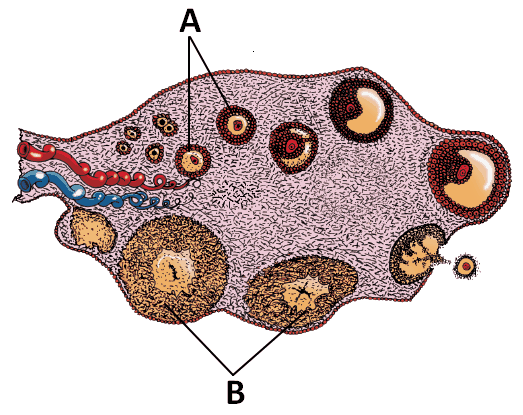
- B - Corpus luteum - secretes progesterone
- A - Tertiary follicle - forms Graafian follicle
- B - Corpus luteum - secretes LH
- A - Primary oocyte - it is the prophase - I of the meiotic division
Show answer
Answer: (1) B - Corpus luteum - secretes progesterone
Q74 NEET 2013 (Karnataka) Fetal Development & Parturition
- oxytocin from foetal pituitary
- human Chorionic Gonadotropin (hCG) from placenta
- human Placental Lactogen (hPL) from placenta
- oxytocin from maternal pituitary
Show answer
Answer: (4) oxytocin from maternal pituitary
Why: The foetal ejection reflex is triggered when stretching of the cervix sends nerve signals to the hypothalamus, which stimulates the posterior pituitary of the mother to release oxytocin. This maternal oxytocin causes strong uterine contractions that expel the foetus; the foetus and placenta do not supply oxytocin for this reflex.
Q75 NEET 2013 Fetal Development & Parturition
Which one of the following is not the function of placenta?
- Secretes estrogen
- Facilitates removal of carbon dioxide and waste material from embryo
- Secretes oxytocin during parturition
- Facilitates supply of oxygen and nutrients to embryo
Show answer
Answer: (3) Secretes oxytocin during parturition
Why: The placenta secretes oestrogen and progesterone, and it allows exchange of oxygen, nutrients and wastes such as carbon dioxide between mother and embryo. Oxytocin is released by the posterior pituitary of the mother, not by the placenta, so 'Secretes oxytocin during parturition' is the option that is not a function of the placenta.
Q76 NEET 2013 Menstrual Cycle: Pre Ovulatory Phase
- FSH
- Oxytocin
- Vasopressin
- Progesterone
Show answer
Answer: (4) Progesterone
Why: Menstrual flow occurs when the corpus luteum degenerates near the end of the cycle, so the levels of progesterone fall. This drop in progesterone causes the thickened endometrium to break down and shed, producing menstrual bleeding.
Q77 NEET 2013 Seminiferous Tubules & Spermatogenesis
- spermatogonia, spermatocyte, spermatozoa, spermatid
- Spermatogonia, spermatozoa, spermatocyte, spermatid
- Spermatogonia, spermatocyte, spermatid, spermatozoa
- Spermatid, spermatocyte, spermatogonia, spermatozoa
Show answer
Answer: (3) Spermatogonia, spermatocyte, spermatid, spermatozoa
Why: Sperm formation proceeds from spermatogonia, which divide to form spermatocytes, which undergo meiosis to form spermatids, which then mature into spermatozoa. The sequence in the matching option follows this order.
Human Reproduction NEET PYQ 2012 (6 questions)
Q78 AIPMT 2012 Mains Menstrual Cycle: Luteal Phase
The secretory phase in the human menstrual cycle is also called:
- Follicular phase lasting for about 6 days
- Luteal phase and lasts for about 13 days
- Follicular phase and lasts for about 13 days
- Luteal phase and lasts for about 6 days
Show answer
Answer: (2) Luteal phase and lasts for about 13 days
Why: The secretory phase of the menstrual cycle, during which the endometrium is maintained under the influence of progesterone, is also called the luteal phase, and it lasts for about 13 days. This matches the option describing the luteal phase lasting about 13 days, whereas the follicular phase is the proliferative phase that precedes it.
Q79 AIPMT 2012 Mains Implantation
Identify the human development stage shown below as well as the related right place of its occurrence in a normal pregnant woman, and select the right option for the two together:
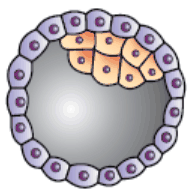
- Blastula — End part of fallopian tube
- Blastocyst — Uterine wall
- 8-celled morula — Starting point of fallopian tube
- Late morula — Middle part of fallopian tube
Show answer
Answer: (2) Blastocyst — Uterine wall
Q80 AIPMT 2012 Embryonic Development till Gastrulation
In a normal pregnant woman, the amount of total gonadotropin activity was assessed. The result expected was:
- High level of circulating FSH and LH in the uterus to stimulate implantation of the embryo
- High level of circulating HCG to stimulate endometrial thickening
- High levels of FSH and LH in uterus to stimulate endometrial thickening
- High level of circulating HCG to stimulate oestrogen and progesterone synthesis
Show answer
Answer: (4) High level of circulating HCG to stimulate oestrogen and progesterone synthesis
Why: During pregnancy, the placenta secretes high levels of HCG, which acts on the corpus luteum to stimulate its secretion of oestrogen and progesterone, maintaining the endometrium and pregnancy. The option about high circulating HCG stimulating oestrogen and progesterone synthesis is therefore correct.
Q81 AIPMT 2012 Fetal Development & Parturition
- Both placenta as well as fully developed foetus
- Oxytocin released from maternal pituitary
- Placenta only
- Fully developed foetus only
Show answer
Answer: (1) Both placenta as well as fully developed foetus
Why: Parturition is triggered by signals from both the placenta and the fully developed foetus, such as the foetal cortisol and placental hormones that help initiate labour. Maternal oxytocin from the posterior pituitary then acts on the uterus to sustain the contractions, but it is not the origin of the initiating signal.
Q82 AIPMT 2012 Semen and Male Fertility
Which one of the following statements is false in respect of viability of mammalian sperm?
- Sperm is viable for only up to 24 hours
- Survival of sperm depends on the pH of the medium and is more active in alkaline medium
- Viability of sperm is determined by its motility
- Sperms must be concentrated in a thick suspension
Show answer
Answer: (1) Sperm is viable for only up to 24 hours
Why: The false statement is the claim that mammalian sperm remain viable only up to 24 hours, since sperm can survive considerably longer under suitable conditions in the female reproductive tract or in culture. The other statements are true: sperm survival depends on the pH of the medium and is favoured in alkaline conditions, viability is judged by motility, and sperm are kept in a concentrated suspension for storage and handling.
Q83 AIPMT 2012 Basic Anatomy of Testis
- Progesterone
- Intestinal mucus
- Glocagon
- Androgens
Show answer
Answer: (4) Androgens
Why: Leydig cells are interstitial cells found in the testes, and they secrete androgens, mainly testosterone, which regulate male secondary sexual characteristics and spermatogenesis. They are not the source of progesterone, intestinal mucus or glucagon.
Human Reproduction NEET PYQ 2011 (3 questions)
Q84 AIPMT 2011 Male Reproductive Duct System
- epididymis to vas deferens
- ovary to uterus
- vagina to uterus
- testis to epididymis
Show answer
Answer: (4) testis to epididymis
Why: The vasa efferentia are the small ducts that carry sperm from the rete testis in the testis to the epididymis, so blocking them stops gametes moving from the testis to the epididymis. The other options describe pathways that do not pass through the vasa efferentia.
Q85 AIPMT 2011 Ovary
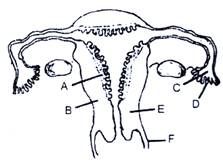
- C-Infundibulum, D-Fimbriae, E-Cervix
- D-Oviducal funnel, E-Uterus, F-Cervix
- A-perimetrium, B-Myometrium, C-Fallopian tube
- B-Endometrium, C-Infundibulum, D-Fimbriae
Show answer
Answer: (1) C-Infundibulum, D-Fimbriae, E-Cervix
Q86 AIPMT 2011 Basic Anatomy of Testis
The testes in humans are situated outside the abdominal cavity inside a pouch called scrotum. The purpose served is:
- escaping any possible compression by the visceral organs
- providing more space for a large epididymis
- providing a secondary sexual feature for exhibiting the male sex
- maintaining the scrotal temperature lower than the internal body temperature
Show answer
Answer: (4) maintaining the scrotal temperature lower than the internal body temperature
Why: Sperm production requires a temperature a few degrees below the internal body temperature, and the scrotum keeps the testes at this lower temperature. The option stating that the scrotum maintains a temperature lower than the internal body temperature gives this purpose.
Human Reproduction NEET PYQ 2010 (9 questions)
Q87 AIPMT 2010 Male Reproductive Duct System
- Testicular lobules to rete testis
- Rete testis to vas deferens
- Vas deferens to epididymis
- Epididymis to urethra
Show answer
Answer: (2) Rete testis to vas deferens
Q88 AIPMT 2010 Fetal Development & Parturition
- Fourth month
- Fifth month
- Sixth month
- Third month
Show answer
Answer: (2) Fifth month
Why: In human pregnancy, the foetus starts showing its first voluntary movements and hair appears on the head around the fifth month. This matches the option Fifth month.
Q89 AIPMT 2010 Seminiferous Tubules & Spermatogenesis
Sertoli cells are found in:
- ovaries and secrete progesterone
- adrenal cortex and secrete adrenaline
- seminiferous tubules and provide
nutrition to germ cells - pancreas and secrete cholecystokinin
Show answer
Answer: (3) seminiferous tubules and provide
nutrition to germ cells
Why: Sertoli cells are found in the seminiferous tubules of the testes, where they nourish and support the developing germ cells. This is the option describing seminiferous tubules and nutrition of germ cells.
Q90 AIPMT 2010 Fetal Development & Parturition
- placenta only
- placenta as well as developed foetus
- oxytocin released from maternal pituitary
- fully developed foetus only
Show answer
Answer: (2) placenta as well as developed foetus
Why: The initiation of parturition is triggered by signals from both the placenta and the fully developed foetus, which together stimulate the release of oxytocin from the maternal pituitary and promote uterine contractions. Oxytocin is a response to these signals rather than their origin, and the placenta alone or the foetus alone is not the complete source.
Q91 AIPMT 2010 Semen and Male Fertility
Seminal plasma in human males is rich in:
- fructose and calcium
- glucose and calcium
- DNA and testosterone
- ribose and potassium
Show answer
Answer: (1) fructose and calcium
Why: Human seminal plasma is rich in fructose, which provides energy to sperm, and calcium, which is needed for sperm motility. The other options list glucose, DNA, testosterone, ribose or potassium, which are not the main components of seminal plasma.
Q92 AIPMT 2010 Spermiogenesis/Sperm Structure/Hormonal Regulation
Which one of the following statements about human sperm is correct?
- The acrosome has a conical, pointed structure used for piercing and penetrating the egg, resulting in fertilization.
- The sperm lysins in the acrosome dissolve the egg envelope, facilitating fertilization.
- The acrosome serves as a sensory structure, leading the sperm towards the ovum.
- The acrosome serves no particular function.
Show answer
Answer: (2) The sperm lysins in the acrosome dissolve the egg envelope, facilitating fertilization.
Why: The acrosome of a human sperm releases lysins, which are enzymes that dissolve the egg envelope (zona pellucida) so the sperm can reach and fuse with the egg. The other statements describe the acrosome incorrectly, since it is not a sensory structure and it does have an important role in fertilization.
Q93 AIPMT 2010 Ovary
The second maturation division of the mammalian ovum occurs:
- Shortly after ovulation before the ovum makes
entry into the Fallopian tube - until after the ovum has been penetrated by a sperm
- until the nucleus of the sperm has fused with that
of the ovum - in the Graafian follicle following the first maturation
division
Show answer
Answer: (2) until after the ovum has been penetrated by a sperm
Why: In mammals the ovum arrested at metaphase II is released at ovulation and completes the second meiotic division only after a sperm has penetrated it, which produces the second polar body. The correct option is therefore the one stating that this division continues until after the ovum has been penetrated by a sperm.
Q94 AIPMT 2010 Embryonic Development till Gastrulation
Which one of the following statements about morula in humans is correct:
- It has almost equal quantity of cytoplasm as an uncleaved zygote but much more DNA
- It has far less cytoplasm as well as less DNA than an uncleaved zygote
- It has more or less equal quantity of cytoplasm and DNA as in uncleaved zygote
- It has more cytoplasm and more DNA than an uncleaved zygote
Show answer
Answer: (1) It has almost equal quantity of cytoplasm as an uncleaved zygote but much more DNA
Q95 AIPMT 2010 Female Reproductive System
- Isthmus
- Infundibulum
- Cervix
- Ampulla
Show answer
Answer: (2) Infundibulum
Why: The infundibulum is the funnel-shaped end of the Fallopian tube that lies nearest the ovary and has finger-like fimbriae that capture the released ovum. Isthmus and ampulla are further along the tube, and the cervix is part of the uterus, so option (2) is correct.
Human Reproduction NEET PYQ 2009 (7 questions)
Q96 AIPMT 2009 Embryonic Development till Gastrulation
- formation of zygote
- pattern of cleavage
- number of blastomeres produced
- fertilization
Show answer
Answer: (2) pattern of cleavage
Why: The amount and distribution of yolk determine the type of cleavage an egg undergoes, so changing yolk affects the pattern of cleavage, which is the option pattern of cleavage. Yolk does not decide whether a zygote forms, how fertilization occurs, or simply the number of blastomeres.
Q97 AIPMT 2009 Fertilization
Which one of the following is the most likely root cause of why menstruation is not taking place in regularly cycling human female?
- Fertilization of the ovum
- Maintenance of the hypertrophical endometrial lining
- Maintenance of high concentration of sex-hormones in the blood stream
- Retention of well-developed corpus luteum
Show answer
Answer: (1) Fertilization of the ovum
Q98 AIPMT 2009 Spermiogenesis/Sperm Structure/Hormonal Regulation
Seminal plasma in humans is rich in:
- fructose, calcium and certain enzymes
- fructose and calcium but has no enzymes
- glucose and certain enzymes but has no calcium
- fructose and certain enzymes but poor in calcium
Show answer
Answer: (1) fructose, calcium and certain enzymes
Why: Human seminal plasma is rich in fructose, which provides energy to sperm, and calcium, along with enzymes such as those secreted by the seminal vesicles and prostate, so the option listing fructose, calcium and certain enzymes is correct.
Q99 AIPMT 2009 Fetal Development & Parturition
Foetal ejection reflex in human female is induced by:
- pressure exerted by aminotic fluid
- release of oxytocin from pituitary
- fully developed foetus and placenta
- differentiation of mammary glands
Show answer
Answer: (3) fully developed foetus and placenta
Q100 AIPMT 2009 Male Reproductive System
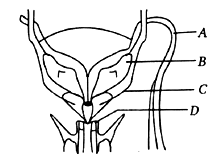
|
(a) |
Ureter |
Prostate |
Seminal vesicle |
Bulbourethral gland |
|
(b) |
Vas deferens |
Seminal vesicle |
Prostate |
Bulbourethral gland |
|
(c) |
Vas deferens |
Seminal vesicle trial gland |
Bulboure |
Prostate |
|
(d) |
Ureter |
Seminal vesicle |
Prostate |
Bulbourethral gland |
- (a)
- (b)
- (c)
- (d)
Show answer
Answer: (2) (b)
Q101 AIPMT 2009 Seminiferous Tubules & Spermatogenesis
The correct sequence of spermatogenetic stages leading to the formation of sperms in a mature human testis is:
- spermatocyte-spermatogonia- spermatid-sperms
- spermatogonia-spermatocyte-spermatid-sperms
- spermatid-spermatocyte-spermatogonia-sperms
- spermatogonia-spermatid-spermatocyte-sperms
Show answer
Answer: (2) spermatogonia-spermatocyte-spermatid-sperms
Why: In spermatogenesis, diploid spermatogonia divide and grow into primary spermatocytes, which undergo meiosis to form haploid spermatids, and these then differentiate into spermatozoa (sperms). The correct sequence is therefore spermatogonia, then spermatocyte, then spermatid, then sperms.
Q102 AIPMT 2009 Introduction to Menstrual Cycle
Which one of the following is the correct match of the events occurring during the menstrual cycle?
- Ovulation - LH and FSH attain peak level and sharp fall in the secretion of progesterone
- Proliferative phase - Rapid regeneration of myometrium and maturation of Graafian follicle
- Development of corpus luteum - Secretory phase and increased secretion of progesterone
- Menstruation - Breakdown of myometrium and ovum not fertilized
Show answer
Answer: (3) Development of corpus luteum - Secretory phase and increased secretion of progesterone
Why: After ovulation the ruptured follicle develops into the corpus luteum, which enters the secretory phase and secretes increasing amounts of progesterone to prepare the uterine lining for a possible implantation.
Human Reproduction NEET PYQ 2008 (3 questions)
Q103 AIPMT 2008 Implantation
- Chorion
- Allantois
- Yolk sac
- Amnion
Show answer
Answer: (4) Amnion
Why: The amnion is the membrane that encloses the amniotic fluid surrounding the embryo, and this fluid keeps the embryo moist and protected from drying out inside the uterus. This matches the option naming the amnion.
Q104 AIPMT 2008 Seminiferous Tubules & Spermatogenesis
- primary spermatocytes
- secondary spermatocytes
- spermatids
- spermatogonia
Show answer
Answer: (2) secondary spermatocytes
Why: During the first meiotic division, the homologous chromosomes separate, so each primary spermatocyte (diploid) gives rise to two haploid secondary spermatocytes. Secondary spermatocytes are therefore the cells formed at the end of the first meiotic division, and they then divide again to form spermatids.
Q105 AIPMT 2008 Introduction to Menstrual Cycle
Which one of the following statements is incorrect about menstruation?
- During normal menstruation about 40 ml of blood is lost
- The menstrual fluid can easily clot
- At menopause in the female, there is an especially abrupt
increase in gonadotropic hormones - The beginning of the cycle of menstruation is called menarche
Show answer
Answer: (2) The menstrual fluid can easily clot
Why: Menstrual fluid does not clot easily because anticoagulants and fibrinolysin present in it prevent clotting, so the statement that it can easily clot is the incorrect one. The other statements about roughly 40 ml blood loss, the abrupt rise in gonadotropins at menopause, and menarche marking the start of the cycle are correct.
Human Reproduction NEET PYQ 2007 (2 questions)
Q106 AIPMT 2007 Menstrual Cycle: Pre Ovulatory Phase
Which part of the ovary in mammals acts as an endocrine gland after ovulation?
- Graafian follicle
- Stroma
- Germinal epithelium
- Vitelline membrane
Show answer
Answer: (1) Graafian follicle
Why: After ovulation the Graafian follicle collapses and transforms into the corpus luteum, which secretes progesterone and some oestrogen, so it functions as an endocrine gland. The stroma, germinal epithelium and vitelline membrane do not take on this hormone-secreting role.
Q107 AIPMT 2007 Introduction to Menstrual Cycle
- LH only
- Combination of FSH and LH
- Combination of estrogen and progesterone
- FSH only
Show answer
Answer: (3) Combination of estrogen and progesterone
Why: Oral contraceptive pills containing a combination of estrogen and progesterone suppress the secretion of FSH and LH from the pituitary, which prevents follicle maturation and the hormonal surge needed for the uterine lining to shed, so menstruation can be postponed. Giving LH or FSH alone would not stop the cycle in this way.
Human Reproduction NEET PYQ 2006 (2 questions)
Q108 AIPMT 2006 Seminiferous Tubules & Spermatogenesis
- FSH
- GH
- Prolactin
- LH
Show answer
Answer: (1) FSH
Why: Sertoli cells in the seminiferous tubules are stimulated by FSH from the anterior pituitary, which supports spermatogenesis and the production of factors needed for sperm development. GH, prolactin and LH act on other target cells, with LH mainly stimulating Leydig cells.
Q109 AIPMT 2006 Introduction to Menstrual Cycle
- Estrogen
- FSH
- FSH-RH
- Progesterone
Show answer
Answer: (4) Progesterone
Why: Menstruation occurs when the corpus luteum degenerates near the end of the cycle, causing a sharp fall in progesterone (the hormone whose withdrawal triggers the shedding of the endometrium). Estrogen and FSH-RH do not cause this shedding directly, and FSH is not the immediate trigger.
Frequently asked questions
How many Human Reproduction questions have been asked in NEET?
This archive holds 109 Human Reproduction questions from 33 of 33 official NEET and AIPMT papers, 2006–2026. It counts every paper held here, including re-exam and regional papers.
Which topics of Human Reproduction are asked most often?
By topic tag: Fetal Development & Parturition (16), Seminiferous Tubules & Spermatogenesis (15), Embryonic Development till Gastrulation (14), Menstrual Cycle: Luteal Phase (11) and Oogenesis (9).
When was Human Reproduction last asked?
The most recent paper in this archive with a question from this chapter is Re-NEET 2026.
Where do the answers come from?
Each answer is the option recorded as correct in the official answer key for that paper. Where a short explanation is shown, it was written separately and checked against the key; it is not part of the official paper. Questions marked NEET 2026 (3 May, cancelled) are from the cancelled first sitting: NTA issued no final key for it, so their answers are the key on record and have not been matched to an official key.
More Biology chapter-wise PYQs
← Chemical Coordination and Integration Reproductive Health →
Botany, Class 11
- The Living World (25)
- Biological Classification (90)
- Plant Kingdom (88)
- Morphology of Flowering Plants (120)
- Anatomy of Flowering Plants (83)
- Cell: The Unit of Life (125)
- Cell Cycle and Cell Division (84)
- Photosynthesis in Higher Plants (69)
- Respiration in Plants (42)
- Plant Growth and Development (71)
Old syllabus (archive)
- Transport in Plants (39)
- Mineral Nutrition (49)
- Reproduction in Organisms (22)
- Environmental Issues (80)
- Digestion and Absorption (45)
Botany, Class 12
- Sexual Reproduction in Flowering Plants (118)
- Principles of Inheritance and Variation (155)
- Molecular Basis of Inheritance (172)
- Strategies for Enhancement in Food Production (36)
- Microbes in Human Welfare (66)
- Organisms and Populations (86)
- Ecosystem (87)
- Biodiversity and Conservation (86)
Zoology, Class 11
- Animal Kingdom (109)
- Structural Organisation in Animals (90)
- Biomolecules (100)
- Breathing and Exchange of Gases (56)
- Body Fluids and Circulation (68)
- Excretory Products and their Elimination (54)
- Locomotion and Movement (58)
- Neural Control and Coordination (53)
- Chemical Coordination and Integration (76)
Zoology, Class 12
- Reproductive Health (67)
- Evolution (101)
- Human Health and Disease (100)
- Biotechnology: Principles and Processes (118)
- Biotechnology and its Applications (101)
Want more than past papers? Practise all 2,311 Human Reproduction questions on NEETprep.