Sexual Reproduction in Flowering Plants has 118 questions in this archive of official NEET and AIPMT papers, asked between 2006 and 2026. It appeared in 33 of the 33 papers held here (AIPMT 2006 to Re-NEET 2026); the most recent paper with a question from it is Re-NEET 2026. The most-asked topics by tag are Pollination & Outbreeding Devices (37), Pistil: Female Gametophyte (19) and Stamen: Male Gametophyte (13). In the last 10 main papers (2017 to 2026) it had 38 questions.
Sexual Reproduction in Flowering Plants practice hub Take the chapter test
Sexual Reproduction in Flowering Plants PYQs year by year
| Year | Papers in archive | Questions | By paper |
|---|---|---|---|
| 2026 | 2 | 7 | NEET 2026: 3, Re-NEET 2026: 4 |
| 2025 | 1 | 4 | NEET 2025: 4 |
| 2024 | 3 | 7 | NEET 2024: 2, NEET 2024 Re-exam (1,563 candidates): 2, NEET 2024 (Jhajjar): 3 |
| 2023 | 2 | 6 | NEET 2023: 3, NEET 2023 (Manipur): 3 |
| 2022 | 3 | 9 | NEET 2022: 3, NEET 2022 (Abroad): 2, NEET 2022 (Ganganagar): 4 |
| 2021 | 1 | 3 | NEET 2021: 3 |
| 2020 | 2 | 5 | NEET 2020: 3, NEET 2020 (Covid Re-exam): 2 |
| 2019 | 2 | 8 | NEET 2019: 5, NEET 2019 (Odisha): 3 |
| 2018 | 1 | 5 | NEET 2018: 5 |
| 2017 | 1 | 6 | NEET 2017: 6 |
| 2016 | 2 | 8 | NEET 2016 Phase 1: 5, NEET 2016 Phase 2: 3 |
| 2015 | 2 | 9 | AIPMT 2015: 4, AIPMT 2015 Re-exam: 5 |
| 2014 | 1 | 4 | AIPMT 2014: 4 |
| 2013 | 2 | 9 | NEET 2013: 4, NEET 2013 (Karnataka): 5 |
| 2012 | 2 | 8 | AIPMT 2012: 5, AIPMT 2012 Mains: 3 |
| 2011 | 1 | 5 | AIPMT 2011: 5 |
| 2010 | 1 | 3 | AIPMT 2010: 3 |
| 2009 | 1 | 1 | AIPMT 2009: 1 |
| 2008 | 1 | 5 | AIPMT 2008: 5 |
| 2007 | 1 | 2 | AIPMT 2007: 2 |
| 2006 | 1 | 4 | AIPMT 2006: 4 |
Most-asked topics
| Topic | PYQs |
|---|---|
| Pollination & Outbreeding Devices | 37 |
| Pistil: Female Gametophyte | 19 |
| Stamen: Male Gametophyte | 13 |
| Pistil: Ovule | 10 |
| Seed | 9 |
| Endosperm | 7 |
| Double Fertilization | 6 |
| Stamen: Microsporangium | 4 |
| Apomixis & Polyembryony | 4 |
| Stamen: Anther | 3 |
| Pollen - Pistil Interaction | 3 |
| Embryo | 3 |
| Fruit | 2 |
| Pre-fertilisation: Structures and Events | 2 |
Sexual Reproduction in Flowering Plants NEET PYQ 2026 (7 questions)
Q1 Re-NEET 2026 Seed
- Pea
- Wheat
- Maize
- Barley
Show answer
Answer: (1) Pea
Why: Pea seeds are non-albuminous because the endosperm is consumed during seed development, and the food reserve is stored in the cotyledons. Wheat, maize and barley are cereals whose seeds retain a food-storing endosperm at maturity, so they are albuminous.
Q2 Re-NEET 2026 Pistil: Ovule
- Polar nucleus
- Antipodals
- Synergids
- Central cells
Show answer
Answer: (3) Synergids
Why: The synergid cells at the micropylar end of the embryo sac secrete chemical signals that guide the pollen tube toward the egg cell. The polar nuclei and central cell fuse with a sperm to form endosperm, while antipodals lie at the opposite end and have no role in guidance.
Q3 Re-NEET 2026 Double Fertilization
- 72
- 18
- 36
- 54
Show answer
Answer: (4) 54
Why: The endosperm forms by triple fusion, in which one sperm nucleus fuses with two polar nuclei, making it triploid rather than diploid. This gives it the diploid count plus an extra haploid set, which for a diploid number of 36 equals 54 chromosomes, the value in the option stated as 54.
Q4 Re-NEET 2026 Stamen: Anther
- 12
- 2
- 6
- 8
Show answer
Answer: (2) 2
Why: A typical bilobed angiosperm anther has 2 theca in each lobe, with each theca containing two pollen sacs, so the total is 2 theca per lobe. This matches the option giving the value 2.
Q5 NEET 2026 (3 May, cancelled) Stamen: Microsporangium
| A. | Microspore tetrads |
| B. | Sporogenous tissue |
| C. | Pollen grains |
| D. | Pollen mother cells |
- D, A, C, B
- B, D, C, A
- B, D, A, C
- A, D, C, B
Show answer
Answer: (3) B, D, A, C
Why: Microsporogenesis begins with the sporogenous tissue in the anther, whose cells differentiate into pollen mother cells. Each pollen mother cell undergoes meiosis to form microspore tetrads, and the microspores then mature into pollen grains. The correct sequence is therefore B, D, A, C.
Q6 NEET 2026 (3 May, cancelled) Double Fertilization
- Central cell
- Primary endosperm cell
- Zygote
- Synergid
Show answer
Answer: (2) Primary endosperm cell
Why: The primary endosperm cell is triploid because it forms when one male gamete fuses with the two polar nuclei of the central cell, giving three sets of chromosomes. The central cell before fertilisation is diploid, the zygote is diploid, and the synergid is haploid.
Q7 NEET 2026 (3 May, cancelled) Pollination & Outbreeding Devices
- Geitonogamy
- Autogamy
- Xenogamy
- Cleistogamy
Show answer
Answer: (3) Xenogamy
Why: Xenogamy is the transfer of pollen from one plant to the stigma of a different plant of the same species. Because the pollen comes from a genetically different individual, it brings genetically different pollen to the stigma, unlike autogamy, geitonogamy or cleistogamy, which involve the same plant.
Sexual Reproduction in Flowering Plants NEET PYQ 2025 (4 questions)
Q8 NEET 2025 Pistil: Female Gametophyte
| Assertion (A): | A typical unfertilised, angiosperm embryo sac at maturity is 8-nucleate and 7-celled. |
| Reason (R): | The egg apparatus has 2 polar nuclei. |
- (A) is True but (R) is False.
- (A) is False but (R) is True.
- Both (A) and (R) are True and (R) is the correct explanation of (A)
- Both (A) and (R) are true but (R) is not the correct explanation of (A)
Show answer
Answer: (1) (A) is True but (R) is False.
Why: A mature angiosperm embryo sac is indeed 8-nucleate and 7-celled, so the assertion is true. The reason is false because the egg apparatus consists of the egg cell and the synergids, and the polar nuclei lie in the central cell, not in the egg apparatus.
Q9 NEET 2025 Pollination & Outbreeding Devices
| Assertion (A): | Both wind and water pollinated flowers are not very colourful and do not produce nectar. |
| Reason (R): | The flowers produce enormous amount of pollen grains in wind and water pollinated flowers. |
- (A) is True but (R) is False.
- (A) is False but (R) is True.
- Both (A) and (R) are True and (R) is the correct explanation of (A).
- Both (A) and (R) are True but (R) is not the correct explanation of (A).
Show answer
Answer: (4) Both (A) and (R) are True but (R) is not the correct explanation of (A).
Q10 NEET 2025 Pistil: Female Gametophyte
- 1 Meiosis and 3 Mitosis
- No Meiosis and 2 Mitosis
- 2 Meiosis and 3 Mitosis
- 1 Meiosis and 2 Mitosis
Show answer
Answer: (1) 1 Meiosis and 3 Mitosis
Why: In an angiosperm, the megaspore mother cell undergoes one meiotic division to form four megaspores, and only one of these survives as the functional megaspore. That functional megaspore then undergoes three successive mitotic divisions to form the mature female gametophyte (embryo sac). The option with 1 meiosis and 3 mitoses is therefore correct.
Q11 NEET 2025 Stamen: Microsporangium
| Assertion (A): | Cells of the tapetum possess dense cytoplasm and generally have more than one nucleus. |
| Reason (R): | The presence of more than one nucleus in the tapetum increases the efficiency of nourishing the developing microspore mother cells. |
- (A) is True but (R) is False.
- (A) is False but (R) is True.
- Both (A) and (R) are True and (R) is the correct explanation of (A).
- Both (A) and (R) are True but (R) is not the correct explanation of (A).
Show answer
Answer: (1) (A) is True but (R) is False.
Sexual Reproduction in Flowering Plants NEET PYQ 2024 (7 questions)
Q12 NEET 2024 (Jhajjar) Pistil: Ovule
- Nucellus
- Integument
- Chalaza
- Hilum
Show answer
Answer: (4) Hilum
Why: The hilum is the scar on the seed coat where the funicle attaches to the body of the ovule. The nucellus, integument and chalaza are parts of the ovule body rather than the point of attachment to the funicle.
Q13 NEET 2024 (Jhajjar) Pistil: Ovule
- Ovule
- Embryo sac
- Nucellus
- Endosperm
Show answer
Answer: (2) Embryo sac
Why: The embryo sac is the female gametophyte in angiosperms, formed inside the ovule from a megaspore through mitosis and containing the egg cell along with other cells. The ovule, nucellus and endosperm are parts of the seed or ovule structure rather than the gametophyte.
Q14 NEET 2024 (Jhajjar) Pollination & Outbreeding Devices
- Amensalism
- Anemophily
- Floral reward
- Commensalism
Show answer
Answer: (3) Floral reward
Why: The Amorphophallus flower offers its enclosed chamber as a safe brood site where the pollinating insects lay their eggs. This benefit given to the pollinator in exchange for pollination is a floral reward.
Q15 NEET 2024 Re-exam (1,563 candidates) Pistil: Ovule
1. Nucellus
2. Integument
3, Placenta
4. Funicle
Show answer
Answer: option (1)
Q16 NEET 2024 Re-exam (1,563 candidates) Stamen: Male Gametophyte
- Epidermal layer
- Tapetum
- Exine layer
- Intine layer
Show answer
Answer: (3) Exine layer
Why: The exine is the outer wall of the pollen grain and is made of sporopollenin, one of the most chemically resistant organic materials, which decays very slowly. This is why the exine survives as a fossil even after the rest of the grain is lost.
Q17 NEET 2024 Pollination & Outbreeding Devices
| A: | The flowers of Vallisneria are colourful and produce nectar. |
| B: | The flowers of waterlily are not pollinated by water. |
| C: | In most of water-pollinated species, the pollen grains are protected from wetting. |
| D: | Pollen grains of some hydrophytes are long and ribbon like. |
| E: | In some hydrophytes, the pollen grains are carried passively inside water. |
- A, B, C and D only
- A, C, D and E only
- B, C, D and E only
- C, D and E only
Show answer
Answer: (3) B, C, D and E only
Why: Vallisneria is water-pollinated and its flowers are neither colourful nor nectar-producing, so statement A is false, while the waterlily is not pollinated by water, so B is true. Statements C, D and E are true: most water-pollinated species protect pollen from wetting, some hydrophyte pollen is long and ribbon-like, and in some hydrophytes pollen is carried passively in water, so option (3) is correct.
Q18 NEET 2024 Pollination & Outbreeding Devices
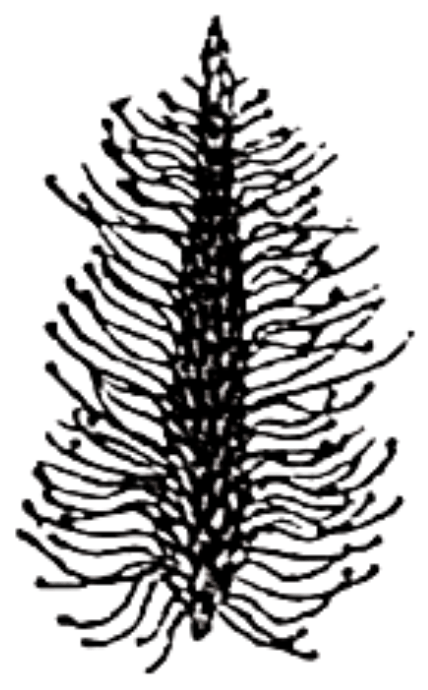
- Water pollinated flowers showing stamens with mucilaginous covering.
- Cleistogamous flowers showing autogamy.
- Compact inflorescence showing complete autogamy.
- Wind pollinated plant inflorescence showing flowers with well exposed stamens.
Show answer
Answer: (4) Wind pollinated plant inflorescence showing flowers with well exposed stamens.
Sexual Reproduction in Flowering Plants NEET PYQ 2023 (6 questions)
Q19 NEET 2023 (Manipur) Stamen: Microsporangium
- Solanaceae, Poaceae and Liliaceae
- Brassicaceae, Liliaceae and Poaceae
- Rosaceae, Liliaceae and Poaceae
- Leguminosae, Solanaceae and Rosaceae
Show answer
Answer: (4) Leguminosae, Solanaceae and Rosaceae
Why: Pollen grains of Leguminosae, Solanaceae and Rosaceae can remain viable for months, which is why they are used in pollen storage and hybridization programs. The other sets include Poaceae and Liliaceae, whose pollen loses viability within minutes to a few days.
Q20 NEET 2023 (Manipur) Pollination & Outbreeding Devices
- Geitonogamy
- Xenogamy
- Autogamy
- Cleistogamy
Show answer
Answer: (1) Geitonogamy
Why: Geitonogamy is the transfer of pollen from the anther of one flower to the stigma of another flower on the same plant. It is a form of self-pollination that still uses a pollinating agent, unlike autogamy, which occurs within the same flower.
Q21 NEET 2023 (Manipur) Pistil: Ovule
| A. | 3 successive free nuclear divisions in functional megaspore. |
| B. | Degeneration of 3 megaspores |
| C. | Meiotic division in megaspore mother cell |
| D. | Migration of 3 nuclei towards each pole. |
| E. | Formation of a wall resulting in seven celled embryosac. |
- (A), (B), (C), (D), (E)
- (C), (E), (A), (D), (B)
- (B), (C), (A), (D), (E)
- (C), (B), (A), (D), (E)
Show answer
Answer: (4) (C), (B), (A), (D), (E)
Why: The megaspore mother cell first undergoes meiosis to give rise to megaspores, and then most of these degenerate, leaving one functional megaspore. The functional megaspore undergoes successive free nuclear divisions, the resulting nuclei migrate towards the two poles, and finally wall formation organises the mature seven-celled embryo sac.
Q22 NEET 2023 Pollination & Outbreeding Devices
- To protect seeds
- To attract insects
- To trap pollen grains
- To disperse pollen grains
Show answer
Answer: (3) To trap pollen grains
Q23 NEET 2023 Double Fertilization
- Synergids, antipodals and Polar nuclei
- Synergids, Primary endosperm nucleus and zygote
- Antipodals, synergids, and primary endosperm nucleus
- Synergids, Zygote and Primary endosperm nucleus
Show answer
Answer: (4) Synergids, Zygote and Primary endosperm nucleus
Why: In a fertilised embryo sac, the synergids are haploid, the zygote formed by fusion of a male gamete with the egg is diploid, and the primary endosperm nucleus formed by fusion with the second male gamete is triploid. This sequence matches the option listing synergids, zygote and primary endosperm nucleus.
Q24 NEET 2023 Pollination & Outbreeding Devices
- wind pollinated plants
- insect pollinated plants
- bird pollinated plants
- bat pollinated plants
Show answer
Answer: (2) insect pollinated plants
Why: Large, colourful, fragrant flowers that produce nectar are adapted to attract insects, so they are characteristic of insect-pollinated plants. Wind-pollinated flowers are typically small, dull and lack scent or nectar, while bird and bat pollinated flowers have their own distinct features.
Sexual Reproduction in Flowering Plants NEET PYQ 2022 (9 questions)
Q25 NEET 2022 (Ganganagar) Pistil: Female Gametophyte
- One egg cell, two synergids
- One egg cell, two synergids, two antipodal cells, three Polar nuclei
- One egg cell, three synergids, two antipodal cells, two Polar nuclei
- One egg cell, two synergids, two antipodal cells, two Polar nuclei
Show answer
Answer: (1) One egg cell, two synergids
Why: The egg apparatus is made up of one egg cell flanked by two synergids at the micropylar end of the embryo sac. The antipodal cells and polar nuclei are not part of the egg apparatus, so the option listing only the egg cell and two synergids is correct.
Q26 NEET 2022 (Ganganagar) Pollen - Pistil Interaction
| a: | the female flower buds of plant producing unisexual flower need not be bagged. |
| b: | there is no need to emasculate unisexual flowers of selected female parent. |
| c: | emasculated flowers are to be bagged immediately after cross pollination. |
| d: | emasculated flowers are to be bagged after removal of anthers. |
| e: | bisexual flowers, showing protogyny are never selected for cross. |
- (a), (b) and (c) only
- (b), (c) and (d) only
- (b), (c) and (e) only
- (a), (d) and (e) only
Show answer
Answer: (2) (b), (c) and (d) only
Why: In artificial hybridization with unisexual flowers, there is no need to emasculate the female parent, and the emasculated bisexual flowers must be bagged immediately after emasculation and after cross pollination to prevent unwanted pollen from reaching the stigma. Emasculation is performed by removing anthers before they dehisce, so bagging is done after removal of anthers. Therefore statements b, c and d describe the correct procedure.
Q27 NEET 2022 (Ganganagar) Embryo
- Calyx
- Endosperm
- Nucellus
- Integument
Show answer
Answer: (3) Nucellus
Why: In beet seeds, the perisperm is formed from the residual persistent nucellus, which remains in the seed as food storage tissue alongside the embryo. The endosperm, calyx and integument do not form the perisperm, so the nucellus is the correct option.
Q28 NEET 2022 (Ganganagar) Apomixis & Polyembryony
- Polyembryony will be seen and each seed will produce many plantlets.
- Seeds of hybrid plants will show longer dormancy.
- Farmers can keep on using the seeds produced by the hybrids to raise new crop year after year.
- There will be segregation of the desired characters only in the progeny.
Show answer
Answer: (3) Farmers can keep on using the seeds produced by the hybrids to raise new crop year after year.
Why: Apomixis is the production of seeds without fertilisation, so the seeds are clones of the mother plant and retain the hybrid vigour. If apomictic genes were introduced into hybrids, farmers could save the seeds and reuse them to raise crops year after year instead of buying new hybrid seed. Polyembryony, longer dormancy and segregation of characters in the progeny do not follow from this.
Q29 NEET 2022 (Abroad) Endosperm
- Pentaploid
- Hexaploid
- Diploid
- Triploid
Show answer
Answer: (2) Hexaploid
Why: A tetraploid plant produces diploid gametes, so the endosperm forms by fusion of the polar nuclei from the female gametophyte with a sperm nucleus from the male gametophyte, and the total chromosome sets add up to the hexaploid condition.
Q30 NEET 2022 (Abroad) Seed
Which of the following set represents the correct labeling of A, B, C and D with respect to the given diagram?
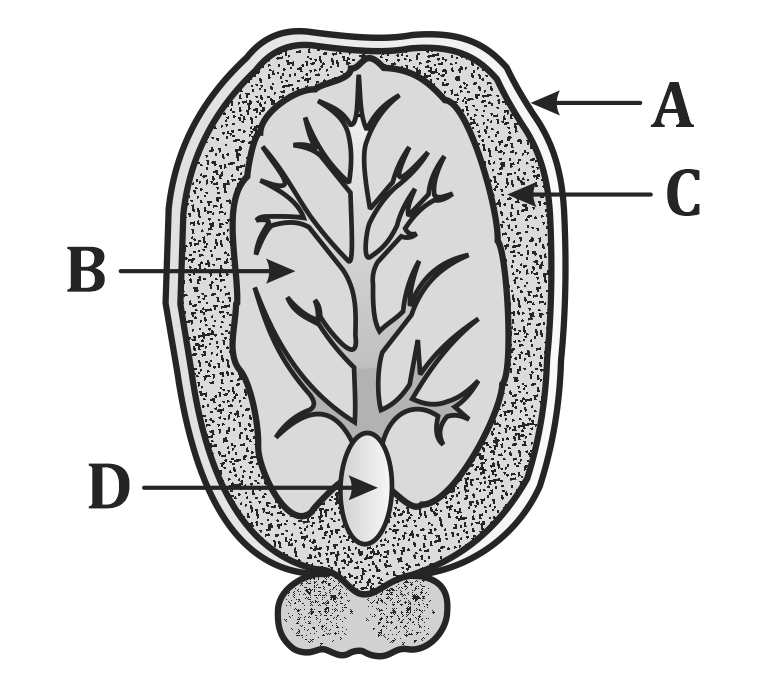
- A- Seed Coat, B- Cotyledon, C- Endosperm, D - Hypocotyle
- A -Seed Coat, B- Scutellum, C- Endocarp, D - Mesocarp
- A- Seed Coat, B- Scutellum, C- Microphyle, D - Endocarp
- A-Pericarp, B - Coleoptile
Show answer
Answer: (1) A- Seed Coat, B- Cotyledon, C- Endosperm, D - Hypocotyle
Q31 NEET 2022 Pollination & Outbreeding Devices
- Moths and butterflies are the most dominant pollinating agents among insects
- Pollination by water is quite rare in flowering plants
- Pollination by wind is more common amongst abiotic pollination
- Flowers produce foul odours to attract flies and beetles to get pollinated
Show answer
Answer: (1) Moths and butterflies are the most dominant pollinating agents among insects
Why: The incorrect statement is the one claiming moths and butterflies are the most dominant insect pollinators. Bees are the most important insect pollinators, while moths and butterflies play a smaller role, and the other three statements about water, wind and foul-smelling flowers attracting flies and beetles are accurate.
Q32 NEET 2022 Pollination & Outbreeding Devices
| Statement I: | Cleistogamous flowers are invariably autogamous. |
| Statement II: | Cleistogamy is disadvantageous as there is no chance for cross pollination. |
In the light of the above statements, choose the correct answer from the options given below:
- Statement I is incorrect but Statement II is correct.
- Both Statement I and Statement II are correct.
- Both Statement I and Statement II are incorrect.
- Statement I is correct but Statement II is incorrect.
Show answer
Answer: (2) Both Statement I and Statement II are correct.
Q33 NEET 2022 Fruit
Which part of the fruit, labelled in the given figure makes it a false fruit?
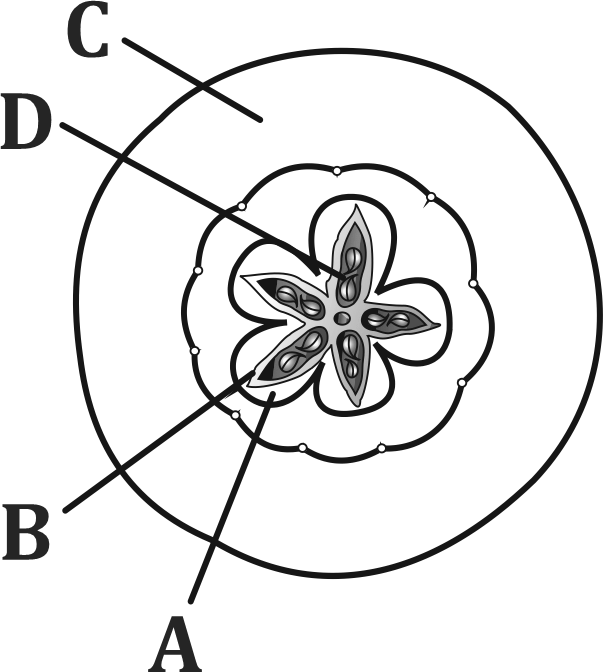
- D-Seed
- A-Mesocarp
- B-Endocarp
- C-Thalamus
Show answer
Answer: (4) C-Thalamus
Sexual Reproduction in Flowering Plants NEET PYQ 2021 (3 questions)
Q34 NEET 2021 Pollination & Outbreeding Devices
The term used for transfer of pollen grains from anthers of one plant to stigma of a different plant which during pollination, brings genetically different types of pollen grains to stigma, is:
- Chasmogamy
- Cleistogamy
- Xenogamy
- Geitonogamy
Show answer
Answer: (3) Xenogamy
Why: Xenogamy is the transfer of pollen from the anther of one plant to the stigma of a different plant, so the pollen carries genetically different material. Chasmogamy and cleistogamy describe flower opening and closing, and geitonogamy is pollination between different flowers of the same plant, so xenogamy is the correct term.
Q35 NEET 2021 Pistil: Female Gametophyte
- 7-nucleate and 7-celled
- 8-nucleate and 8-celled
- 8-nucleate and 7-celled
- 7-nucleate and 8-celled
Show answer
Answer: (3) 8-nucleate and 7-celled
Why: A mature embryo sac contains eight nuclei, because the megaspore undergoes three rounds of mitotic division. These nuclei form only seven cells, since the two polar nuclei lie together in a single central cell, giving the egg apparatus, antipodals and central cell.
Q36 NEET 2021 Stamen: Male Gametophyte
- Poaceae; Solanaceae
- Rosaceae; Leguminosae
- Poaceae; Rosaceae
- Poaceae; Leguminosae
Show answer
Answer: (2) Rosaceae; Leguminosae
Why: In some members of Rosaceae and Leguminosae, pollen grains stay viable for months after release, which is useful for hybridisation and crop breeding. In contrast, pollen of Poaceae loses viability very quickly, so the Rosaceae and Leguminosae pair is correct.
Sexual Reproduction in Flowering Plants NEET PYQ 2020 (5 questions)
Q37 NEET 2020 (Covid Re-exam) Seed
- False fruits
- Aggregate fruits
- True fruits
- Parthenocarpic fruits
Show answer
Answer: (1) False fruits
Why: In some plants such as apple, the fleshy edible part develops from the thalamus (receptacle) rather than from the ovary, so the fruit is a false fruit. True fruits develop only from the ovary, which is why the False fruits option is correct.
Q38 NEET 2020 (Covid Re-exam) Pollination & Outbreeding Devices
- Well exposed stamens and stigma
- Many ovules in each ovary
- Flowers are small and not brightly colored
- Pollen grains are light and non-sticky
Show answer
Answer: (2) Many ovules in each ovary
Why: Wind-pollinated plants have exposed stamens and stigmas, small inconspicuous non-colored flowers, and light non-sticky pollen, but they do not have many ovules per ovary as a defining feature. The option stating many ovules in each ovary is therefore the incorrect statement.
Q39 NEET 2020 Pre-fertilisation: Structures and Events
| (a) | Pollen grains inside the anther |
| (b) | Germinated pollen grain with two male gametes |
| (c) | Seed inside the fruit |
| (d) | Embryo sac inside the ovule |
- (a), (b) and (c)
- (c) and (d)
- (a) and (d)
- (a) only
Show answer
Answer: (3) (a) and (d)
Why: A pollen grain inside the anther is a male gametophyte developing within the sporophytic anther, and an embryo sac inside the ovule is a female gametophyte developing within the sporophytic ovule, so both show a gametophyte inside a sporophyte. The seed inside the fruit and the germinated pollen grain do not represent this two-generation arrangement.
Q40 NEET 2020 Pistil: Ovule
The body of the ovule is fused within the funicle at :
- Micropyle
- Nucellus
- Chalaza
- Hilum
Show answer
Answer: (4) Hilum
Q41 NEET 2020 Pollination & Outbreeding Devices
- Water currents only
- Wind and water
- Insects and water
- Insects or wind
Show answer
Answer: (4) Insects or wind
Why: Water hyacinth and water lily flowers are held above the water surface, so they are pollinated by insects or by wind rather than by water currents. This is why option (4) is correct.
Sexual Reproduction in Flowering Plants NEET PYQ 2019 (8 questions)
Q42 NEET 2019 (Odisha) Pistil: Female Gametophyte
- Tetrasporic with one mitotic stage of division
- Monosporic with three sequential mitotic divisions
- Monosporic with two sequential mitotic divisions
- Bisporic with two sequential mitotic divisions
Show answer
Answer: (2) Monosporic with three sequential mitotic divisions
Why: The most common type of embryo sac in angiosperms is the monosporic type developed from a single megaspore, which undergoes three sequential mitotic divisions to form an eight-nucleate embryo sac. This is the Polygonum type, and it is the one described in the option with three sequential mitotic divisions.
Q43 NEET 2019 (Odisha) Pollination & Outbreeding Devices
What type of pollination takes place in Vallisneria?
- Pollination occurs in submerged conditions by water.
- Flowers emerge above the surface of water and pollination occurs by insects.
- Flowers emerge above the water surface and pollen is carried by the wind.
- Male flowers are carried by water currents to female flowers at the surface of the water.
Show answer
Answer: (4) Male flowers are carried by water currents to female flowers at the surface of the water.
Why: In Vallisneria, the male flowers detach from the plant and float up to the water surface, where water currents carry them to the female flowers that rise to the surface on long stalks. This is the option describing male flowers carried by water currents to female flowers at the surface.
Q44 NEET 2019 (Odisha) Pollination & Outbreeding Devices
- Wheat
- Papaya
- Castor
- Maize
Show answer
Answer: (2) Papaya
Why: Papaya is dioecious, with male and female flowers borne on separate plants. Because no flower can receive pollen from the same plant, both autogamy and geitonogamy are prevented, unlike in wheat, castor or maize, which have bisexual or monoecious flowers on the same plant.
Q45 NEET 2019 Seed
Persistent nucellus in the seed is known as:
- Tegmen
- Chalaza
- Perisperm
- Hilum
Show answer
Answer: (3) Perisperm
Why: Perisperm is the persistent nucellus that remains in a mature seed as a food storage tissue, as seen in black pepper and beet. The tegmen, chalaza and hilum are parts of the seed coat or ovule and do not describe a persistent nucellus.
Q46 NEET 2019 Double Fertilization
What is the fate of the male gametes discharged in the synergid?
- One fuses with the egg and the other fuses with central cell nuclei
- One fuses with the egg and the other(s) degenerate(s) in the synergid
- All fuse with the egg
- One fuses with the egg and the other(s) fuse(s) with a synergid nucleus
Show answer
Answer: (1) One fuses with the egg and the other fuses with central cell nuclei
Q47 NEET 2019 Pollination & Outbreeding Devices
Select the incorrect statement:
- Inbreeding helps in the accumulation of superior genes and the elimination of undesirable genes
- Inbreeding increases homozygosity
- Inbreeding is essential to evolve pure lines in any animal
- Inbreeding selects harmful recessive genes that reduce fertility and productivity
Show answer
Answer: (4) Inbreeding selects harmful recessive genes that reduce fertility and productivity
Q48 NEET 2019 Seed
In some plants, the female gamete develops into an embryo without fertilization. This phenomenon is known as:
- Parthenogenesis
- Autogamy
- Parthenocarpy
- Syngamy
Show answer
Answer: (1) Parthenogenesis
Why: Parthenogenesis is the development of an embryo from an unfertilised female gamete, as seen in some plants. Option (1) Parthenogenesis names this phenomenon, whereas parthenocarpy refers to fruit formation without fertilisation.
Q49 NEET 2019 Pistil: Female Gametophyte
Which one of the following statements regarding post-fertilization development in flowering plants is incorrect?
- Ovules develop into an embryo sac
- Ovary develops into fruit
- Zygote develops into an embryo
- Central cell develops into endosperm
Show answer
Answer: (1) Ovules develop into an embryo sac
Why: Ovules develop into seeds after fertilisation, whereas the embryo sac is formed from a megaspore inside the ovule before fertilisation, so the statement that ovules develop into an embryo sac is incorrect. The other statements are correct because the ovary becomes the fruit, the zygote forms the embryo, and the central cell forms the endosperm.
Sexual Reproduction in Flowering Plants NEET PYQ 2018 (5 questions)
Q50 NEET 2018 Stamen: Male Gametophyte
Which of the following has proved helpful in preserving pollens as fossils?
- Pollen kit
- Cellulosic intine
- Oil content
- Sporopollenin
Show answer
Answer: (4) Sporopollenin
Why: Sporopollenin is a highly resistant polymer that forms the exine wall of pollen grains and allows them to withstand decay, which is why pollen can be preserved as fossils.
Q51 NEET 2018 Pollination & Outbreeding Devices
Winged pollen grains are present in:
1 Mustard
2. Cycas
3. Mango
4. Pinus
Show answer
Answer: option (4)
Q52 NEET 2018 Stamen: Male Gametophyte
Pollen grains can be stored for several years in liquid nitrogen having a temperature of:
- –120 °C
- –80 °C
- –196 °C
- –160 °C
Show answer
Answer: (3) –196 °C
Why: Pollen grains can be stored for many years in liquid nitrogen at minus 196 degrees Celsius, the boiling point of liquid nitrogen, which halts metabolic activity. The other temperatures listed are not the standard storage temperature for this purpose.
Q53 NEET 2018 Double Fertilization
Double fertilization is:
- Fusion of two male gametes of a pollen tube with two different eggs
- Fusion of one male gamete with two polar nuclei
- Fusion of two male gametes with one egg
- Syngamy and triple fusion
Show answer
Answer: (4) Syngamy and triple fusion
Why: Double fertilization involves two fusions inside the embryo sac. Syngamy is the fusion of one male gamete with the egg to form the zygote, and triple fusion is the fusion of the other male gamete with the polar nuclei to form the primary endosperm nucleus.
Q54 NEET 2018 Pollination & Outbreeding Devices
Which one of the following plants shows a very close relationship with a species of moth, where none of the two can complete its life cycle without the other?
- Hydrilla
- Yucca
- Banana
- Viola
Show answer
Answer: (2) Yucca
Why: The yucca plant and the yucca moth have an obligate mutualism. The moth pollinates the yucca flower and lays its eggs in the ovary, where the larvae feed on some developing seeds, and the yucca depends on the moth for pollination and seed production.
Sexual Reproduction in Flowering Plants NEET PYQ 2017 (6 questions)
Q55 NEET 2017 Pollination & Outbreeding Devices
- Autogamy and geitonogamy
- Geitonogamy and xenogamy
- Cleistogamy and xenogamy
- Autogamy and xenogamy
Show answer
Answer: (1) Autogamy and geitonogamy
Why: A dioecious plant has male and female flowers on separate individuals, so self-pollination of any kind is impossible, which prevents both autogamy (pollen to stigma of the same flower) and geitonogamy (pollen to another flower on the same plant). Xenogamy, transfer between different plants, still occurs.
Q56 NEET 2017 Pollination & Outbreeding Devices
Flowers which have single ovule in the ovary and are packed into inflorescence are usually pollinated by:
- Bee
- Wind
- Bat
- Water
Show answer
Answer: (2) Wind
Why: Flowers with a single ovule packed into dense inflorescences, such as those of grasses and catkins, are typically wind-pollinated. They are small, inconspicuous, lack nectar and scent, and produce abundant light pollen, so the option naming wind is correct.
Q57 NEET 2017 Pistil: Female Gametophyte
Functional megaspore in an angiosperm develops into:
- Endosperm
- Embryo sac
- Embryo
- Ovule
Show answer
Answer: (2) Embryo sac
Why: In an angiosperm, the functional megaspore, the one that survives after meiosis in the megasporangium, divides mitotically to form the embryo sac. The other megaspores degenerate.
Q58 NEET 2017 Pollination & Outbreeding Devices
Attractants and rewards are required for:
- Entomophily
- Hydrophily
- Cleistogamy
- Anemophily
Show answer
Answer: (1) Entomophily
Why: Entomophily is pollination by insects, and flowers pollinated this way must attract insects with colourful petals, scent, nectar and pollen as rewards. Hydrophily (water), cleistogamy (closed flowers that self-pollinate) and anemophily (wind) do not depend on attractants or rewards for pollinators.
Q59 NEET 2017 Double Fertilization
Double fertilization is exhibited by:
- Algae
- Fungi
- Angiosperms
- Gymnosperms
Show answer
Answer: (3) Angiosperms
Why: Double fertilization, in which one male gamete fuses with the egg to form the zygote and the other fuses with the polar nuclei to form the endosperm, occurs only in flowering plants. Algae, fungi and gymnosperms do not show this process.
Q60 NEET 2017 Endosperm
- Cotyledon
- Endosperm
- Pericarp
- Perisperm
Show answer
Answer: (2) Endosperm
Why: The white edible kernel of coconut is solid endosperm, which stores food for the developing embryo. The cotyledon in coconut is reduced to a haustorium that absorbs this food, so it is not the edible part.
Sexual Reproduction in Flowering Plants NEET PYQ 2016 (8 questions)
Q61 NEET 2016 Phase 2 Pollination & Outbreeding Devices
Pollination in water hyacinth and water lily is brought about by the agency of:
- water
- insects or wind
- birds
- bats
Show answer
Answer: (2) insects or wind
Why: Water hyacinth and water lily are flowering plants that bloom above the water surface, where they are pollinated by insects or by wind. Water does not act as a pollinating agent for these plants, and birds or bats are not involved.
Q62 NEET 2016 Phase 2 Pistil: Ovule
- megasporangium
- megasporophyll
- megaspore mother cell
- megaspore
Show answer
Answer: (1) megasporangium
Why: The ovule is the structure that contains the female gametophyte, and its central nucellus with its surrounding integuments corresponds to a megasporangium. The megasporophyll is the leaf-like carpel bearing the ovules, while the megaspore mother cell and the megaspore are cells produced inside the megasporangium.
Q63 NEET 2016 Phase 2 Pistil: Female Gametophyte
In the majority of angiosperms:
- egg has a filiform apparatus
- there are numerous antipodal cells
- reduction division occurs in the megaspore mother cells
- a small central cell is present in the embryo sac
Show answer
Answer: (3) reduction division occurs in the megaspore mother cells
Why: In most angiosperms, the megaspore mother cell undergoes meiosis (reduction division) to produce haploid megaspores, which then develop into the embryo sac. This is why the option stating that reduction division occurs in the megaspore mother cells is correct.
Q64 NEET 2016 Phase 1 Stamen: Anther
Proximal end of the filament of stamen is attached to the?
- connective
- placenta
- thalamus or petal
- anther
Show answer
Answer: (3) thalamus or petal
Why: The proximal end of a stamen filament is attached to the thalamus (receptacle) or, in epipetalous flowers, to a petal, which is the option naming thalamus or petal. The anther sits at the distal end of the filament.
Q65 NEET 2016 Phase 1 Apomixis & Polyembryony
Seed formation without fertilization in flowering plants involves the process of?
- budding
- somatic hybridization
- apomixis
- sporulation
Show answer
Answer: (3) apomixis
Why: Apomixis is the formation of seeds without the fusion of gametes, so the embryo develops from a diploid cell of the ovule or from unfertilized egg cells. This is the process that produces seeds in flowering plants without fertilization.
Q66 NEET 2016 Phase 1 Endosperm
- fleshy mesocarp
- free - nuclear proembryo
- free - nuclear endosperm
- endocarp
Show answer
Answer: (3) free - nuclear endosperm
Why: The liquid coconut water in a tender coconut is free-nuclear endosperm, in which the primary endosperm nucleus divides repeatedly without cell wall formation, producing many free nuclei floating in the cytoplasm. Later, cell walls form around these nuclei to make the solid white kernel.
Q67 NEET 2016 Phase 1 Stamen: Anther
Which one of the following statements is not true?
- Exine of pollen grains is made up of sporopollenin
- Pollen grains of many species cause severe allergies
- Stored pollen in liquid nitrogen can be used in crop breeding programs
- Tapetum helps in the dehiscence of anther
Show answer
Answer: (4) Tapetum helps in the dehiscence of anther
Why: The tapetum nourishes the developing pollen grains, while anther dehiscence (the splitting open of the anther to release pollen) results from physical changes in the anther wall, such as drying of the endothecium. That is why the statement that the tapetum helps in dehiscence of the anther is the untrue one. The other statements are correct: the exine is made of sporopollenin, pollen causes allergies in many species, and pollen can be stored in liquid nitrogen for breeding programmes.
Q68 NEET 2016 Phase 1 Pollen - Pistil Interaction
Which of the following statements is not correct?
- Insects that consume pollen or nectar without bringing about pollination are called pollen-nectar robbers.
- Pollen germination and pollen tube growth are regulated by chemical compounds of pollen interacting with those of the pistil.
- Some reptiles have also been reported as pollinators in some plant species.
- Pollen grains of many species can germinate on the stigma of a flower, but only one pollen tube of the same species grows into the style.
Show answer
Answer: (4) Pollen grains of many species can germinate on the stigma of a flower, but only one pollen tube of the same species grows into the style.
Sexual Reproduction in Flowering Plants NEET PYQ 2015 (9 questions)
Q69 AIPMT 2015 Re-exam Fruit
- Brinjal
- Apple
- Jackfruit
- Banana
Show answer
Answer: (4) Banana
Why: Banana is parthenocarpic, meaning it develops fruit without fertilisation of the ovary, so the fruit is seedless. Brinjal, apple and jackfruit develop from fertilised ovules and therefore contain seeds in the normal way.
Q70 AIPMT 2015 Re-exam Stamen: Male Gametophyte
- Two sperms and a vegetative cell
- Single sperm and a vegetative cell
- Single sperm and two vegetative cells
- Three sperms
Show answer
Answer: (1) Two sperms and a vegetative cell
Why: In angiosperms, the mature male gametophyte (pollen grain) at shedding has two cells: a vegetative cell and a generative cell, which later divides to form two sperm cells. Thus it carries two sperms along with the vegetative cell.
Q71 AIPMT 2015 Re-exam Stamen: Male Gametophyte
- Occur in anther
- Form gametes without further divisions
- Involve meiosis
- Occur in ovule
Show answer
Answer: (3) Involve meiosis
Why: Both microsporogenesis in the anther and megasporogenesis in the ovule involve meiosis, which reduces the chromosome number by half to produce haploid spores. These haploid spores then undergo further mitotic divisions to form the gametophytes, so the statement that gametes form without further divisions is incorrect.
Q72 AIPMT 2015 Re-exam Pistil: Female Gametophyte
- Generative cell
- nucellar embryo
- aleurone cell
- synergids
Show answer
Answer: (4) synergids
Why: The filiform apparatus is a thread-like cellular structure found at the micropylar end of the synergids in the embryo sac of a flowering plant. It helps guide the pollen tube into the embryo sac during fertilisation.
Q73 AIPMT 2015 Re-exam Endosperm
- Immature embryo
- Free nuclear endosperm
- Innermost layers of the seed coat
- Degenerated nucellus
Show answer
Answer: (2) Free nuclear endosperm
Why: The clear liquid of a tender coconut is free nuclear endosperm, in which the endosperm nuclei divide repeatedly without cell wall formation before cellularisation begins. It is not an embryo, seed coat layer or degenerated nucellus.
Q74 AIPMT 2015 Pollination & Outbreeding Devices
- Colour and large size of the flower
- Nectar and pollen grains
- Floral fragrance and calcium crystals
- Protein pellicle and stigmatic exudates
Show answer
Answer: (2) Nectar and pollen grains
Why: Nectar and pollen grains are the main floral rewards offered to animal pollinators, providing sugar and protein-rich food. Colour, size and fragrance are attractants rather than rewards, and the other listed items are not standard rewards.
Q75 AIPMT 2015 Pollination & Outbreeding Devices
Which one of the following may require pollinators, but is genetically similar to autogamy?
- Geitonogamy
- Xenogamy
- Apogamy
- Cleistogamy
Show answer
Answer: (1) Geitonogamy
Why: Geitonogamy is the transfer of pollen from one flower to another flower on the same plant, so it needs an external agent such as an insect or wind, yet it is genetically similar to autogamy because both lead to self-pollination within one plant. Xenogamy involves a different plant, apogamy is not a pollination process, and cleistogamy is pollination within a closed bud that needs no pollinator.
Q76 AIPMT 2015 Stamen: Male Gametophyte
Which one of the following statements is not true?
- Pollen grains are rich in nutrients and they are used in the
form of tablets and syrups - Pollen grains of some plants cause severe allergies and
bronchial afflictions in some people - The flowers pollinated by flies and beetles secrete foul odour
to attract them - Honey is made by bees by digesting pollen collected from
flowers
Show answer
Answer: (4) Honey is made by bees by digesting pollen collected from
flowers
Why: Honey is produced by bees from nectar, which is collected from flowers and converted by enzymes and dehydration in the hive, not from pollen digested by bees. The other three statements are true: pollen is nutrient-rich and used in tablets and syrups, some pollen causes allergies and bronchial problems, and fly- and beetle-pollinated flowers often give off foul odours.
Q77 AIPMT 2015 Pistil: Ovule
- hollow style
- solid style
- dry stigma
- wet stigma
Show answer
Answer: (2) solid style
Why: Transmission tissue is a loose, specialised tissue of the style that guides the pollen tubes towards the ovary, and it is characteristically found in the solid style, whereas a hollow style has a central canal lined by such tissue in a different arrangement. Among the options, the solid style is the one in which this tissue is the defining feature.
Sexual Reproduction in Flowering Plants NEET PYQ 2014 (4 questions)
Q78 AIPMT 2014 Pollination & Outbreeding Devices
Geitonogamy involves:
- Pollination of a flower by the pollen from another flower of the same plant.
- Pollination of a flower by the pollen from another same flower.
- Pollination of a flower by the pollen from a flower of another plant in the same population.
- Pollination of a flower by the pollen from a flower of another plant belonging to a distant population.
Show answer
Answer: (1) Pollination of a flower by the pollen from another flower of the same plant.
Why: Geitonogamy is the transfer of pollen from the anther of one flower to the stigma of another flower on the same plant, which is the option describing pollination between flowers of the same plant. It is a form of cross-pollination functionally but genetically similar to self-pollination.
Q79 AIPMT 2014 Stamen: Male Gametophyte
Pollen tablets are available in the market for:
- In vitro fertilization
- Breeding programmes
- Supplementing food
- Ex-situ conservation
Show answer
Answer: (3) Supplementing food
Why: Pollen tablets are compressed pollen grains sold as a dietary supplement rich in proteins, vitamins and minerals. They are used for supplementing food rather than for fertilisation, breeding or conservation work.
Q80 AIPMT 2014 Stamen: Male Gametophyte
- Pteris
- Funaria
- Lilium
- Pinus
Show answer
Answer: (3) Lilium
Q81 AIPMT 2014 Pistil: Female Gametophyte
Function of filiform apparatus is to:
- Recognize the suitable pollen at the stigma
- Stimulate division of generative cell
- Producer nectar
- Guide the entry of the pollen tube
Show answer
Answer: (4) Guide the entry of the pollen tube
Why: The filiform apparatus is a group of cellular projections at the micropylar end of a synergid in the embryo sac, and it guides the pollen tube into the embryo sac through the micropyle. It does not recognise pollen, stimulate generative cell division or produce nectar.
Sexual Reproduction in Flowering Plants NEET PYQ 2013 (9 questions)
Q82 NEET 2013 (Karnataka) Pollination & Outbreeding Devices
- Vallisneria
- Mulberry
- Cucumber
- Maize
Show answer
Answer: (3) Cucumber
Why: Cucumber is a monoecious plant with unisexual flowers that depend on insects such as bees for pollen transfer, so it requires animal vectors. Vallisneria is pollinated by water, mulberry and maize are wind-pollinated.
Q83 NEET 2013 (Karnataka) Seed
- Endosperm
- Cotyledons
- Hypocotyl
- Perisperm
Show answer
Answer: (1) Endosperm
Why: In albuminous seeds, such as those of castor and wheat, the food reserve is stored in the endosperm, which is the triploid tissue formed after double fertilisation. In non-albuminous seeds like pea and gram, the cotyledons absorb and store the food instead.
Q84 NEET 2013 (Karnataka) Pistil: Female Gametophyte
- Mitotic division
- Formation of a thick wall
- Differentiation
- Meiotic division
Show answer
Answer: (4) Meiotic division
Why: A megaspore mother cell is a diploid cell in the ovule that undergoes meiotic division to produce haploid megaspores. This reduction division is what gives rise to the female gametophyte.
Q85 NEET 2013 (Karnataka) Pollination & Outbreeding Devices
- Cleistogamous flowers are always autogamous
- Xenogamy occurs only by wind pollination
- Chasmogamous flowers do not open at all
- Geitonogamy involves the pollen and stigma of flowers of different plants
Show answer
Answer: (1) Cleistogamous flowers are always autogamous
Why: Cleistogamous flowers never open, so their anthers shed pollen directly onto the stigma of the same flower, which makes them always autogamous. Xenogamy is not limited to wind pollination, chasmogamous flowers do open, and geitonogamy is pollination between different flowers of the same plant rather than different plants.
Q86 NEET 2013 (Karnataka) Stamen: Male Gametophyte
- Sporopollenin can be degraded by enzymes
- Sporopollenin in made up of inorganic materials
- Sporopollenin can withstand high temperatures as well as strong acids and alkalis
- Sporopollenin can withstand high temperatures but not strong acids
Show answer
Answer: (3) Sporopollenin can withstand high temperatures as well as strong acids and alkalis
Why: Sporopollenin is an extremely resistant biopolymer that is not broken down by enzymes and remains stable at high temperatures as well as in strong acids and alkalis, which is why pollen grains fossilise so well. The option stating that it withstands high temperatures as well as strong acids and alkalis is therefore correct.
Q87 NEET 2013 Pollination & Outbreeding Devices
- More vigorous offspring
- No dependence of pollinator
- Vivipary
- Higher genetic variability
Show answer
Answer: (2) No dependence of pollinator
Why: Cleistogamous flowers never open and self-pollinate within the closed bud, so they do not depend on any pollinating agent such as insects or wind. This is the advantage that the option 'No dependence of pollinator' describes.
Q88 NEET 2013 Seed
- having no reserve food
- being a diploid tissue
- its formation by fusion of secondary nucleus with several sperms
- being a haploid tissue
Show answer
Answer: (2) being a diploid tissue
Why: Perisperm is nucellar tissue that persists in the seed from the diploid sporophyte of the ovule, so it is diploid, while endosperm is formed by fusion of a male gamete with the polar nuclei of the central cell. This makes the difference that perisperm is a diploid tissue.
Q89 NEET 2013 Pistil: Ovule
- Fruit
- Nucellus
- Ovule
- Embryo sac
Show answer
Answer: (3) Ovule
Why: The megasporangium is the ovule itself, in which the megaspore mother cell develops and undergoes meiosis to form the embryo sac. The nucellus is only a part of the ovule, while the fruit and embryo sac are different structures.
Q90 NEET 2013 Stamen: Microsporangium
- Sporogenous tissue is haploid
- Endothecium produces the microspores
- Tapetum nourishes the developing pollen
- Hard outer layer of pollen is called intine
Show answer
Answer: (3) Tapetum nourishes the developing pollen
Why: The tapetum is the innermost layer of the anther wall, and it supplies nutrients to the developing pollen grains. The sporogenous tissue is diploid, the endothecium is a protective and mechanical layer rather than a source of microspores, and the hard outer layer of the pollen grain is the exine, not the intine.
Sexual Reproduction in Flowering Plants NEET PYQ 2012 (8 questions)
Q91 AIPMT 2012 Mains Pollination & Outbreeding Devices
- Butterflies
- Birds
- Wind
- Bees
Show answer
Answer: (3) Wind
Why: Plants whose ovaries contain only one or a few ovules usually produce large amounts of light, dry, unscented pollen that is carried by wind, which is the mode of wind pollination. Butterflies, birds and bees are associated with insect or animal pollination, which typically involves plants with more ovules and showy flowers.
Q92 AIPMT 2012 Mains Pollen - Pistil Interaction
- Absorption of water for seed germination
- Initiation of pollen tube
- Release of male gametes
- The emergence of radicle
Show answer
Answer: (2) Initiation of pollen tube
Why: Germ pores are thin-walled regions in the exine of a pollen grain, and the pollen tube emerges through them when the pollen lands on a suitable stigma and germinates. So their function is the initiation of the pollen tube, not water absorption or the release of gametes.
Q93 AIPMT 2012 Mains Pre-fertilisation: Structures and Events
Which one of the following statements is wrong?
- Vegetative cell is larger than generative cell
- Pollen grains in some plants remain viable for months
- Intine is made up of cellulose and pectin
- When pollen is shed at a two-celled stage, double fertilization does not take place
Show answer
Answer: (4) When pollen is shed at a two-celled stage, double fertilization does not take place
Why: The incorrect statement is the one claiming that double fertilization does not occur when pollen is shed at the two-celled stage. In such plants the generative cell divides within the pollen tube to form two male gametes, so both fusions still take place. The statements that the vegetative cell is larger than the generative cell, that some pollen remains viable for months, and that the intine is made of cellulose and pectin are correct.
Q94 AIPMT 2012 Stamen: Male Gametophyte
2. Sporopollenin
3. Lignin
4. Cellulose
Show answer
Answer: option (2)
Q95 AIPMT 2012 Endosperm
- Endosperm
- Endocarp
- Mesocarp
- Embryo
Show answer
Answer: (1) Endosperm
Why: The coconut water is free nuclear endosperm, and the solid white edible part is the cellular endosperm that develops around it. Both are therefore equivalent to endosperm, the nourishing tissue of the seed.
Q96 AIPMT 2012 Pollination & Outbreeding Devices
- Papaya
- Cucumber
- Castor
- Maize
Show answer
Answer: (1) Papaya
Why: Papaya is a dioecious plant with male and female flowers on separate individuals, so both self-pollination (autogamy) and pollination between flowers on the same plant (geitonogamy) are impossible. In cucumber, castor and maize, the flowers are unisexual but borne on the same plant, which still permits geitonogamy.
Q97 AIPMT 2012 Pistil: Female Gametophyte
The gynoecium consists of many free pistils in flowers of:
- Aloe
- Tomato
- Papaver
- Michelia
Show answer
Answer: (4) Michelia
Why: Michelia, a member of Magnoliaceae, has a gynoecium made of many free carpels, each forming its own pistil, which is the apocarpous condition. Aloe and tomato have a single compound pistil, and Papaver has a single syncarpous gynoecium with several fused carpels.
Q98 AIPMT 2012 Pollination & Outbreeding Devices
- Commelina
- Zostera
- Salvia
- Fig
Show answer
Answer: (1) Commelina
Why: Commelina produces cleistogamous flowers, which remain closed and self-pollinate, so seed set is assured even without pollinating agents. Zostera, Salvia and fig depend on pollinating agents such as water currents or insects for successful seed production.
Sexual Reproduction in Flowering Plants NEET PYQ 2011 (5 questions)
Q99 AIPMT 2011 Pistil: Female Gametophyte
- egg
- synergid
- zygote
- suspensor
Show answer
Answer: (2) synergid
Why: The filiform apparatus is a set of thin, finger-like cell wall projections found in the synergids, the two cells beside the egg in the embryo sac. It helps guide the pollen tube into the embryo sac during fertilisation.
Q100 AIPMT 2011 Seed
What would be the number of chromosomes of the aleurone cells of a plant with 42 chromosomes in its root tip cells?
- 63
- 84
- 21
- 42
Show answer
Answer: (1) 63
Why: Aleurone cells are part of the endosperm, which is triploid because it forms by fusion of a male gamete with two polar nuclei. To find its chromosome number, first halve the root tip (diploid) chromosome count to get the haploid number, then multiply that haploid number by three to get the triploid endosperm count.
Q101 AIPMT 2011 Pollination & Outbreeding Devices
- lilies
- grasses
- orchids
- legumes
Show answer
Answer: (2) grasses
Why: Grasses are typically wind pollinated, producing light, non-sticky pollen and exposed feathery stigmas that are well suited to carrying pollen by air. Lilies, orchids and legumes are generally pollinated by insects or other animals instead.
Q102 AIPMT 2011 Apomixis & Polyembryony
- Gossypium
- Triticum
- Brassia
- Citrus
Show answer
Answer: (4) Citrus
Why: Citrus is the genus in which nucellar polyembryony is commonly reported, where nucellar cells surrounding the embryo sac develop into extra embryos alongside the zygotic embryo. The other genera listed, Gossypium, Triticum and Brassica, are not known for this phenomenon.
Q103 AIPMT 2011 Pollination & Outbreeding Devices
- Xenogamy
- Chasmogamy
- Cleistogamy
- Geitonogamy
Show answer
Answer: (3) Cleistogamy
Why: Cleistogamy is the type of autogamy in which flowers never open and the anthers shed pollen directly onto the stigma within the closed bud, so self-pollination is the only possibility. Xenogamy is cross-pollination, while chasmogamy and geitonogamy involve opened flowers and are not autogamous in the same way.
Sexual Reproduction in Flowering Plants NEET PYQ 2010 (3 questions)
Q104 AIPMT 2010 Pollination & Outbreeding Devices
- xenogamy
- geitonogamy
- karyogamy
- autogamy
Show answer
Answer: (2) geitonogamy
Why: Transfer of pollen from an anther to the stigma of another flower on the same plant is geitonogamy, which is the option that matches the correct answer. Xenogamy would involve pollen moving to a different plant, while autogamy is pollen transfer within the same flower.
Q105 AIPMT 2010 Apomixis & Polyembryony
- synergids
- maternal sporophytic tissue in ovule
- antipodal cells
- diploid egg
Show answer
Answer: (2) maternal sporophytic tissue in ovule
Why: In apomixis, as seen in Citrus, embryos develop from the nucellus, which is the diploid maternal sporophytic tissue within the ovule, without meiosis or fertilization. This produces seeds whose embryos are genetically identical to the mother plant.
Q106 AIPMT 2010 Pollination & Outbreeding Devices
Wind pollinated flowers are:
- small, brightly coloured, producing large number of pollen grains
- small, producing large number of dry pollen grains
- large, producing abundant nectar and pollen
- small, producing nectar and dry pollen
Show answer
Answer: (2) small, producing large number of dry pollen grains
Why: Wind-pollinated flowers are small and not showy, so they do not need colour or nectar to attract insects, and they produce large numbers of light, dry pollen grains that can be carried by air currents. Option (2), small flowers producing a large number of dry pollen grains, matches this description.
Sexual Reproduction in Flowering Plants NEET PYQ 2009 (1 question)
Q107 AIPMT 2009 Endosperm
- cotton
- coffee
- lily
- castor
Show answer
Answer: (4) castor
Why: Castor seed has endosperm, a perisperm, and a caruncle, which is a small outgrowth near the micropyle. Cotton, coffee, and lily do not show this combination of features, so castor is the correct example.
Sexual Reproduction in Flowering Plants NEET PYQ 2008 (5 questions)
Q108 AIPMT 2008 Endosperm
- coconut
- castor
- pea
- maize
Show answer
Answer: (3) pea
Why: In pea, a non-endospermic dicot seed, the endosperm is digested and absorbed by the developing embryo before seed maturity, so the cotyledons store the food. This matches the option naming pea.
Q109 AIPMT 2008 Pistil: Female Gametophyte
- Megaspore mother cell and antipodal cells
- Egg cell and antipodal cells
- Nucellus and antipodal cells
- Egg nucleus and secondary nucleus
Show answer
Answer: (2) Egg cell and antipodal cells
Why: The egg cell and the antipodal cells are both products of mitotic divisions within the haploid female gametophyte (embryo sac), so each carries the haploid chromosome number. The megaspore mother cell and nucellus are diploid sporophytic tissues, and the secondary nucleus is formed by fusion of polar nuclei, making it non-haploid.
Q110 AIPMT 2008 Pollination & Outbreeding Devices
- autogamy, but not geitonogamy
- Both geitonogamy and xenogamy
- geitonogamy, but not xenogamy
- autogamy and geitonogamy
Show answer
Answer: (1) autogamy, but not geitonogamy
Why: Unisexual flowers, where stamens and carpels are in separate flowers, prevent autogamy because pollen cannot land on the stigma of the same flower. Geitonogamy can still occur because pollen can be transferred between different flowers on the same plant.
Q111 AIPMT 2008 Pistil: Female Gametophyte
What does the filiform apparatus do at the entrance into the ovule?
- it helps in the entry of pollen tube into the synergid
- it prevents the entry of more than one pollen tube into the embryo sac
- it brings about the opening of the pollen tube
- it guides the pollen tube from the synergid to the egg
Show answer
Answer: (1) it helps in the entry of pollen tube into the synergid
Q112 AIPMT 2008 Stamen: Male Gametophyte
- Cork
- Wood fibre
- Pollen exine
- Leaf cuticle
Show answer
Answer: (3) Pollen exine
Why: The pollen exine is made of sporopollenin, an extremely chemically and enzymatically resistant polymer that protects the pollen grain. This resistance is why pollen fossils persist for long periods, unlike cork, wood fibre or cuticle, which are more readily broken down.
Sexual Reproduction in Flowering Plants NEET PYQ 2007 (2 questions)
Q113 AIPMT 2007 Pistil: Ovule
- microspore
- generative cell
- vegetative cell
- microspore mother cell
Show answer
Answer: (2) generative cell
Why: In angiosperms, the generative cell of the pollen grain divides mitotically to produce the male gametes, so the generative cell is the correct option. The microspore and microspore mother cell give rise to the pollen grain, and the vegetative cell forms the pollen tube rather than the gametes.
Q114 AIPMT 2007 Pistil: Female Gametophyte
- Microspore mother cell
- Male gamete
- Egg
- Pollen grain
Show answer
Answer: (1) Microspore mother cell
Why: During microsporogenesis, the microspore mother cell (microsporangium's pollen mother cell) is enveloped by a thick callose wall, which is later dissolved to release the individual microspores. The other options are either gametes or structures that do not carry this callose coat at that stage.
Sexual Reproduction in Flowering Plants NEET PYQ 2006 (4 questions)
Q115 AIPMT 2006 Embryo
- 2+4+2
- 3+2+3
- 2+3+3
- 3+3+2
Show answer
Answer: (2) 3+2+3
Why: In a normal dicot embryo sac, the three antipodal cells lie at the chalazal end, the two synergids with the egg cell form the micropylar group of three, and the two polar nuclei lie in the central cell, so the arrangement is 3+2+3, matching the option that lists three nuclei, then two, then three. This is the standard seven-celled, eight-nucleate organisation of the angiosperm female gametophyte.
Q116 AIPMT 2006 Pistil: Female Gametophyte
- 16
- 24
- 32
- 8
Show answer
Answer: (2) 24
Why: Synergids are haploid, so their eight chromosomes give the gametic number of the species. The aleurone layer belongs to the endosperm, which is triploid and formed from two polar nuclei and one sperm nucleus, so its count is the sum of three haploid sets of eight, which matches the option 24.
Q117 AIPMT 2006 Pollination & Outbreeding Devices
Long filamentous threads protruding at the end of a young cob of maize are:
- anthers
- styles
- ovaries
- hairs
Show answer
Answer: (2) styles
Why: The long filamentous threads protruding from the tip of a young maize cob are styles, which are the elongated stigma-bearing parts of the individual female flowers. Each thread catches pollen grains, and each is connected to one ovule beneath it.
Q118 AIPMT 2006 Embryo
In a cereal grain, the single cotyledon of the embryo is represented by:
- coleorhiza
- scutellum
- prophyll
- coleoptiles
Show answer
Answer: (2) scutellum
Why: The single cotyledon of the embryo in a cereal grain such as maize or wheat is the scutellum, which absorbs digested food from the endosperm during germination. This is the option naming the scutellum.
Frequently asked questions
How many Sexual Reproduction in Flowering Plants questions have been asked in NEET?
This archive holds 118 Sexual Reproduction in Flowering Plants questions from 33 of 33 official NEET and AIPMT papers, 2006–2026. It counts every paper held here, including re-exam and regional papers.
Which topics of Sexual Reproduction in Flowering Plants are asked most often?
By topic tag: Pollination & Outbreeding Devices (37), Pistil: Female Gametophyte (19), Stamen: Male Gametophyte (13), Pistil: Ovule (10) and Seed (9).
When was Sexual Reproduction in Flowering Plants last asked?
The most recent paper in this archive with a question from this chapter is Re-NEET 2026.
Where do the answers come from?
Each answer is the option recorded as correct in the official answer key for that paper. Where a short explanation is shown, it was written separately and checked against the key; it is not part of the official paper. Questions marked NEET 2026 (3 May, cancelled) are from the cancelled first sitting: NTA issued no final key for it, so their answers are the key on record and have not been matched to an official key.
More Biology chapter-wise PYQs
← Reproduction in Organisms Principles of Inheritance and Variation →
Botany, Class 11
- The Living World (25)
- Biological Classification (90)
- Plant Kingdom (88)
- Morphology of Flowering Plants (120)
- Anatomy of Flowering Plants (83)
- Cell: The Unit of Life (125)
- Cell Cycle and Cell Division (84)
- Photosynthesis in Higher Plants (69)
- Respiration in Plants (42)
- Plant Growth and Development (71)
Old syllabus (archive)
- Transport in Plants (39)
- Mineral Nutrition (49)
- Reproduction in Organisms (22)
- Environmental Issues (80)
- Digestion and Absorption (45)
Botany, Class 12
- Principles of Inheritance and Variation (155)
- Molecular Basis of Inheritance (172)
- Strategies for Enhancement in Food Production (36)
- Microbes in Human Welfare (66)
- Organisms and Populations (86)
- Ecosystem (87)
- Biodiversity and Conservation (86)
Zoology, Class 11
- Animal Kingdom (109)
- Structural Organisation in Animals (90)
- Biomolecules (100)
- Breathing and Exchange of Gases (56)
- Body Fluids and Circulation (68)
- Excretory Products and their Elimination (54)
- Locomotion and Movement (58)
- Neural Control and Coordination (53)
- Chemical Coordination and Integration (76)
Zoology, Class 12
- Human Reproduction (109)
- Reproductive Health (67)
- Evolution (101)
- Human Health and Disease (100)
- Biotechnology: Principles and Processes (118)
- Biotechnology and its Applications (101)
Want more than past papers? Practise all 2,027 Sexual Reproduction in Flowering Plants questions on NEETprep.