Morphology of Flowering Plants has 120 questions in this archive of official NEET and AIPMT papers, asked between 2006 and 2026. It appeared in 32 of the 33 papers held here (AIPMT 2006 to Re-NEET 2026); the most recent paper with a question from it is Re-NEET 2026. The most-asked topics by tag are Flower & Parts of Flower (52), Fruits & their Types (14) and Families of Flowering Plant (14). In the last 10 main papers (2017 to 2026) it had 30 questions.
Morphology of Flowering Plants practice hub Take the chapter test
Morphology of Flowering Plants PYQs year by year
| Year | Papers in archive | Questions | By paper |
|---|---|---|---|
| 2026 | 2 | 8 | NEET 2026: 5, Re-NEET 2026: 3 |
| 2025 | 1 | 4 | NEET 2025: 4 |
| 2024 | 3 | 12 | NEET 2024: 5, NEET 2024 Re-exam (1,563 candidates): 4, NEET 2024 (Jhajjar): 3 |
| 2023 | 2 | 6 | NEET 2023: 3, NEET 2023 (Manipur): 3 |
| 2022 | 3 | 9 | NEET 2022: 3, NEET 2022 (Abroad): 3, NEET 2022 (Ganganagar): 3 |
| 2021 | 1 | 2 | NEET 2021: 2 |
| 2020 | 2 | 6 | NEET 2020: 3, NEET 2020 (Covid Re-exam): 3 |
| 2019 | 2 | 4 | NEET 2019: 1, NEET 2019 (Odisha): 3 |
| 2018 | 1 | 2 | NEET 2018: 2 |
| 2017 | 1 | 4 | NEET 2017: 4 |
| 2016 | 2 | 9 | NEET 2016 Phase 1: 5, NEET 2016 Phase 2: 4 |
| 2015 | 2 | 9 | AIPMT 2015: 5, AIPMT 2015 Re-exam: 4 |
| 2014 | 1 | 6 | AIPMT 2014: 6 |
| 2013 | 2 | 8 | NEET 2013: 3, NEET 2013 (Karnataka): 5 |
| 2012 | 2 | 7 | AIPMT 2012: 5, AIPMT 2012 Mains: 2 |
| 2011 | 1 | 6 | AIPMT 2011: 6 |
| 2010 | 1 | 5 | AIPMT 2010: 5 |
| 2009 | 1 | 5 | AIPMT 2009: 5 |
| 2008 | 1 | 4 | AIPMT 2008: 4 |
| 2007 | 1 | 0 | — |
| 2006 | 1 | 4 | AIPMT 2006: 4 |
Most-asked topics
| Topic | PYQs |
|---|---|
| Flower & Parts of Flower | 52 |
| Fruits & their Types | 14 |
| Families of Flowering Plant | 14 |
| Seed | 10 |
| Parts of Flower | 10 |
| Modification of Roots | 5 |
| Venation, Types of Leaves & Phyllotaxy | 4 |
| Morphology of Roots | 4 |
| Inflorescence | 4 |
| Aerial Stem Modification | 4 |
| Families of Flowering Plants: Solanaceae | 3 |
| Modifications of Stem | 3 |
| Modification of Leaf | 3 |
| Morphology of Stems | 3 |
| Semi Technical Description | 2 |
1 of the 120 questions carry no topic tag and are not counted in this table.
Morphology of Flowering Plants NEET PYQ 2026 (8 questions)
Q1 Re-NEET 2026 Venation, Types of Leaves & Phyllotaxy
- sepals
- leaves
- flowers
- fruits
Show answer
Answer: (2) leaves
Why: Phyllotaxy refers to the pattern in which leaves are arranged on the stem or branch, such as alternate, opposite or whorled. It does not describe the arrangement of sepals, flowers or fruits.
Q2 Re-NEET 2026 Flower & Parts of Flower
| List-I | List-II | ||
| A. | Marginal placentation | I. | Argemone |
| B. | Axile placentation | II. | Tomato |
| C. | Parietal placentation | III. | Primrose |
| D. | Free central placentation | IV. | Pea |
Choose the correct answer from the options given below :
- A-IV,B-II,C-I,D-III
- A-II,B-IV,C-I,D-III
- A-IV,B-II,C-III,D-I
- A-IV,B-III,C-I,D-II
Show answer
Answer: (1) A-IV,B-II,C-I,D-III
Why: In pea the ovules are attached along the margin of the ovary, which is marginal placentation, and in tomato they arise from a central axis, which is axile placentation. In Argemone the placentae line the inner walls of the ovary (parietal placentation), while in Primrose the ovules sit on a central column with no partitions (free central placentation). So the correct match is Pea with marginal, Tomato with axile, Argemone with parietal, and Primrose with free central.
Q3 Re-NEET 2026 Fruits & their Types
| (a) | Flowers are bisexual and actinomorphic |
| (b) | Calyx have five sepals and are united |
| (c) | Androecium have five stamens and are epipetalous |
| (d) | Ovary is inferior |
- (b), (c) and (d) only
- (a), (b) and (c) only
- (d) only
- (a) and (b) only
Show answer
Answer: (2) (a), (b) and (c) only
Why: Solanaceae flowers are bisexual and actinomorphic, the calyx has five sepals that are united, and the androecium has five stamens that are epipetalous (attached to the petals). The ovary in this family is superior, not inferior, so statement (d) is wrong and the correct choice is (a), (b) and (c) only.
Q4 NEET 2026 (3 May, cancelled) Flower & Parts of Flower
| List-I (Placentation) |
List-II (Example) |
||
| A. | Marginal | I. | Mustard |
| B. | Axile | II. | Pea |
| C. | Parietal | III. | Marigold |
| D. | Basal | IV. | Lemon |
- A-I, B-III, C-II, D-IV
- A-IV, B-II, C-I, D-III
- A-II, B-IV, C-I, D-III
- A-III, B-I, C-IV, D-II
Show answer
Answer: (3) A-II, B-IV, C-I, D-III
Why: Marginal placentation occurs in pea, where ovules attach along the margin of a single carpel. Axile placentation occurs in lemon, with ovules arranged around a central axis in a multi-chambered ovary. Parietal placentation occurs in mustard, with ovules attached to the inner walls of the ovary. Basal placentation occurs in marigold, with a single ovule attached at the base of the ovary.
Q5 NEET 2026 (3 May, cancelled) Morphology of Roots
- The root cap zone
- The region of meristematic activity
- The region of elongation
- The region of maturation
Show answer
Answer: (4) The region of maturation
Why: Root hairs are tubular extensions of epidermal cells that arise from the region of maturation, also called the zone of differentiation, located just behind the zone of elongation. This is where the epidermal cells have fully differentiated, and root hairs increase the absorptive surface area.
Q6 NEET 2026 (3 May, cancelled) Morphology of Roots
- Increased vacuolation
- Large conspicuous nuclei
- Cell enlargement
- New cell wall deposition
Show answer
Answer: (2) Large conspicuous nuclei
Why: Large conspicuous nuclei are a feature of meristematic cells, which are actively dividing, not of cells in the elongation phase. During elongation, cells enlarge, undergo increased vacuolation, and deposit new cell wall material, so the nucleus is no longer prominent.
Q7 NEET 2026 (3 May, cancelled) Inflorescence
- the main axis terminates in a flower
- the growth is limited
- flowers are borne in an acropetal succession
- flowers are solitary
Show answer
Answer: (3) flowers are borne in an acropetal succession
Why: In a racemose inflorescence the main axis grows indefinitely, and flowers open in an acropetal succession, meaning the youngest flowers are formed toward the apex and the oldest ones lie toward the base.
Q8 NEET 2026 (3 May, cancelled) Families of Flowering Plants: Solanaceae
Show answer
Answer: (1)
Why: The Solanaceae flower is bisexual and actinomorphic with a superior ovary made of fused carpels, as shown by the subscript G(2). The sepals are united, the petals are united into a tubular corolla, and the stamens are attached to the corolla tube (epipetalous), which is what the bracket over the corolla and androecium indicates. The option showing this fused corolla and stamen arrangement is therefore correct.
Morphology of Flowering Plants NEET PYQ 2025 (4 questions)
Q9 NEET 2025 Flower & Parts of Flower
- Pea
- Chilli
- Petunia
- Datura
Show answer
Answer: (1) Pea
Q10 NEET 2025 Semi Technical Description
| Statement I : | In a floral formula, stands for zygomorphic nature of the flower, and G stands for inferior ovary. |
| Statement II: | In a floral formula, stands for actinomorphic nature of the flower and G stands for superior ovary. |
In the light of the above statements, choose the correct answer from the options given below:
- Statement I is correct but Statement II is incorrect
- Statement I is incorrect but Statement II is correct
- Both Statement I and Statement II are correct
- Both Statement I and Statement II are incorrect
Show answer
Answer: (2) Statement I is incorrect but Statement II is correct
Why: In a floral formula, the symbol for a radially symmetrical (actinomorphic) flower is the circle with a plus sign, not a zygomorphic symbol, so the first statement is wrong. The second statement is correct because the circle with a plus sign denotes actinomorphic symmetry and G denotes the gynoecium with a superior ovary.
Q11 NEET 2025 Seed
- Integument
- Aleurone layer
- Coleoptile
- Coleorhiza
Show answer
Answer: (2) Aleurone layer
Q12 NEET 2025 Seed
| List-I | List-II | ||
| A. | Scutellum | I. | Persistent nucellus |
| B. | Non-albuminous | II. | Cotyledon of monocot seed |
| C. | Epiblast | III. | Groundnut |
| D. | Perisperm | IV. | Rudimentary cotyledon |
- A-IV, B-III, C-I, D-II
- A-II, B-IV, C-III, D-I
- A-II, B-III, C-IV, D-I
- A-IV, B-III, C-II, D-I
Show answer
Answer: (3) A-II, B-III, C-IV, D-I
Morphology of Flowering Plants NEET PYQ 2024 (12 questions)
Q13 NEET 2024 (Jhajjar) Flower & Parts of Flower
| A. | In cymose inflorescence, the flowers are borne in an acropetalous succession. |
| B. | In gulmohar, the flowers are actinomorphic. |
| C. | In the flowers of cucumber, the margin of the thalamus grows upward enclosing the ovary completely and getting fused with it, the other parts of flowers arise above the ovary. |
| D. | Bracts are reduced leaves found at the base of the pedicle. |
| E. | The flowers are hypogynous in mustard. |
- A, B, C only
- B, D, E only
- A, C, D only
- C, D, E only
Show answer
Answer: (4) C, D, E only
Why: The flowers are hypogynous in mustard, and bracts are reduced leaves found at the base of the pedicel, so statements D and E are correct. In cucumber the thalamus margin grows up to enclose the ovary and fuses with it, with the other floral parts arising above the ovary, which describes an epigynous flower, so statement C is correct. Statement A is wrong because in cymose inflorescence the succession is basipetal, not acropetal, and statement B is wrong because gulmohar flowers are zygomorphic rather than actinomorphic.
Q14 NEET 2024 (Jhajjar) Modification of Roots
- Pneumatophores
- Prop roots
- Stilt roots
- Storage roots
Show answer
Answer: (1) Pneumatophores
Why: Rhizophora grows negatively geotropic aerial roots that rise upward out of the mud, and these are called pneumatophores. They help the root system obtain oxygen for gas exchange in waterlogged soil.
Q15 NEET 2024 (Jhajjar) Flower & Parts of Flower
| List-I | List-II | ||
| A. | Polyadelphous | I. | Filaments of stamens united into more than two bundles |
| B. | Syncarpous | II. | Sterile stamen |
| C. | Staminode | III. | Stamens are attached to the petals |
| D. | Epipetalous | IV. | Carpels are fused |
- A-I, B-IV, C-II, D-III
- A-II, B-I, C-III, D-IV
- A-II, B-III, C-I, D-IV
- A-I, B-II, C-IV, D-III
Show answer
Answer: (1) A-I, B-IV, C-II, D-III
Why: In polyadelphous stamens, the filaments are united into more than two bundles, and in syncarpous gynoecium the carpels are fused together. A staminode is a sterile stamen, and epipetalous stamens are attached to the petals, which gives the option A-I, B-IV, C-II, D-III.
Q16 NEET 2024 Re-exam (1,563 candidates) Flower & Parts of Flower
| List-I | List-II | ||
| A. | Vexillary aestivation | I. | Brinjal |
| B. | Epipetalous stamens | II. | Peach |
| C. | Epiphyllous stamens | III. | Pea |
| D. | Perigynous flower | IV. | Lily |
- A- III, B-I, C-IV, D-II
- A- III, B-IV, C-I, D-II
- A- III, B-II, C-I, D-IV
- A- II, B-I, C-IV, D-III
Show answer
Answer: (1) A- III, B-I, C-IV, D-II
Why: Vexillary aestivation, where the standard petal overlaps the others, is seen in pea. Epipetalous stamens, attached to the petals, occur in brinjal, epiphyllous stamens, attached to the perianth segments, occur in lily, and a perigynous flower, where the floral parts surround the ovary on a raised rim, occurs in peach.
Q17 NEET 2024 Re-exam (1,563 candidates) Flower & Parts of Flower
| List I | List II | ||
| A. | China rose | I. | Free central |
| B. | Mustard | II. | Basal |
| C. | Primrose | III. | Axile |
| D. | Marigold | IV. | Parietal |
Choose the correct answer from the options given below:
- A- IV, B-III, C-II, D-I
- A- II, B-III, C-IV, D-I
- A- III, B-IV, C-I, D-II
- A- III, B-VI, C-II, D-I
Show answer
Answer: (3) A- III, B-IV, C-I, D-II
Why: In China rose, the ovary is multilocular and the ovules are attached to a central column, which is axile placentation. Mustard has parietal placentation, primrose has free central placentation with ovules on a central column without partitions, and marigold has basal placentation with a single ovule attached at the base of the ovary.
Q18 NEET 2024 Re-exam (1,563 candidates) Flower & Parts of Flower
A. Sesbania
B. Brinjal
C. Indigofera
D. Tobacco
E. Asparagus
Choose the correct answer from options given below:
- B and E only
- C, D and E only
- A, B and D only
- A and C only
Show answer
Answer: (4) A and C only
Why: Sesbania and Indigofera are legumes, which have a monocarpellary, unilocular ovary bearing many ovules along a single marginal placenta and develop into a pod. Brinjal and tobacco have bilocular ovaries, and asparagus has a trilocular ovary, so these do not match the description.
Q19 NEET 2024 Re-exam (1,563 candidates) Fruits & their Types
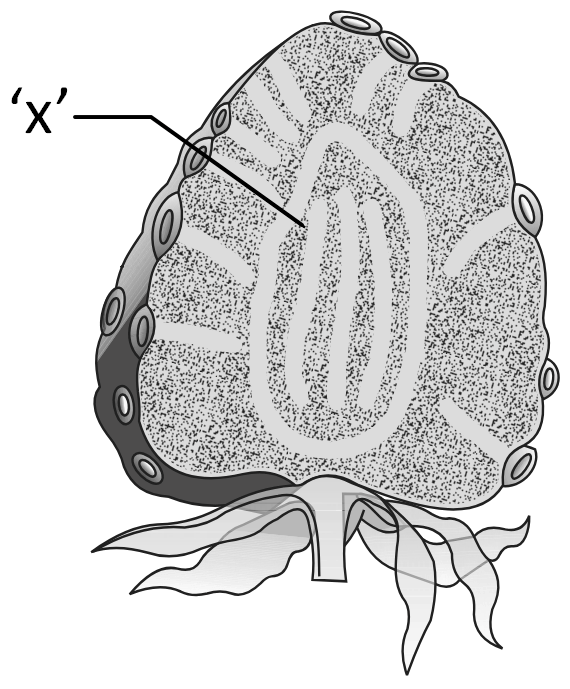
- Endosperm
- Thalamus
- Endocarp
- Mesocarp
Show answer
Answer: (2) Thalamus
Q20 NEET 2024 Flower & Parts of Flower
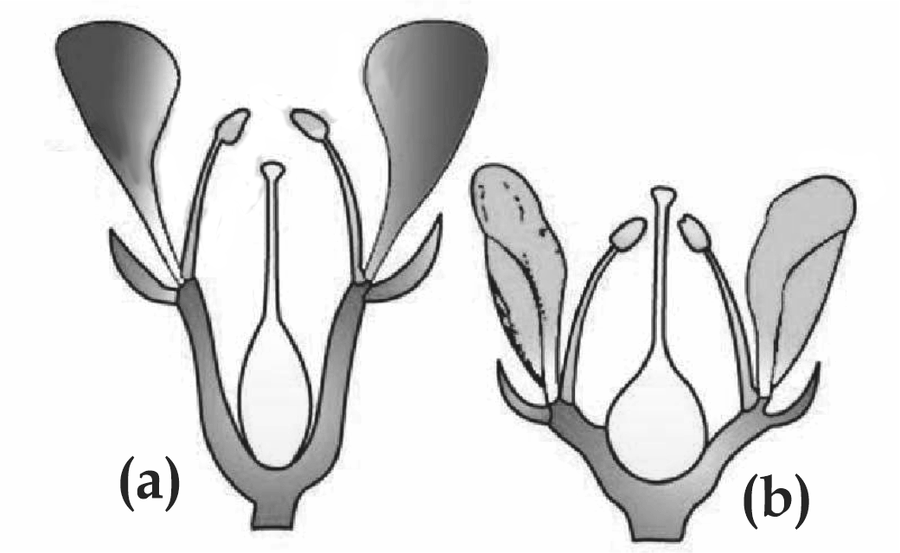
- (a) Hypogynous; (b) Epigynous
- (a) Perigynous; (b) Epigynous
- (a) Perigynous; (b) Perigynous
- (a) Epigynous; (b) Hypogynous
Show answer
Answer: (3) (a) Perigynous; (b) Perigynous
Q21 NEET 2024 Flower & Parts of Flower
- Cassia
- Pisum
- Sesbania
- Datura
Show answer
Answer: (4) Datura
Why: Datura has regular, radially symmetric flowers that can be divided into equal halves through many planes, which defines an actinomorphic flower. Cassia, Pisum and Sesbania have irregular, zygomorphic flowers that can be divided into equal halves through only one plane.
Q22 NEET 2024 Seed
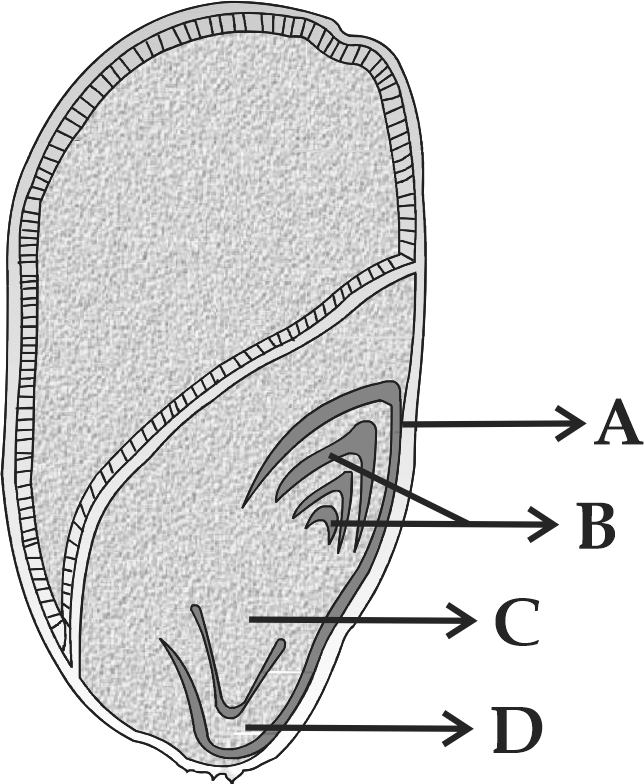
- B
- C
- D
- A
Show answer
Answer: (2) C
Q23 NEET 2024 Flower & Parts of Flower
| List I (Types of stamens ) |
List II (Example) |
||
| A. | Monoadelphous | I. | Citrus |
| B. | Diadelphous | II. | Pea |
| C. | Polyadelphous | III. | Lily |
| D. | Epiphyllous | IV. | China-rose |
- A-IV, B-I, C-II, D-III
- A-I, B-II, C-IV, D-III
- A-III, B-I, C-IV, D-II
- A-IV, B-II, C-I, D-III
Show answer
Answer: (4) A-IV, B-II, C-I, D-III
Why: Hibiscus (China-rose) has monoadelphous stamens, with all filaments fused into a single bundle, and pea has diadelphous stamens in two bundles, one of nine fused filaments and one separate. Citrus shows polyadelphous stamens in several bundles, while in lily the stamens are epiphyllous, attached to the tepals.
Q24 NEET 2024 Flower & Parts of Flower
| List-I | List-II | ||
| A. | Rose | I. | Twisted aestivation |
| B. | Pea | II. | Perigynous flower |
| C. | Cotton | III. | Drupe |
| D. | Mango | IV. | Marginal placentation |
- A-I, B-II, C-III, D-IV
- A-IV, B-III, C-II, D-I
- A-II, B-III, C-IV, D-I
- A-II, B-IV, C-I, D-III
Show answer
Answer: (4) A-II, B-IV, C-I, D-III
Why: Rose has a perigynous flower in which the other floral parts surround the ovary at a raised level, and pea has marginal placentation where ovules attach along the ventral suture of the ovary. Cotton shows twisted aestivation in its petals, and mango produces a drupe, a fleshy fruit with a hard stony endocarp.
Morphology of Flowering Plants NEET PYQ 2023 (6 questions)
Q25 NEET 2023 (Manipur) Flower & Parts of Flower
- Valvate
- Vexillary
- Imbricate
- Twisted
Show answer
Answer: (1) Valvate
Why: In Calotropis the petals in the flower bud just touch one another at their margins without overlapping, which is the valvate type of aestivation.
Q26 NEET 2023 (Manipur) Flower & Parts of Flower
- Keel, Wings and standard
- Vexillum, Keel and standard
- Keel, Standard and Carina
- Standard, Wings and Keel
Show answer
Answer: (4) Standard, Wings and Keel
Why: The posterior petal is the large standard (or banner), the two lateral petals are the wings, and the two anterior petals are fused into the keel that encloses the reproductive organs. So the correct option is Standard, Wings and Keel.
Q27 NEET 2023 (Manipur) Flower & Parts of Flower
| Type of flower | Example | ||
| (A) | Zygomorphic | (I) | Mustard |
| (B) | Hypogynous | (II) | Plum |
| (C) | Perigynous | (III) | Cassia |
| (D) | Epigynous | (IV) | Cucumber |
Choose the correct answer from the options given below:
- A-I, B-II, C-IV, D-III
- A-I, B-II, C-III, D-IV
- A-IV, B-I, C-III, D-II
- A-III, B-I, C-II, D-IV
Show answer
Answer: (4) A-III, B-I, C-II, D-IV
Why: Cassia flowers are zygomorphic, with bilateral symmetry, while mustard has hypogynous flowers with the other floral parts attached below the superior ovary. Plum has perigynous flowers where the floral parts surround the ovary at its rim, and cucumber has epigynous flowers with an inferior ovary fused to the receptacle.
Q28 NEET 2023 Families of Flowering Plant
- Epiphyllous and Dithecous anthers
- Diadelphous and Dithecous anthers
- Polyadelphous and epipetalous stamens
- Monoadelphous and Monothecous anthers
Show answer
Answer: (2) Diadelphous and Dithecous anthers
Why: Fabaceae has diadelphous stamens, in which the filaments are fused into two bundles, one holding most of the stamens and the other a single free stamen, and the anthers are dithecous with two pollen sacs each. Solanaceae stamens are free or epipetalous and Liliaceae stamens are free, so neither shows diadelphous filament fusion.
Q29 NEET 2023 Flower & Parts of Flower
- China rose, Petunia and Lemon
- Mustard, Cucumber and Primrose
- China rose, Beans and Lupin
- Tomato, Dianthus and Pea
Show answer
Answer: (1) China rose, Petunia and Lemon
Why: Axile placentation, in which ovules are attached to a central axis of a multilocular ovary, is found in China rose, Petunia and Lemon. The other options list plants such as mustard, primrose, beans, lupin, tomato, dianthus and pea, which show other placentation types.
Q30 NEET 2023 Inflorescence
| Assertion (A): | A flower is defined as a modified shoot wherein the shoot apical meristem changes to floral meristem. |
| Reason (R): | Internode of the shoot gets condensed to produce different floral appendages laterally at successive nodes instead of leaves. |
- (A) is False but (R) is True.
- Both (A) and (R) are True and (R) is the correct explanation of (A).
- Both (A) and (R) are True but (R) is not the correct explanation of (A).
- (A) is True but (R) is False.
Show answer
Answer: (2) Both (A) and (R) are True and (R) is the correct explanation of (A).
Why: Both the assertion and the reason are true, and the reason correctly explains the assertion. A flower is a modified shoot in which the shoot apical meristem becomes a floral meristem, and the internodes are condensed so that floral appendages such as sepals, petals, stamens and carpels arise at successive nodes instead of leaves.
Morphology of Flowering Plants NEET PYQ 2022 (9 questions)
Q31 NEET 2022 (Ganganagar) Semi Technical Description
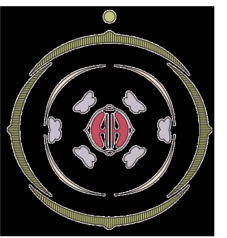
- Fabaceae
- Brassicaceae
- Solanaceae
- Liliaceae
Show answer
Answer: (2) Brassicaceae
Q32 NEET 2022 (Ganganagar) Flower & Parts of Flower
| List-I | List-II | ||
| (a) | Imbricate | (i) | Calotropis |
| (b) | Valvate | (ii) | Cassia |
| (c) | Vexillary | (iii) | Cotton |
| (d) | Twisted | (iv) | Bean |
Choose the correct answer from the options given below:
- a-(ii), b-(i), c-(iii), d-(iv)
- a-(ii), b-(i), c-(iv), d-(iii)
- a-(ii), b-(iv), c-(iii), d-(i)
- a-(i), b-(iii), c-(iv), d-(ii)
Show answer
Answer: (2) a-(ii), b-(i), c-(iv), d-(iii)
Why: In imbricate aestivation, petals overlap irregularly as seen in Cassia, while in valvate aestivation the petals just meet at their edges without overlapping, as in Calotropis. Vexillary (papilionaceous) aestivation, with a large standard petal overlapping the others, is found in bean, and twisted aestivation, where each petal overlaps the next in one direction, is found in cotton.
Q33 NEET 2022 (Ganganagar) Modifications of Stem
- Rhizome is a condensed form of stem.
- The apical bud in rhizome always remains above the ground.
- The rhizome is aerial with no distinct nodes and internodes.
- The rhizome is thick, prostrate and branched.
Show answer
Answer: (3) The rhizome is aerial with no distinct nodes and internodes.
Why: A rhizome is an underground, prostrate, thick and branched stem that is a modified or condensed form of stem, and it has distinct nodes and internodes. The statement that the rhizome is aerial with no distinct nodes and internodes is incorrect, since rhizomes grow horizontally below the ground and bear nodes and internodes.
Q34 NEET 2022 (Abroad) Flower & Parts of Flower
| (a) | The sterile stamens are called staminodes |
| (b) | When stamens are attached to petals they are called epipetalous |
| (c) | Monadelphy is seen in China-rose |
| (d) | Polyadelphy is seen in Pea |
| (e) | Variation in the length of anther filaments is seen in Mustard |
Choose the correct answer from the options given below:
- (a), (c), (d) and (e) only
- (a) , (b), (c) and (e) only
- (a) , (b) and (c) only
- (b) , (c) and (d) only
Show answer
Answer: (2) (a) , (b), (c) and (e) only
Why: Sterile stamens are called staminodes, and stamens fused to the petals are called epipetalous. China-rose shows monadelphous stamens, where filaments are united into one bundle, and mustard shows variation in the lengths of its filaments. Pea shows diadelphous rather than polyadelphous stamens, so the statement about polyadelphy is wrong.
Q35 NEET 2022 (Abroad) Venation, Types of Leaves & Phyllotaxy
- Palmately compound - Alstonia
- Alternate Phyllotaxy - China-rose
- Leaf tendril - Pea
- Opposite phyllotaxy - Calotropis
Show answer
Answer: (1) Palmately compound - Alstonia
Why: Alstonia has simple leaves arranged in whorls, not palmately compound leaves, so this pairing is the mismatch. The other pairs are correct: China-rose has alternate phyllotaxy, pea has leaf tendrils, and Calotropis has opposite phyllotaxy.
Q36 NEET 2022 (Abroad) Flower & Parts of Flower
- Lemon
- Pea
- China-rose
- Primrose
Show answer
Answer: (4) Primrose
Why: Primrose has ovules borne on a free central placenta in a unilocular ovary, meaning the ovary has a single chamber with no septa. This is free central placentation, which is seen in Primrose, whereas lemon, pea and China-rose have axile or other placentation types with septa or a different arrangement.
Q37 NEET 2022 Flower & Parts of Flower
a. Mustard
b. Gulmohar
c. Cassia
d. Datura
e. Chilly
Choose the correct answer from the options given below:
- c, d, e only
- a, b, c only
- b, c only
- d, e only
Show answer
Answer: (3) b, c only
Why: Zygomorphic flowers have bilateral symmetry, and among the listed plants this is true of Gulmohar and Cassia, which are both members of the Caesalpinioideae subfamily of legumes. Mustard, Datura and Chilly have radially symmetric (actinomorphic) flowers.
Q38 NEET 2022 Modifications of Stem
| (a) | The leaflets are modified into pointed hard thorns in Citrus and Bougainvillea. |
| (b) | Axillary buds form slender and spirally coiled tendrils in cucumber and pumpkin. |
| (c) | Stem is flattened and fleshy in Opuntia and modified to perform the function of leaves. |
| (d) | Rhizophora shows vertically upward growing roots that help to get oxygen for respiration. |
| (e) | Subaerially growing stems in grasses and strawberry help in vegetative propagation. |
Choose the correct answer from the options given below:
- (a), (b), (d), and (e) only
- (b), (c) only
- (a), (d) only
- (b), (c), (d) and (e) only
Show answer
Answer: (4) (b), (c), (d) and (e) only
Why: In Citrus and Bougainvillea the thorns are modified stem or axillary structures, not leaflets, so statement (a) is wrong. Axillary buds forming tendrils in cucumber, the flattened fleshy stem of Opuntia, the upward-growing pneumatophores of Rhizophora, and subaerial stems in grasses and strawberry are all correct.
Q39 NEET 2022 Families of Flowering Plant
- Solanum nigrum
- Colchicum autumnale
- Pisum sativum
- Allium cepa
Show answer
Answer: (3) Pisum sativum
Why: Pisum sativum (pea) is a member of Fabaceae, which shows vexillary aestivation in which the large standard petal overlaps the wing and keel petals. Its stamens are diadelphous, with nine stamens fused and one free, which is characteristic of the pea family.
Morphology of Flowering Plants NEET PYQ 2021 (2 questions)
Q40 NEET 2021 Flower & Parts of Flower
- Pea
- China rose and citrus
- China rose
- Citrus
Show answer
Answer: (1) Pea
Why: Diadelphous stamens, where filaments are joined into two bundles, are characteristic of pea, which belongs to the Fabaceae family. China rose and citrus do not show this arrangement, so pea is the correct choice.
Q41 NEET 2021 Families of Flowering Plant
Match Column-I with Column-II
| Column-I | Column-II | ||
| (a) |  |
(i) | Brassicaceae |
| (b) |  |
(ii) | Liliaceae |
| (c) |  |
(iii) | Fabaceae |
| (d) |  |
(iv) | Solanaceae |
Select the correct answer from the options given below:
- a-(ii), b-(iii), c-(iv), d-(i)
- a-(iv), b-(ii), c-(i), d-(iii)
- a-(iii), b-(iv), c-(ii), d-(i)
- a-(i), b-(ii), c-(iii), d-(iv)
Show answer
Answer: (3) a-(iii), b-(iv), c-(ii), d-(i)
Morphology of Flowering Plants NEET PYQ 2020 (6 questions)
Q42 NEET 2020 (Covid Re-exam) Flower & Parts of Flower
Correct position of floral parts over thalamus in the mustard plant is:
- Gynoecium occupies the highest position, while the other parts are situated below it.
- Margin of the thalamus grows upward, enclosing the ovary completely, and other parts arise below the ovary.
- Gynoecium is present in the center and other parts cover it partially.
- Gynoecium is situated in the center, and other parts of the flower are located at the rim of the thalamus, at the same level.
Show answer
Answer: (1) Gynoecium occupies the highest position, while the other parts are situated below it.
Q43 NEET 2020 (Covid Re-exam) Families of Flowering Plant
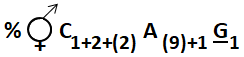
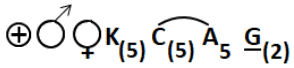
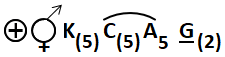
Which of the following is the correct floral formula of Liliaceae?
Show answer
Answer: (3) 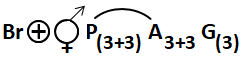
Q44 NEET 2020 (Covid Re-exam) Fruits & their Types
| (i) | In both, fruit is a drupe |
| (ii) | Endocarp is edible in both |
| (iii) | Mesocarp in Coconut is fibrous, and in Mango, it is fleshy |
| (iv) | In both, the fruit develops from the monocarpellary ovary |
Select the correct option from below:
- (i), (iii) and (iv) only
- (i), (ii) and (iii) only
- (i) and (iv) only
- (i) and (ii) only
Show answer
Answer: (1) (i), (iii) and (iv) only
Why: Both mango and coconut are drupes that develop from a monocarpellary superior ovary. Coconut has a fibrous mesocarp while mango has a fleshy mesocarp, whereas the endocarp is edible in neither fruit (it is hard and stony in mango and the hard shell in coconut), so statements (i), (iii) and (iv) are correct.
Q45 NEET 2020 Flower & Parts of Flower
Ray florets have:
- Superior ovary
- Hypogynous ovary
- Half-inferior ovary
- Inferior ovary
Show answer
Answer: (4) Inferior ovary
Why: Ray florets in composite flowers such as sunflower arise from a flower whose ovary is inferior, meaning the ovary is positioned below the attachment of the other floral parts, so the inferior ovary option is correct.
Q46 NEET 2020 Morphology of Roots
The roots that originate from the base of the stem are:
- Primary roots
- Prop roots
- Lateral roots
- Fibrous roots
Show answer
Answer: (4) Fibrous roots
Why: Fibrous roots arise from the base of the stem, as is typical of monocot plants, and they form a dense mass of thin roots that replace the primary root, which is the first root to emerge from the radicle.
Q47 NEET 2020 Flower & Parts of Flower
- Mustard
- Sunflower
- Plum
- Brinjal
Show answer
Answer: (3) Plum
Why: In plum the ovary is half inferior, meaning it is partly embedded in the floral receptacle, whereas in mustard and brinjal the ovary is superior and in sunflower it is completely inferior.
Morphology of Flowering Plants NEET PYQ 2019 (4 questions)
Q48 NEET 2019 (Odisha) Venation, Types of Leaves & Phyllotaxy
Which of the following shows whorled phyllotaxy?
- Mustard
- China rose
- Alstonia
- Calotropis
Show answer
Answer: (3) Alstonia
Why: Whorled phyllotaxy means three or more leaves arise at the same node and form a circle around the stem, and Alstonia shows this arrangement. Mustard and China rose have alternate phyllotaxy, while Calotropis has opposite phyllotaxy.
Q49 NEET 2019 (Odisha) Families of Flowering Plant
- Brassica
- Aloe
- Solanum
- Sesbania
Show answer
Answer: (3) Solanum
Why: Solanum has a bicarpellary syncarpous ovary in which the septum is placed obliquely, which is a characteristic feature of the Solanaceae. Brassica has a different septum arrangement, while Aloe and Sesbania do not show this ovary type.
Q50 NEET 2019 (Odisha) Parts of Flower
Match the placentation types Column-I with their examples Column-II.
| Column-I | Column-II | ||
| (a) | Basal | (i) | Mustard |
| (b) | Axile | (ii) | China rose |
| (c) | Parietal | (iii) | Dianthus |
| (d) | Free central | (iv) | Sunflower |
Choose the correct answer from the following options:
- a-(ii), b-(iii), c-(iv), d-(i)
- a-(i), b-(ii), c-(iii), d-(iv)
- a-(iv), b-(ii), c-(i), d-(iii)
- a-(iii), b-(iv), c-(i), d-(ii)
Show answer
Answer: (3) a-(iv), b-(ii), c-(i), d-(iii)
Why: In basal placentation, the ovules arise from the base of the ovary, as in sunflower. In axile placentation, seeds form on a central axis of a multilocular ovary, as in China rose. In parietal placentation, ovules develop on the inner walls of the ovary, as in mustard. In free central placentation, ovules arise from a central axis with no partitions, as in Dianthus.
Q51 NEET 2019 Parts of Flower
- Free central
- basal
- Axile
- Parietal
Show answer
Answer: (4) Parietal
Why: Parietal placentation is the arrangement in which ovules develop on the inner wall of a unilocular ovary or on peripheral parts of a multilocular ovary, as seen in mustard and Cucurbits. This is distinct from free central placentation, where ovules arise from a central axis without septa, and from axile placentation, where ovules are attached to a central axis within a multilocular ovary.
Morphology of Flowering Plants NEET PYQ 2018 (2 questions)
Q52 NEET 2018 Modification of Roots
- Halophytes
- Free-floating hydrophytes
- Carnivorous plants
- Submerged hydrophytes
Show answer
Answer: (1) Halophytes
Why: Pneumatophores are aerial root projections that grow upward out of waterlogged, oxygen-poor soil to obtain air for root respiration, and they are characteristic of halophytes such as mangroves. Free-floating hydrophytes, carnivorous plants and submerged hydrophytes do not develop them.
Q53 NEET 2018 Modification of Roots
- Stem
- Adventitious root
- Tap root
- Rhizome
Show answer
Answer: (2) Adventitious root
Why: Sweet potato is a modified adventitious root that stores food, as seen in its swollen, fleshy storage roots, while the stem and rhizome are different structures. Its roots arise from parts other than the radicle, which is why it is classed as an adventitious root.
Morphology of Flowering Plants NEET PYQ 2017 (4 questions)
Q54 NEET 2017 Modification of Roots
- Halophytes
- Psammophytes
- Hydrophytes
- Mesophytes
Show answer
Answer: (1) Halophytes
Why: Halophytes grow in saline habitats such as mangroves, and they develop characteristic pneumatophores (aerial breathing roots) to obtain oxygen in waterlogged, anaerobic soil. Vivipary, the germination of seeds while still attached to the parent plant, is also seen in mangrove halophytes.
Q55 NEET 2017 Fruits & their Types
Coconut fruit is a:
- Berry
- Nut
- Capsule
- Drupe
Show answer
Answer: (4) Drupe
Why: A coconut has a thin outer skin, a fibrous middle layer and a hard woody endocarp enclosing a single seed, which is the typical structure of a drupe derived from a superior ovary. It is not a true berry, nut or capsule.
Q56 NEET 2017 Aerial Stem Modification
- Adventitious root
- Stem
- Leaf
- Stipules
Show answer
Answer: (2) Stem
Why: The thorns of Bougainvillea are modified stem structures, and this is why they are borne on the stem and not at the leaf base. The option stating that thorns are modified stems is the correct one.
Q57 NEET 2017 Morphology of Roots
Root hairs develop from the region of:
- Elongation
- Root cap
- Meristematic activity
- Maturation
Show answer
Answer: (4) Maturation
Why: Root hairs arise as outgrowths of epidermal cells from the zone of maturation, which lies just behind the zone of elongation. The option naming the maturation region is the correct one.
Morphology of Flowering Plants NEET PYQ 2016 (9 questions)
Q58 NEET 2016 Phase 2 Flower & Parts of Flower
- Brassica
- Trifolium
- Pisum
- Cassia
Show answer
Answer: (1) Brassica
Why: The flowers of Brassica, the mustard plant, are actinomorphic, so they can be divided into equal halves through many planes and show radial symmetry. The flowers of Trifolium, Pisum and Cassia are zygomorphic, with bilateral symmetry.
Q59 NEET 2016 Phase 2 Flower & Parts of Flower
Free-central placentation is found in?
- Dianthus
- Argemone
- Brassica
- Citrus
Show answer
Answer: (1) Dianthus
Why: Free central placentation, in which ovules are borne on a central axis with septa absent, is characteristic of Dianthus (carnation family). The other plants listed have different placentation types.
Q60 NEET 2016 Phase 2 Parts of Flower
The term 'polyadelphous' is related to?
- gynoecium
- androecium
- corolla
- calyx
Show answer
Answer: (2) androecium
Why: Polyadelphous describes the androecium, where the stamens are united into more than one bundle by their filaments. It does not refer to the gynoecium, corolla or calyx.
Q61 NEET 2016 Phase 2 Flower & Parts of Flower
- Three
- Four
- Five
- Six
Show answer
Answer: (2) Four
Q62 NEET 2016 Phase 1 Families of Flowering Plant
- Solanaceae
- Fabaceae
- Poaceae
- Liliaceae
Show answer
Answer: (4) Liliaceae
Why: Liliaceae (the lily family) has a gynoecium made of three fused carpels, giving a tricarpellary, syncarpous ovary. This fused-carpel arrangement is characteristic of lily-type flowers, unlike the other families listed.
Q63 NEET 2016 Phase 1 Seed
2. coleoptile
3. scutellum
4. plumule
Show answer
Answer: option (3)
Q64 NEET 2016 Phase 1 Flower & Parts of Flower
- pappus
- vexillum
- corona
- carina
Show answer
Answer: (2) vexillum
Why: In a papilionaceous (pea-type) corolla, the large upright petal at the back of the flower is called the vexillum or standard. The two side petals are the wings and the lower pair forms the keel.
Q65 NEET 2016 Phase 1 Aerial Stem Modification
- phyllodes
- phylloclades
- scales
- cladodes
Show answer
Answer: (2) phylloclades
Why: Phylloclades are flattened, green, photosynthetic stems that take over the functions of leaves, as seen in plants like Opuntia. Phyllodes are petioles that become flattened and leaf-like, while cladodes are needle-like or thread-like stems and scales are reduced leaves.
Q66 NEET 2016 Phase 1 Morphology of Stems
Which of the following is not a stem modification?
- Thorns of citrus
- Tendrils of cucumber
- Flattened structure of Opuntia
- Pitcher of Nepenthes
Show answer
Answer: (4) Pitcher of Nepenthes
Why: The pitcher of Nepenthes is a modified leaf, not a modified stem, so it is the structure that is not a stem modification. Citrus thorns and cucumber tendrils are modified stems, and the flattened structures of Opuntia are photosynthetic stem modifications called cladodes.
Morphology of Flowering Plants NEET PYQ 2015 (9 questions)
Q67 AIPMT 2015 Re-exam Flower & Parts of Flower
Among China rose, mustard, brinjal, potato, guava, cucumber, onion and tulip, how many plants have superior ovary?
- Five
- Six
- Three
- Four
Show answer
Answer: (2) Six
Why: Plants with a superior ovary are China rose, mustard, brinjal, potato, onion and tulip, which makes six, while guava and cucumber have inferior ovaries, so the answer is option (2).
Q68 AIPMT 2015 Re-exam Seed
- epiblast
- coleorrhiza
- scutellum
- coleoptile
Show answer
Answer: (3) scutellum
Why: In the wheat grain embryo, the single large shield-shaped cotyledon is called the scutellum. During germination it absorbs digested food from the endosperm and passes it to the growing embryo. The epiblast, coleorrhiza and coleoptile are other embryonic structures, not the cotyledon.
Q69 AIPMT 2015 Re-exam Parts of Flower
- Dianthus
- Lemon
- Pea
- Argemone
Show answer
Answer: (2) Lemon
Q70 AIPMT 2015 Re-exam Modification of Roots
- Sunflower
- Pistia
- China rose
- Wheat
Show answer
Answer: (2) Pistia
Why: Pistia is a free-floating aquatic plant that absorbs water and minerals mainly through its leaf-like surface and feathery roots, so its roots play an insignificant role in water absorption. Sunflower, China rose and wheat are terrestrial plants whose roots are the main organs for water uptake.
Q71 AIPMT 2015 Flower & Parts of Flower
- tulip
- lndigofera
- Aloe
- tomato
Show answer
Answer: (2) lndigofera
Why: A keel is the pair of petals fused at the lower side of a papilionaceous (pea-family) corolla, which enclose the androecium and gynoecium. Indigofera belongs to the Fabaceae, whose flowers show this papilionaceous structure with a keel, whereas tulip, Aloe and tomato do not have a keel.
Q72 AIPMT 2015 Flower & Parts of Flower
Perigynous flowers are found in:
- guava
- cucumber
- China rose
- rose
Show answer
Answer: (4) rose
Why: In perigynous flowers the thalamus is cup-shaped and the other floral parts arise around the margin of the ovary at a level slightly below it. Rose is the perigynous example in this list, with the ovary embedded in a fleshy thalamus, while guava, cucumber and China rose are not perigynous in this sense.
Q73 AIPMT 2015 Modification of Leaf
- Opuntia
- pea
- onion
- silk cotton
Show answer
Answer: (1) Opuntia
Why: In Opuntia the leaves are modified into spines, which reduces water loss in its arid habitat, while the stem performs photosynthesis. Pea, onion and silk cotton do not have leaves modified into spines as a characteristic feature.
Q74 AIPMT 2015 Seed
- seed, where the funicle was attached
- fruit, where it was attached to the pedicel
- fruit, where style was present
- seed, where micropyle was present
Show answer
Answer: (1) seed, where the funicle was attached
Why: The hilum is the scar left on the seed coat where the funicle (the stalk connecting the ovule to the placenta) was attached. It is a feature of the seed, not of the fruit, and it does not mark the micropyle.
Q75 AIPMT 2015 Families of Flowering Plant
 is the floral formula of:
- Allium
- Sesbania
- Petunia
- Brassica
Show answer
Answer: (3) Petunia
Morphology of Flowering Plants NEET PYQ 2014 (6 questions)
Q76 AIPMT 2014
Non- albuminous seed is produced in:
- Maize
- Castor
- Wheat
- Pea
Show answer
Answer: (4) Pea
Why: In pea, the endosperm is absorbed by the developing embryo before seed maturity, so the food reserves are stored in the cotyledons and the seed is non-albuminous. Maize, wheat and castor retain a persistent endosperm at maturity and are albuminous seeds.
Q77 AIPMT 2014 Seed
Which one of the following statements is correct?
- The seed in grasses is not endospermic
- Mango is a parthenocarpic fruit
- A proteinaceous aleurone layer is present in maize grain.
- A sterile pistil is called a staminode.
Show answer
Answer: (3) A proteinaceous aleurone layer is present in maize grain.
Why: The correct statement is that maize grain has a protein-rich aleurone layer surrounding the endosperm. Grass seeds are endospermic, mango fruits are not parthenocarpic (they develop from fertilised ovaries), and a sterile stamen, not a sterile pistil, is called a staminode.
Q78 AIPMT 2014 Fruits & their Types
- Multicarpellary syncarpous gynoecium
- Multicarpellary apocarpous gynoecium
- Complete inflorescence
- Multicarpellary superior ovary
Show answer
Answer: (2) Multicarpellary apocarpous gynoecium
Why: An aggregate fruit develops from a flower with an apocarpous gynoecium, in which many separate carpels in a single flower each form a small fruitlet that together make up one aggregate fruit, as in strawberry or custard apple. A syncarpous gynoecium gives rise to a simple fruit instead.
Q79 AIPMT 2014 Fruits & their Types
- Apple
- Banana
- Tomato
- Potato
Show answer
Answer: (3) Tomato
Why: In tomato, the fleshy edible part is formed from the pericarp (the fruit wall), and the placenta, the tissue bearing the seeds, is also eaten. In apple and banana the edible parts are different tissues, and potato is a tuber rather than a fruit.
Q80 AIPMT 2014 Morphology of Stems
- Carrot
- Groundnut
- Sweet potato
- Potato
Show answer
Answer: (4) Potato
Why: The potato tuber is a modified underground stem that stores food, identified by its nodes and eyes, which are axillary buds. Carrot and sweet potato are underground roots, and groundnut fruits develop underground but are not stems.
Q81 AIPMT 2014 Flower & Parts of Flower
When the margins of sepals or petals overlap one another without any particular direction, the condition is termed as:
- Vexillary
- Imbricate
- Twisted
- Valvate
Show answer
Answer: (2) Imbricate
Why: When sepal or petal margins overlap one another without any fixed direction, as in a pinwheel-like but irregular arrangement with each part partly covered by its neighbour, the aestivation is called imbricate. This is distinct from valvate, where the margins merely touch without overlapping, and from twisted, where each part overlaps its neighbour in one consistent direction.
Morphology of Flowering Plants NEET PYQ 2013 (8 questions)
Q82 NEET 2013 (Karnataka) Flower & Parts of Flower
- Six
- Seven
- Eight
- Five
Show answer
Answer: (2) Seven
Q83 NEET 2013 (Karnataka) Families of Flowering Plant
- Brinjal
- Tulip
- Aloe
- Soybean
Show answer
Answer: (4) Soybean
Q84 NEET 2013 (Karnataka) Seed
- 2, 6 dichlorophenol indophenols
- 2, 3, 5 triphenyl tetrazolium chloride
- DMSO
- Safranine
Show answer
Answer: (2) 2, 3, 5 triphenyl tetrazolium chloride
Q85 NEET 2013 (Karnataka) Inflorescence
- has unlimited growth
- bears a solitary flower
- has unlimited growth but lateral branches end in flowers
- terminates in a flower
Show answer
Answer: (4) terminates in a flower
Why: In a cymose inflorescence, the main axis ends in a terminal flower, so its growth is limited, and further growth occurs from lateral branches that also end in flowers. This matches the description of the option stating that the main axis terminates in a flower.
Q86 NEET 2013 (Karnataka) Venation, Types of Leaves & Phyllotaxy
- Three
- Four
- Five
- Two
Show answer
Answer: (1) Three
Why: Opposite phyllotaxy, with two leaves arising at the same node on opposite sides of the stem, is found in Ocimum, Calotropis and Nerium, which gives the count of three in the options. Sunflower and mustard have alternate leaves, China rose is alternate, and Alstonia has whorled leaves. Guava is also often described as having opposite leaves, so the count is somewhat debatable depending on the source.
Q87 NEET 2013 Flower & Parts of Flower
Among bitter gourd, mustard, brinjal, pumpkin, china rose, lupin, cucumber, sunn hemp, gram, guava, bean, chilli, plum, petunia, tomato, rose, Withania, potato, onion, aloe and tulip how many plants have hypogynous flower?
- Ten
- Fifteen
- Eighteen
- Six
Show answer
Answer: (2) Fifteen
Why: A flower is hypogynous when the ovary is superior and the other floral parts are attached below it, as in the Solanaceae, Brassicaceae, Fabaceae and Liliaceae families. Counting the hypogynous plants in the list (mustard, brinjal, china rose, lupin, sunn hemp, gram, bean, chilli, petunia, tomato, Withania, potato, onion, aloe, tulip) gives the Fifteen option.
Q88 NEET 2013 Flower & Parts of Flower
- Actiniomorphic, epigynous with valvel aestivation
- Zygomorphic, hypogynous with imbricate aestivation
- Zygomorphic, epigynous with twisted aestivation
- Actinomorphic, hypogynous with twisted aestivation
Show answer
Answer: (4) Actinomorphic, hypogynous with twisted aestivation
Why: China rose has regular, actinomorphic (radially symmetrical) flowers in which the ovary is superior and the floral parts are attached below it, which is the hypogynous condition. The petals are arranged in twisted aestivation, as described in the option Actinomorphic, hypogynous with twisted aestivation.
Q89 NEET 2013 Seed
- Coconut
- Groundnut
- Gram
- Maize
Show answer
Answer: (4) Maize
Why: In maize the seed coat is fused with the fruit wall to form a fruit coat (caryopsis), so it is not a thin, membranous seed coat as seen in coconut, groundnut and gram. The seed coat of the other three options is distinct and thin.
Morphology of Flowering Plants NEET PYQ 2012 (7 questions)
Q90 AIPMT 2012 Mains Flower & Parts of Flower
How many plants in the list given below have marginal placentation?
Mustard, Gram, Tulip, Asparagus, Arhar, Sun hemp, Chilli, Colchicine, Onion, Moong, Pea, Tobacco, Lupin
- Five
- Six
- Three
- Four
Show answer
Answer: (2) Six
Why: Marginal placentation, where ovules are attached along the margin of a single carpel, is found in the legume family, which includes Pea, Gram, Arhar, Moong, Sun hemp and Lupin, giving six plants, matching the option six. Mustard has parietal placentation, while Tulip, Asparagus, Onion, Chilli and Tobacco have axile placentation.
Q91 AIPMT 2012 Mains Families of Flowering Plant
Which one of the following organisms is correctly matched with its three characteristics?
- Tomato: Twisted aestivation, Axile placentation, Berry
- Onion: Bulb, Imbricate aestivation, Axile placentation
- Maize: C3 pathway, Closed vascular bundles, Scutellum
- Pea: C3 pathway, Endospermic seed, Vaxillary aestivation
Show answer
Answer: (2) Onion: Bulb, Imbricate aestivation, Axile placentation
Q92 AIPMT 2012 Modification of Leaf
Phyllode is present in:
- Asparagus
- Euphorbia
- Australian Acacia
- Opuntia
Show answer
Answer: (3) Australian Acacia
Why: Phyllodes are flattened, leaf-like petioles that perform photosynthesis, and they are characteristic of Australian Acacia. Asparagus and Opuntia bear cladodes, which are modified stems, while Euphorbia has modified stems and reduced leaves.
Q93 AIPMT 2012 Families of Flowering Plant
- Fabaceae
- Asteraceae
- Solanaceae
- Brassicaceae
Show answer
Answer: (1) Fabaceae
Why: Vexillary aestivation, where the largest petal overlaps the two lateral petals which in turn enclose the two smallest petals, is the characteristic floral arrangement of the family Fabaceae. Asteraceae, Solanaceae and Brassicaceae show different aestivation patterns or none of this type.
Q94 AIPMT 2012 Inflorescence
How many plants in the list given below have composite fruits that develop from an inflorescence?
Walnut, poppy, radish, fig, pineapple, apple, tomato, mulberry
- Four
- Five
- Two
- Three
Show answer
Answer: (4) Three
Why: Composite fruits develop from an entire inflorescence, as in pineapple, fig and mulberry, so these three plants from the list are the correct answer. Walnut, poppy, radish, apple and tomato do not form fruits from an inflorescence.
Q95 AIPMT 2012 Parts of Flower
Placentation in tomato and lemon is:
- Parietal
- free central
- marginal
- axile
Show answer
Answer: (4) axile
Why: In tomato and lemon the ovary has multiple carpels fused together, and the ovules are attached to a central column in the middle of the ovary, which is axile placentation. The correct option is axile.
Q96 AIPMT 2012 Families of Flowering Plant
- Solanum
- Sesbania
- Trifolium
- Brassica
Show answer
Answer: (1) Solanum
Why: Solanum, such as potato and brinjal, bears a cymose inflorescence in which the main axis terminates in a flower and growth continues from lateral branches. Sesbania, Trifolium and Brassica have racemose inflorescences, in which the main axis grows indefinitely.
Morphology of Flowering Plants NEET PYQ 2011 (6 questions)
Q97 AIPMT 2011 Flower & Parts of Flower
- Seeds of orchids have oil-rich endosperm
- Placentation in primrose is basal
- Flower of a tulip is a modified shoot
- In tomato, fruit is a capsule
Show answer
Answer: (3) Flower of a tulip is a modified shoot
Why: The flower of a tulip is a modified shoot, since its floral parts are borne on a reproductive axis that is a modified stem. The other statements are incorrect because orchid seeds lack an endosperm, primrose has free central placentation, and the tomato fruit is a berry rather than a capsule.
Q98 AIPMT 2011 Aerial Stem Modification
- flower buds
- shoot buds
- axillary buds
- root buds
Show answer
Answer: (3) axillary buds
Why: The eyes of a potato tuber are nodes that carry axillary buds, which are buds that form in the axils of the scale-like leaves on the underground modified stem. These buds can sprout to form new shoots, which is why they are called eyes.
Q99 AIPMT 2011 Families of Flowering Plant
The correct floral formula of chilli is:
- ⊕⚥K5 C5 A5 G(2)
- ⊕⚥K5 C5 A5 G(2)
- ⊕⚥K(5) C(5)A5 G(2)
- ⊕⚥K(5) C5 A5 G(2)
Show answer
Answer: (3) ⊕⚥K(5) C(5)A5 G(2)
Q100 AIPMT 2011 Flower & Parts of Flower
- gulmohur
- tomato
- datura
- mustard
Show answer
Answer: (1) gulmohur
Why: Gulmohur (Delonix regia) flowers are zygomorphic, meaning they have only one plane of symmetry, as seen in their unequal petals. Tomato, datura and mustard flowers are actinomorphic, with several planes of symmetry.
Q101 AIPMT 2011 Fruits & their Types
- wheat
- pea
- tomato
- mango
Show answer
Answer: (4) mango
Why: Mango fruit is a drupe, having a thin skin, a fleshy mesocarp and a stony endocarp enclosing the seed. Wheat produces a caryopsis, pea produces a legume, and tomato produces a berry.
Q102 AIPMT 2011 Flower & Parts of Flower
- cucumber
- cotton
- guava
- peach
Show answer
Answer: (4) peach
Why: In peach the ovary is half inferior, meaning the floral parts are attached at a level midway around the ovary, unlike cucumber and guava where the ovary is wholly inferior. Cotton has a superior ovary.
Morphology of Flowering Plants NEET PYQ 2010 (5 questions)
Q103 AIPMT 2010 Flower & Parts of Flower
- Gulmohur
- Cassia
- Calotropis
- Bean
Show answer
Answer: (4) Bean
Why: The keel is the pair of lower petals fused together that encloses the stamens and pistil, a characteristic feature of papilionaceous flowers, and the Bean flower is the one that shows this structure. Gulmohur and Cassia have radially or irregularly arranged petals without a keel, and Calotropis has a different corolla structure.
Q104 AIPMT 2010 Parts of Flower
The technical term used for the androecium in a flower of China rose (Hibiscus rosa-sinensis) is:
- monadelphous
- diadelphous
- polyandrous
- polyadelphous
Show answer
Answer: (1) monadelphous
Why: In China rose (Hibiscus rosa-sinensis), the numerous stamens have their filaments fused into a single bundle around the style, which is termed monadelphous, matching the correct option. Diadelphous and polyadelphous refer to filaments forming two or several bundles, while polyandrous means the stamens are free.
Q105 AIPMT 2010 Parts of Flower
- marginal
- basal
- free central
- axile
Show answer
Answer: (2) basal
Why: In a unilocular ovary bearing a single ovule, the ovule arises from the base of the ovary cavity, which is termed basal placentation, as seen in families such as Asteraceae and Polygonaceae. Marginal, free central and axile placentation involve ovules attached along the ovary wall, a central column with free ovules, or a central column within a multilocular ovary, respectively, and so do not fit this arrangement.
Q106 AIPMT 2010 Seed
- Cotyledon
- Endosperm
- Aleurone layer
- Plumule
Show answer
Answer: (1) Cotyledon
Why: The scutellum of a wheat or maize grain is a single shield-shaped cotyledon that absorbs digested food from the endosperm during germination, so it is comparable to the cotyledon of other monocotyledons. The endosperm, aleurone layer and plumule are different structures with other roles.
Q107 AIPMT 2010 Flower & Parts of Flower
- guava
- plum
- brinjal
- cucumber
Show answer
Answer: (2) plum
Why: In plum, the flower has an epigynous-type arrangement in which the ovary is half-inferior, meaning it is partly sunk below the attachment point of the other floral parts, unlike guava where it is fully inferior, and brinjal and cucumber where it is superior or inferior respectively in a different pattern. Plum is the correct option because its ovary is recognised as half-inferior among the four listed plants.
Morphology of Flowering Plants NEET PYQ 2009 (5 questions)
Q108 AIPMT 2009 Families of Flowering Plant
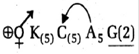 is that of:
- tulip
- soybean
- sunn hemp
- tobacco
Show answer
Answer: (4) tobacco
Q109 AIPMT 2009 Morphology of Stems
- runner
- offset
- rhizome
- sucker
Show answer
Answer: (4) sucker
Q110 AIPMT 2009 Fruits & their Types
- groundnut and pomegranate
- walnut and tamarind
- french bean and coconut
- cashew nut and litchi
Show answer
Answer: (1) groundnut and pomegranate
Why: The fleshy, edible part of groundnut seeds is the cotyledons, and the edible portion of pomegranate is the fleshy testa (seed coat), so groundnut and pomegranate is the matching pair.
Q111 AIPMT 2009 Fruits & their Types
- hesperidium
- sorosis
- syconus
- caryopsis
Show answer
Answer: (3) syconus
Why: A syconus is the fleshy multiple fruit formed from a hypanthodium inflorescence, as in fig, where many tiny flowers are enclosed in a hollow fleshy receptacle.
Q112 AIPMT 2009 Parts of Flower
- Argemone
- Dianthus
- Lemon
- Marigold
Show answer
Answer: (3) Lemon
Why: Lemon has axile placentation, where ovules are attached to a central axis within a multilocular ovary, as seen in China rose, tomato and lemon. Argemone and Dianthus show free central or other placentation, and Marigold has a different arrangement, so Lemon is the option that fits axile placentation.
Morphology of Flowering Plants NEET PYQ 2008 (4 questions)
Q113 AIPMT 2008 Parts of Flower
- caryopsis
- cypsela
- berry
- cremocarp
Show answer
Answer: (2) cypsela
Why: A cypsela is a dry, indehiscent, single-seeded fruit formed from a bicarpellary, syncarpous, inferior ovary, as in members of the sunflower family. The caryopsis is a grain of grasses, the berry is fleshy, and the cremocarp splits into two mericarps, so none of these fits the description.
Q114 AIPMT 2008 Fruits & their Types
- achenes
- samaras
- berries
- mericarps
Show answer
Answer: (1) achenes
Why: In the fig syconus, the fleshy receptacle wraps around many tiny true fruits, which are achenes, and these are the actual fruits that the fleshy receptacle encloses. Samaras, berries and mericarps are not the structures found inside a syconus.
Q115 AIPMT 2008 Flower & Parts of Flower
- lemon
- mustard
- sunflower
- pea
Show answer
Answer: (2) mustard
Why: The replum is a false septum-like partition found in the ovary of mustard, a member of the Cruciferae family, where it carries the seeds after the ovary forms a silique. It is not present in the ovaries of lemon, sunflower or pea.
Q116 AIPMT 2008 Fruits & their Types
- pomegranate
- orange
- guava
- cucumber
Show answer
Answer: (1) pomegranate
Morphology of Flowering Plants NEET PYQ 2006 (4 questions)
Q117 AIPMT 2006 Parts of Flower
- Basal
- Axile
- Free-central
- Marginal
Show answer
Answer: (4) Marginal
Why: Sweet pea has marginal placentation, in which the ovules are borne along the ventral suture (margin) of a single carpel, forming a single ovary chamber. This is the typical arrangement seen in legumes such as the pea family.
Q118 AIPMT 2006 Fruits & their Types
Pineapple (annanas) fruit develops from:
- a unilocular polycarpillary flower
- a multipistillate syncarpous flower
- a cluster of compactly borne flowers on a common axis
- a multilocular monocarpillary flower
Show answer
Answer: (3) a cluster of compactly borne flowers on a common axis
Why: The pineapple fruit is a composite or aggregate-type fruit (sorosis) that develops from a cluster of compactly borne flowers arranged on a common axis, with their fleshy perianth and bracts fusing together. Each individual flower contributes to the single fleshy fruit mass.
Q119 AIPMT 2006 Fruits & their Types
- Custard apple
- Pomegranate
- Orange
- Litchi
Show answer
Answer: (4) Litchi
Why: In litchi the edible part is the aril, a fleshy structure that develops from the seed stalk and surrounds the seed. The other fruits listed have edible parts that come from other tissues, such as the pericarp or the seed coat.
Q120 AIPMT 2006 Families of Flowering Plant
- Asteraceae
- Brassicaceae
- Solanaceae
- Liliaceae
Show answer
Answer: (3) Solanaceae
Why: Solanaceae (the potato or tomato family) has pentamerous actinomorphic flowers, a bicarpellary ovary with oblique septa formed by the placentation, and fruits that are capsules or berries. Asteraceae has composite flower heads, Brassicaceae has tetradynamous stamens with a siliqua, and Liliaceae has trimerous flowers with a superior ovary.
Frequently asked questions
How many Morphology of Flowering Plants questions have been asked in NEET?
This archive holds 120 Morphology of Flowering Plants questions from 32 of 33 official NEET and AIPMT papers, 2006–2026. It counts every paper held here, including re-exam and regional papers.
Which topics of Morphology of Flowering Plants are asked most often?
By topic tag: Flower & Parts of Flower (52), Fruits & their Types (14), Families of Flowering Plant (14), Seed (10) and Parts of Flower (10).
When was Morphology of Flowering Plants last asked?
The most recent paper in this archive with a question from this chapter is Re-NEET 2026.
Where do the answers come from?
Each answer is the option recorded as correct in the official answer key for that paper. Where a short explanation is shown, it was written separately and checked against the key; it is not part of the official paper. Questions marked NEET 2026 (3 May, cancelled) are from the cancelled first sitting: NTA issued no final key for it, so their answers are the key on record and have not been matched to an official key.
More Biology chapter-wise PYQs
← Plant Kingdom Anatomy of Flowering Plants →
Botany, Class 11
- The Living World (25)
- Biological Classification (90)
- Plant Kingdom (88)
- Anatomy of Flowering Plants (83)
- Cell: The Unit of Life (125)
- Cell Cycle and Cell Division (84)
- Photosynthesis in Higher Plants (69)
- Respiration in Plants (42)
- Plant Growth and Development (71)
Old syllabus (archive)
- Transport in Plants (39)
- Mineral Nutrition (49)
- Reproduction in Organisms (22)
- Environmental Issues (80)
- Digestion and Absorption (45)
Botany, Class 12
- Sexual Reproduction in Flowering Plants (118)
- Principles of Inheritance and Variation (155)
- Molecular Basis of Inheritance (172)
- Strategies for Enhancement in Food Production (36)
- Microbes in Human Welfare (66)
- Organisms and Populations (86)
- Ecosystem (87)
- Biodiversity and Conservation (86)
Zoology, Class 11
- Animal Kingdom (109)
- Structural Organisation in Animals (90)
- Biomolecules (100)
- Breathing and Exchange of Gases (56)
- Body Fluids and Circulation (68)
- Excretory Products and their Elimination (54)
- Locomotion and Movement (58)
- Neural Control and Coordination (53)
- Chemical Coordination and Integration (76)
Zoology, Class 12
- Human Reproduction (109)
- Reproductive Health (67)
- Evolution (101)
- Human Health and Disease (100)
- Biotechnology: Principles and Processes (118)
- Biotechnology and its Applications (101)
Want more than past papers? Practise all 2,376 Morphology of Flowering Plants questions on NEETprep.