Principles of Inheritance and Variation has 155 questions in this archive of official NEET and AIPMT papers, asked between 2006 and 2026. It appeared in 33 of the 33 papers held here (AIPMT 2006 to Re-NEET 2026); the most recent paper with a question from it is Re-NEET 2026. The most-asked topics by tag are Monohybrid Cross (15), Sex Determination (12) and Polygenic Inheritance & Pleiotropy (12). In the last 10 main papers (2017 to 2026) it had 43 questions.
Principles of Inheritance and Variation practice hub Take the chapter test
Principles of Inheritance and Variation PYQs year by year
| Year | Papers in archive | Questions | By paper |
|---|---|---|---|
| 2026 | 2 | 10 | NEET 2026: 7, Re-NEET 2026: 3 |
| 2025 | 1 | 3 | NEET 2025: 3 |
| 2024 | 3 | 20 | NEET 2024: 6, NEET 2024 Re-exam (1,563 candidates): 6, NEET 2024 (Jhajjar): 8 |
| 2023 | 2 | 11 | NEET 2023: 5, NEET 2023 (Manipur): 6 |
| 2022 | 3 | 18 | NEET 2022: 6, NEET 2022 (Abroad): 6, NEET 2022 (Ganganagar): 6 |
| 2021 | 1 | 2 | NEET 2021: 2 |
| 2020 | 2 | 7 | NEET 2020: 4, NEET 2020 (Covid Re-exam): 3 |
| 2019 | 2 | 9 | NEET 2019: 5, NEET 2019 (Odisha): 4 |
| 2018 | 1 | 4 | NEET 2018: 4 |
| 2017 | 1 | 5 | NEET 2017: 5 |
| 2016 | 2 | 10 | NEET 2016 Phase 1: 7, NEET 2016 Phase 2: 3 |
| 2015 | 2 | 12 | AIPMT 2015: 6, AIPMT 2015 Re-exam: 6 |
| 2014 | 1 | 3 | AIPMT 2014: 3 |
| 2013 | 2 | 9 | NEET 2013: 5, NEET 2013 (Karnataka): 4 |
| 2012 | 2 | 4 | AIPMT 2012: 2, AIPMT 2012 Mains: 2 |
| 2011 | 1 | 1 | AIPMT 2011: 1 |
| 2010 | 1 | 5 | AIPMT 2010: 5 |
| 2009 | 1 | 4 | AIPMT 2009: 4 |
| 2008 | 1 | 1 | AIPMT 2008: 1 |
| 2007 | 1 | 6 | AIPMT 2007: 6 |
| 2006 | 1 | 11 | AIPMT 2006: 11 |
Most-asked topics (top 15 of 34)
| Topic | PYQs |
|---|---|
| Monohybrid Cross | 15 |
| Sex Determination | 12 |
| Polygenic Inheritance & Pleiotropy | 12 |
| Non - Disjunction & Aneuploidy | 12 |
| Dominance Deviation from Mendel | 11 |
| Mendelian Disorders: Sickle Cell Anemia | 10 |
| Monohybrid Cross: Further Understanding | 10 |
| Dihybrid Cross Analysis | 8 |
| Mendelian Disorders | 8 |
| Mendelian Disorders: Hemophilia | 8 |
| Sex Aneuploidy - Turner & Klinefelter Syndrome | 8 |
| Introduction to Genetics | 7 |
| Dihybrid Cross: Details | 6 |
| Pedigree Analysis: Basics | 5 |
| Linkage | 5 |
2 of the 155 questions carry no topic tag and are not counted in this table.
Principles of Inheritance and Variation NEET PYQ 2026 (10 questions)
Q1 Re-NEET 2026 Mendel’s Laws of Inheritance
| Assertion (A): | In an experiment, Mendel observed that the F1 progeny plants are all tall and none are dwarf. |
| Reason (R): | Stem height is a contrasting trait, with tall being dominant and dwarf being recessive. |
- (A) is not correct but (R) is correct
- Both (A) and (R) are correct and (R) is the correct explanation of (A)
- Both (A) and (R) are correct but (R) is not the correct explanation of (A)
- (A) is correct but (R) is not correct
Show answer
Answer: (2) Both (A) and (R) are correct and (R) is the correct explanation of (A)
Why: All F1 plants are tall because tall is the dominant trait and dwarf is recessive, so a single dominant allele is enough to express tallness. The reason correctly explains why the assertion's observation occurs, so both statements are correct and the reason is the explanation.
Q2 Re-NEET 2026 Dihybrid Cross Analysis
- Father: and Mother:
- Father: and Mother:
- Father: and Mother:
- Father: and Mother:
Show answer
Answer: (1) Father: and Mother:
Why: A child with blood group O must receive the i allele from both parents, so the parents must each carry an i allele. The father with genotype IAIB has no i allele, so no child from that pairing can be group O, which makes this the impossible combination. The other three pairings each contain an i allele in both parents, so a group O child is possible.
Q3 Re-NEET 2026 Chromosomal Disorders
| Statement I: | Down's syndrome is caused by the absence of one of the X-chromosomes. |
| Statement II: | Turner's syndrome is caused by the presence of an additional copy of the chromosomes. |
- Statement I is incorrect but Statement II is correct
- Both Statement I and Statement II are correct
- Both Statement I and Statement II are incorrect
- Statement I is correct but Statement II is incorrect
Show answer
Answer: (3) Both Statement I and Statement II are incorrect
Q4 NEET 2026 (3 May, cancelled) Mendelian Disorders: Sickle Cell Anemia
- Haemophilia
- Thalassemia
- Sickle-cell anaemia
- Phenylketonuria
Show answer
Answer: (3) Sickle-cell anaemia
Why: Sickle-cell anaemia results from a single base change that replaces glutamic acid with valine in the beta globin chain of haemoglobin, producing abnormal sickle-shaped red blood cells. Haemophilia, thalassemia and phenylketonuria have different causes and do not involve this substitution.
Q5 NEET 2026 (3 May, cancelled)
| List-I | List-II | ||
| A. | Incomplete dominance | I. | Human skin colour |
| B. | Co-dominance | II. | Inheritance of flower colour in Antirrhinum sp. |
| C. | Pleiotropy | III. | Phenylketonuria disease in humans |
| D. | Polygenic inheritance | IV. | ABO blood groups |
- A-II, B-IV, C-III, D-I
- A-I, B-III, C-II, D-IV
- A-II, B-I, C-III, D-IV
- A-I, B-IV, C-III, D-II
Show answer
Answer: (1) A-II, B-IV, C-III, D-I
Why: Incomplete dominance is seen in flower colour inheritance in Antirrhinum, where heterozygotes show an intermediate phenotype, so A matches II. Co-dominance is shown by the ABO blood groups, where both alleles are expressed fully in the heterozygote, so B matches IV. Pleiotropy, where one gene affects several traits, is exemplified by phenylketonuria, so C matches III. Polygenic inheritance, where many genes act together to give a continuous range of phenotypes such as human skin colour, matches D with I.
Q6 NEET 2026 (3 May, cancelled) Sex Determination
| A. | An offspring formed from the union of a sperm and an egg, develops as a female (queen or worker). |
| B. | An unfertilized egg develops as a male by parthenogenesis. |
| C. | A male has half the number of chromosomes than that of a female. |
| D. | Males produce sperm by meiosis. |
| E. | Honeybees have a haplodiploid sex-determination system. |
- B, C, D and E only
- A, B, C and D only
- A, B, D and E only
- A, B, C and E only
Show answer
Answer: (4) A, B, C and E only
Why: In honeybees, a fertilised egg develops into a female (queen or worker) and an unfertilised egg develops into a male by parthenogenesis, so A and B are true. Males are haploid and so have half the chromosome number of females, and the system is haplodiploid, so C and E are true. Males produce sperm by mitosis rather than meiosis, so statement D is false.
Q7 NEET 2026 (3 May, cancelled) Mendelian Disorders: Sickle Cell Anemia
- CAG
- GUG
- AUG
- GAG
Show answer
Answer: (2) GUG
Why: In sickle cell anaemia, the sixth codon of the beta globin gene changes from GAG, which codes for glutamic acid, to GUG, which codes for valine. This single substitution makes haemoglobin polymerise under low oxygen and distorts red blood cells into a sickle shape.
Q8 NEET 2026 (3 May, cancelled) Polygenic Inheritance & Pleiotropy
- 50%
- 0%
- 75%
- 25%
Show answer
Answer: (4) 25%
Why: An O child needs to receive the recessive i allele from both parents. The mother, heterozygous for A, has IA i, and the father, heterozygous for B, has IB i, so each parent passes i with a probability of one half, and the combined probability is the product of these two independent chances, which equals 25%.
Q9 NEET 2026 (3 May, cancelled) Sex Determination
- all males
- all females
- females and males, respectively
- males and females, respectively
Show answer
Answer: (4) males and females, respectively
Why: In grasshoppers the sex determination is of the XX-XO type, where males have one fewer sex chromosome than females. So the members with 23 chromosomes are males and those with 24 chromosomes are females, which matches the option males and females, respectively.
Q10 NEET 2026 (3 May, cancelled) Sex Determination
- Male honeybees
- Male grasshoppers
- Male earthworms
- Male frogs
Show answer
Answer: (1) Male honeybees
Why: In male honeybees (drones), the cells are haploid because they develop parthenogenetically from unfertilised eggs, and they produce sperm by mitotic division without meiosis, so the option naming male honeybees is correct.
Principles of Inheritance and Variation NEET PYQ 2025 (3 questions)
Q11 NEET 2025 Polygenic Inheritance & Pleiotropy
What is the pattern of inheritance for polygenic traits?
- Autosomal dominant pattern
- X-linked recessive inheritance pattern
- Mendelian inheritance pattern
- Non-Mendelian inheritance pattern
Show answer
Answer: (4) Non-Mendelian inheritance pattern
Q12 NEET 2025 Pedigree Analysis: Problem Solving
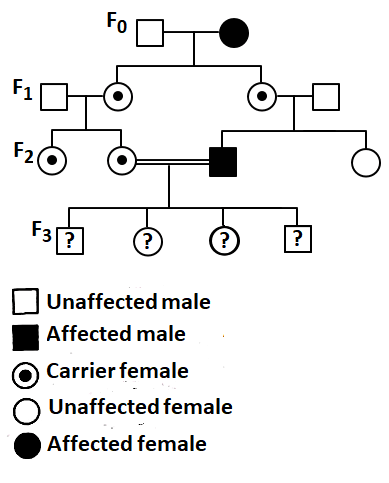
- 1/8
- Zero
- 1/4
- 1/2
Show answer
Answer: (3) 1/4
Q13 NEET 2025 Dihybrid Cross Analysis
- Phenotypic ratio - 9 : 3 : 3 : 1
- Phenotypic ratio - 9 :7
- Phenotypic ratio - 1 : 2 : 1
- Phenotypic ratio - 3 : 1
Show answer
Answer: (1) Phenotypic ratio - 9 : 3 : 3 : 1
Why: When two independently assorting genes are both inherited as heterozygotes in a dihybrid cross, the F2 phenotypic ratio is the classic 9:3:3:1, giving the four phenotypes round yellow, round green, wrinkled yellow and wrinkled green. The ratio 9:7 applies only to complementary gene interaction, and 3:1 and 1:2:1 apply to monohybrid crosses or incomplete dominance.
Principles of Inheritance and Variation NEET PYQ 2024 (20 questions)
Q14 NEET 2024 (Jhajjar) Co-dominance
- Incomplete dominance
- Multiple allele
- Pleiotropy
- Linkage
Show answer
Answer: (2) Multiple allele
Why: The ABO blood group is controlled by one gene that exists in more than two allelic forms in the population (IA, IB and i). This pattern is called multiple alleles, which is the option naming multiple alleles.
Q15 NEET 2024 (Jhajjar) Monohybrid Cross
- TT and TT
- Tt and tt
- Tt and Tt
- tt and tt
Show answer
Answer: (3) Tt and Tt
Why: Crossing two tall plants that are both heterozygous (Tt and Tt) gives offspring in a 3:1 ratio of tall to dwarf, following Mendel's monohybrid cross where tall (T) is dominant over dwarf (t). The options TT x TT and tt x tt would give no dwarf or no tall offspring respectively, and Tt x tt would give a 1:1 ratio.
Q16 NEET 2024 (Jhajjar) Dihybrid Cross Analysis
- Double homozygous
- Double heterozygous
- Homozygous for seed colour and heterozygous for flower colour.
- Heterozygous for seed colour and homozygous for flower colour.
Show answer
Answer: (2) Double heterozygous
Why: Since the progeny show four different phenotypes, the two traits must be inherited independently and the yellow seeded violet flowered parent must carry a heterozygous genotype at both loci, which is the double heterozygous condition. Yellow seed colour and violet flower colour are dominant, so this parent must have one dominant and one recessive allele for each character.
Q17 NEET 2024 (Jhajjar) Polygenic Inheritance & Pleiotropy
- Co-dominance
- Pleiotropy
- Multiple alleles
- Polygenic inheritance
Show answer
Answer: (2) Pleiotropy
Why: Pleiotropy is when one gene influences several different phenotypic traits at once. This differs from co-dominance, multiple alleles, and polygenic inheritance, which involve allele interactions or many genes.
Q18 NEET 2024 (Jhajjar) Mendelian Disorders
- Sickle cell anemia
- Phenylketonuria
- Haemophilia
- Thalassemia
Show answer
Answer: (3) Haemophilia
Why: Haemophilia is an X-linked recessive disorder, not an autosomal recessive one, because the gene for clotting factor lies on the X chromosome. Sickle cell anaemia, phenylketonuria and thalassemia are all caused by autosomal recessive alleles.
Q19 NEET 2024 (Jhajjar) Sex Determination
| Assertion (A): | In honey bee population, sons do not have fathers but have grandfathers. |
| Reason (R): | Haploidy in drones of honey bee is due to parthenogenesis while fertilisation results into female bees. |
- Both (A) and (R) are True and (R) is the correct explanation of (A).
- Both (A) and (R) are True but (R) is not the correct explanation of (A).
- (A) is True but (R) is False.
- (A) is False but (R) is True.
Show answer
Answer: (1) Both (A) and (R) are True and (R) is the correct explanation of (A).
Why: A drone develops from an unfertilised egg by parthenogenesis, so it has only a mother and no father, while the mother queen arose from a fertilised egg and so has a father who is a drone, making the drone's grandfather the queen's father. Fertilised eggs develop into diploid female bees, which is why the reason correctly explains the assertion.
Q20 NEET 2024 (Jhajjar) Mendelian Disorders
- Mental retardation
- Skin rashes
- Excessive accumulation of phenylpyruvate in blood
- Furrowed tongue
Show answer
Answer: (4) Furrowed tongue
Why: Phenylketonuria causes mental retardation, skin rashes (eczema-like skin changes), and excessive accumulation of phenylpyruvate in blood due to a faulty enzyme that converts phenylalanine to tyrosine. A furrowed tongue is not a manifestation of this disorder, so it is the incorrect option.
Q21 NEET 2024 (Jhajjar) Sex Determination
- Birds, Grasshopper, Wasp, Moth
- Grasshopper, Birds, Moth, Wasp
- Birds, Moth, Grasshopper, Wasp
- Grasshopper, Moth, Birds, Wasp
Show answer
Answer: (2) Grasshopper, Birds, Moth, Wasp
Why: The XX-XO system is found in grasshoppers, where females have two X chromosomes and males have one X with no partner. Birds use the ZZ-ZW system, in which males are ZZ and females are ZW. Moths use the ZZ-ZO system, in which males are ZZ and females carry one Z with no partner. Wasps show haplodiploidy, where males develop from unfertilised haploid eggs and females from fertilised diploid eggs.
Q22 NEET 2024 Re-exam (1,563 candidates) Polygenic Inheritance & Pleiotropy
| Statement I: | When many alleles of single gene govern a character, it is called polygenic inheritance. |
| Statement II: | In polygenic inheritance, the effect of each allele is additive |
- Statement I is True but Statement II is False
- Statement I is False but Statement II is True
- Both Statement I and Statement II are True
- Both Statement I and Statement II are False
Show answer
Answer: (2) Statement I is False but Statement II is True
Why: Statement I is false because polygenic inheritance means a character is controlled by many different genes, not many alleles of a single gene. Statement II is true because in polygenic inheritance each contributing allele adds a small effect to the final phenotype, so Statement I is false but Statement II is true.
Q23 NEET 2024 Re-exam (1,563 candidates)
| List-I Types of inheritance |
List-II Example |
||
| A. | Incomplete dominance | I. | Blood groups in human |
| B. | Co-dominance | II. | Flower colour in Antirrhinum |
| C. | Pleiotropy | III. | Skin colour in human |
| D. | Polygenic inheritance | IV. | Phenylketonuria |
- A-III,B-IV, C-II, D-I
- A-II, B-I, C-IV, D-III
- A-II,B-III, C-I, D-IV
- A-IV, B-I, C-III, D-II
Show answer
Answer: (2) A-II, B-I, C-IV, D-III
Why: Incomplete dominance is shown by flower colour in Antirrhinum, where heterozygotes have an intermediate colour. Co-dominance is seen in human blood groups, where both alleles are expressed fully, and pleiotropy is exemplified by phenylketonuria, where one gene affects several traits. Polygenic inheritance explains skin colour in humans, where many genes each add to the total effect, so the correct option pairs them in that order.
Q24 NEET 2024 Re-exam (1,563 candidates) Chromosomal Disorders
| Statement I: | Failure of segregation of chromatids during cell cycle, resulting in the gain or loss of whole set of chromosome in an organism, is known as aneuploidy. |
| Statement II: | Failure of cytokinesis after anaphase stage of cell division resulting in the gain or loss of chromosome is called polyploidy. |
- Statement I is True but Statement II is False
- Statement I is False but Statement II is True
- Both Statement I and Statement II are True
- Both Statement I and Statement II are False
Show answer
Answer: (4) Both Statement I and Statement II are False
Why: Both statements are false. Aneuploidy is the gain or loss of individual chromosomes, not of a whole set, while polyploidy is the addition of complete chromosome sets. Failure of cytokinesis after anaphase leads to polyploidy, not to the gain or loss of single chromosomes.
Q25 NEET 2024 Re-exam (1,563 candidates) Dihybrid Cross: General Consideration
(a) tall plants with round seeds and
(b) tall plants with wrinkled seeds
Identify the genotype of the parent plant:
- TtRr
- TtRR
- TTRR
- TTRr
Show answer
Answer: (4) TTRr
Why: Selfing a plant that gives both tall round and tall wrinkled offspring shows that it must be homozygous for tallness, since all progeny are tall, and heterozygous for seed shape, since round is dominant and wrinkled appears. That genotype is TTRr, which is the option listed as TTRr.
Q26 NEET 2024 Re-exam (1,563 candidates) Non - Disjunction & Aneuploidy
A. Substitution
B. Addition
C. Deletion
D. Translocation
E. Inversion
Choose the most appropriate answer from the options given below:
- C and D only
- D and E only
- A and B only
- B and C only
Show answer
Answer: (4) B and C only
Why: Aneuploidy is a change in the number of individual chromosomes, caused by addition of extra chromosomes or deletion (loss) of chromosomes from the set. Substitution, translocation and inversion are structural chromosomal changes rather than changes in chromosome number.
Q27 NEET 2024 Re-exam (1,563 candidates) Co-dominance
A. IAIA | IBi | IBi
B. IAIA | IBi | IAi
C. IB i IA IA| IA IB
D. IAIA | IBIB | IAi
E. IA | IBi | IAi
Choose the correct answer from the options given below:
- C and D
- D and A
- A and B
- B and E
Show answer
Answer: (4) B and E
Why: The correct set is mother I^A I^A, father I^B i, and child I^A i, where the mother contributes an I^A allele, the father contributes his i allele, and the child inherits both to show blood group A. This combination matches the option listing the mother as I^A I^A, the father as I^B i, and the child as I^A i, and the option giving only I^A for the mother is an incomplete genotype.
Q28 NEET 2024 Monohybrid Cross
| List-I | List-II | ||
| A. | Two or more alternative forms of a gene | I. | Back Cross |
| B. | Cross of F1 progeny with homozygous recessive parent | II. | Ploidy |
| C. | Cross of F1 progeny with any of the parents | III. | Allele |
| D. | Number of chromosome sets in plant |
IV. | Test cross |
- A-II, B-I, C-III, D-IV
- A-III, B-IV, C-I, D-II
- A-IV, B-III, C-II, D-I
- A-I, B-II, C-III, D-IV
Show answer
Answer: (2) A-III, B-IV, C-I, D-II
Why: Alleles are alternative forms of a gene (A matches III), and a test cross is the cross of an F1 progeny with the homozygous recessive parent (B matches IV). Crossing an F1 progeny back to either parent is a back cross (C matches I), and the number of chromosome sets in a plant is its ploidy (D matches II), giving option (2).
Q29 NEET 2024 Monohybrid Cross
| A: | Out of one pair of factors, one is dominant and the other is recessive. |
| B: | Alleles do not show any expression and both the characters appear as such in F2 generation. |
| C: | Factors occur in pairs in normal diploid plants. |
| D: | The discrete unit controlling a particular character is called factor. |
| E: | The expression of only one of the parental characters is found in a monohybrid cross. |
- A, C, D and E only
- B, C and D only
- A, B, C, D and E
- A, B and C only
Show answer
Answer: (1) A, C, D and E only
Why: The law of dominance rests on each character being controlled by a pair of discrete factors, one dominant and one recessive, and on only one parental character being expressed in a monohybrid cross. Factors occur in pairs in normal diploid plants, and each factor is a discrete unit controlling a particular character. The statement that alleles show no expression is wrong, because the dominant allele clearly expresses its trait.
Q30 NEET 2024 Law of Segregation and Law of Independent Assortment
- Red flowered as well as pink flowered plants
- Only pink flowered plants
- Red, Pink as well as white flowered plants
- Only red flowered plants
Show answer
Answer: (1) Red flowered as well as pink flowered plants
Why: A pink flowered plant has the genotype Rr and a red flowered plant has RR, so the cross produces progeny with genotypes RR and Rr, which are red and pink respectively. Since white flowers need two copies of the recessive allele, none appear, so option (1) Red flowered as well as pink flowered plants is correct.
Q31 NEET 2024 Monohybrid Cross: Further Understanding
- bb
- Bb
- BB/Bb
- BB
Show answer
Answer: (1) bb
Why: A test cross is done by crossing the black seeded plant with the recessive white seeded plant of genotype bb, as in option (1) bb. If all progeny are black, the test plant is BB, but if some progeny are white, the test plant must be Bb.
Q32 NEET 2024 Mendelian Disorders
| List-I | List-II | ||
| A. | Down's syndrome | I. | chromosome |
| B. | -Thalassemia | II. | chromosome |
| C. | -Thalassemia | III. | chromosome |
| D. | Klinefelter's syndrome |
IV. | chromosome |
Choose the correct answer from the options given below:
- A-II, B-III,C-IV, D-I
- A-III, B-IV,C-I, D-II
- A-IV, B-I, C-II, D-III
- A-I, B-II, C-III, D-IV
Show answer
Answer: (2) A-III, B-IV,C-I, D-II
Why: Down's syndrome is caused by an extra 21st chromosome, alpha-thalassemia is linked to the 16th chromosome, beta-thalassemia is linked to the 11th chromosome, and Klinefelter's syndrome involves an extra X chromosome.
Q33 NEET 2024 Co-dominance
| A. | |
| B. | |
| C. | |
| D. | |
| E. |
- B only
- C & B only
- D & E only
- A only
Show answer
Answer: (4) A only
Why: A child with blood group O must have the genotype ii, so both parents must each contribute an i allele. A father with blood group B must be I^B i, and a mother with blood group A must be I^A i, which matches the first option.
Principles of Inheritance and Variation NEET PYQ 2023 (11 questions)
Q34 NEET 2023 (Manipur) Monohybrid Cross: Further Understanding
| List-I (Type of cross) |
List-II (Phenotypic ratio) |
||
| (A) | Monohybrid cross | (I) | 1:1 |
| (B) | Dihybrid cross | (II) | 1:2:1 |
| (C) | Incomplete dominance | (III) | 3:1 |
| (D) | Test cross | (IV) | 9:3:3:1 |
- A-III, B-IV, C-II, D-I
- A-II, B-IV, C-III, D-I
- A-II, B-III, C-IV, D-I
- A-IV, B-III, C-I, D-II
Show answer
Answer: (1) A-III, B-IV, C-II, D-I
Why: A monohybrid cross gives a 3:1 phenotypic ratio, a dihybrid cross gives 9:3:3:1, and incomplete dominance produces a 1:2:1 ratio. A test cross, in which a heterozygote is crossed with a homozygous recessive, gives a 1:1 ratio.
Q35 NEET 2023 (Manipur) Monohybrid Cross
- 30 produced violet and 10 produced white flowers
- 20 produced violet and 20 produced white flowers.
- All 40 produced violet flowers
- All 40 produced white flowers
Show answer
Answer: (2) 20 produced violet and 20 produced white flowers.
Why: Crossing a heterozygous violet plant (Vv) with a homozygous white plant (vv) gives a test-cross ratio of 1:1, so half of the progeny are violet and half are white. Out of 40 progeny, this means 20 violet and 20 white, as stated in the 20 and 20 option.
Q36 NEET 2023 (Manipur) Mendelian Disorders: Sickle Cell Anemia
- Thalassemia
- Sickle cell anemia
- Haemophilia
- Phenylketonuria
Show answer
Answer: (2) Sickle cell anemia
Why: Sickle cell anaemia results from a single base substitution in the beta globin gene that changes the codon for glutamic acid to one for valine, producing abnormal haemoglobin. Thalassemia involves reduced synthesis of globin chains rather than this substitution.
Q37 NEET 2023 (Manipur) Dihybrid Cross: General Consideration
| 1. | 9 | 2. | 16 |
| 3. | 4 | 4. | 6 |
Show answer
Answer: option (4)
Q38 NEET 2023 (Manipur) Mendelian Disorders: Sickle Cell Anemia
| A: | There is a change in the gene for beta-globin |
| B: | In beta-globin, there is a valine in place of Lysine |
| C: | It is an example of point mutation |
| D: | In the normal gene, U is replaced by A |
Choose the correct answer from the options given below:
- (B), (C) and (D) only
- (B) and (D) only
- (A), (B) and (D) only
- (A) and (C) only
Show answer
Answer: (4) (A) and (C) only
Why: Sickle cell anaemia results from a change in the gene for beta-globin, and it is a point mutation because a single base substitution alters one codon. The amino acid change is glutamic acid to valine, not lysine to valine, and the base change is an A replaced by U in the mRNA codon (a T replaced by A in the DNA template), so the statements about valine replacing lysine and the replacement of U by A in the normal gene are incorrect. Therefore the statements about the gene change and the point mutation are the correct ones.
Q39 NEET 2023 (Manipur) Sex Determination
| A: | It is an example of female heterogamety |
| B: | Male produces two different types of gametes either with or without X chromosomes. |
| C: | Total number of chromosomes (autosomes and sex chromosomes) is same in both males and females. |
| D: | All eggs bear an additional X chromosome besides the autosomes. |
- (B) and (D) only
- (A), (C) and (D) only
- (A) only
- (A) and (C) only
Show answer
Answer: (1) (B) and (D) only
Why: Male grasshoppers are XO and females are XX, so the male is the heterogametic sex, producing sperm that either carry an X or lack it, while every egg carries an X in addition to the autosomes. Statement A is wrong because this is male heterogamety, and statement C is wrong because the male has fewer chromosomes than the female.
Q40 NEET 2023 Polygenic Inheritance & Pleiotropy
- more than two genes affecting a single character.
- presence of several alleles of a single gene controlling a single crossover.
- presence of two alleles, each of the two genes controlling a single trait.
- a single gene affecting multiple phenotypic expressions.
Show answer
Answer: (4) a single gene affecting multiple phenotypic expressions.
Why: Pleiotropy is the condition in which a single gene influences several different phenotypic characters at once, so one gene product affects multiple traits. This differs from polygenic inheritance, where several genes act on one character.
Q41 NEET 2023 Understanding Linkage
- Henking
- Thomas Hunt Morgan
- Sutton and Boveri
- Alfred Sturtevant
Show answer
Answer: (4) Alfred Sturtevant
Why: Alfred Sturtevant, a student of Thomas Hunt Morgan, used the frequency of recombination between linked gene pairs to map the relative positions of genes on a chromosome, creating the first genetic linkage map in Drosophila. Morgan supervised the work but Sturtevant is the one credited with this first use of the recombination frequency measure.
Q42 NEET 2023 Non - Disjunction & Aneuploidy
| A. | This disorder was first described by Langdon Down (1866). |
| B. | Such an individual has overall masculine development. However, the feminine development is also expressed. |
| C. | The affected individual is short statured. |
| D. | Physical, psychomotor and mental development is retarded. |
| E. | Such individuals are sterile. |
- A and E only
- A and B only
- C and D only
- B and E only
Show answer
Answer: (4) B and E only
Why: The correct statements are that affected individuals show overall masculine development with some feminine features, and that they are sterile. Klinefelter's syndrome was not first described by Langdon Down, and affected individuals are generally tall rather than short, and their physical and mental development is not typically retarded in the way described.
Q43 NEET 2023 Non - Disjunction & Aneuploidy
- Thalassemia
- Down's syndrome
- Turner's syndrome
- Klinefelter's syndrome
Show answer
Answer: (2) Down's syndrome
Why: Down's syndrome is characterised by a broad palm with a single palmar crease, also called a simian crease. This feature is not seen in thalassemia, Turner's syndrome or Klinefelter's syndrome.
Q44 NEET 2023 Pedigree Analysis: Basics


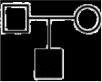
Show answer
Answer: (3) 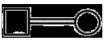
Principles of Inheritance and Variation NEET PYQ 2022 (18 questions)
Q45 NEET 2022 (Ganganagar) Mendelian Disorders: Hemophilia
| Statement I: | Sickle cell anaemia and Haemophilia are autosomal dominant traits. |
| Statement II: | Sickle cell anaemia and Haemophilia are disorders of the blood. |
In light of the above statements, choose the correct answer from the options given below :
- Both Statement I and Statement II are correct.
- Both Statement I and Statement II are incorrect.
- Statement I is correct but Statement II is incorrect.
- Statement I is incorrect but Statement II is correct.
Show answer
Answer: (4) Statement I is incorrect but Statement II is correct.
Why: Statement I is incorrect because sickle cell anaemia is an autosomal recessive trait and haemophilia is an X-linked recessive trait, not autosomal dominant. Statement II is correct because both are disorders of the blood.
Q46 NEET 2022 (Ganganagar) Chromosomal Basis of Inheritance: Introduction
- Thomas Morgan
- Sutton and Boveri
- Gregor Mendel
- Robert Brown
Show answer
Answer: (2) Sutton and Boveri
Why: The chromosomal theory of inheritance, which states that genes are located on chromosomes and that chromosomes behave in a manner that parallels Mendelian factors, was proposed independently by Sutton and Boveri. Morgan later experimentally confirmed it using Drosophila, while Mendel and Brown did not propose this theory.
Q47 NEET 2022 (Ganganagar) Non - Disjunction & Aneuploidy
- 47 chromosomes with XXY sex chromosomes
- 45 chromosomes with XO sex chromosomes
- 47 chromosomes with XYY sex chromosomes
- Trisomy of chromosome 21
Show answer
Answer: (4) Trisomy of chromosome 21
Why: The described features, including a small round head, furrowed tongue, open mouth, broad palm with a single palm crease, and developmental delay, are characteristic of Down syndrome. This condition results from an extra copy of chromosome 21, which is trisomy of chromosome 21, rather than a change in sex chromosomes.
Q48 NEET 2022 (Ganganagar) Dihybrid Cross Analysis
- 100%
- 56.25%
- 18.75 %
- 9%
Show answer
Answer: (3) 18.75 %
Why: In pea, green pod colour and constricted pod shape are recessive, while yellow pod colour and inflated shape are dominant. The phenotype combining one recessive and one dominant trait is a standard class in the classic dihybrid phenotypic ratio, and the expected proportion of that class in F2 progeny is 18.75 percent.
Q49 NEET 2022 (Ganganagar) Pedigree Analysis: Basics
 Sex unspecified
 Affected individual
 Consanguineous mating
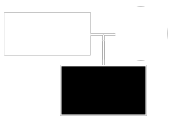 Parent with male child affected with disease
Show answer
Answer: (3) Consanguineous mating
Q50 NEET 2022 (Ganganagar) Mendelian Disorders: Hemophilia
| (a) | Haemophilic son and haemophilic daughter. |
| (b) | Haemophilic son and carrier daughter. |
| (c) | Normal daughter and normal son. |
| (d) | Normal son and haemophilic daughter. |
- (a) and (b) only
- (b) and (c) only
- (a) and (d) only
- (b) and (d) only
Show answer
Answer: (2) (b) and (c) only
Why: The girl must be a carrier, since she is normal but received the haemophilia allele from her haemophilic mother, and the man is normal. Sons can therefore be haemophilic or normal, and daughters can be carriers or normal, so a haemophilic son with a carrier daughter, and a normal daughter with a normal son, are the possible combinations. A haemophilic daughter is impossible because she would need a haemophilic father.
Q51 NEET 2022 (Abroad) Polygenic Inheritance & Pleiotropy
Select the correct statements with respect to pleiotropism:
| (a) | A gene is said to be pleiotropic if it affects more than one trait |
| (b) | Phenylketonuria is an example of pleiotropy |
| (c) | A condition where one gene has several alleles is referred to as pleiotropism |
| (d) | A trait is said to be pleiotropic if several genes control it |
Choose the correct answer from the options given below:
- (a) and (b) only
- (a) and (d) only
- (a), (b) and (c) only
- (b), (c) and (d) only
Show answer
Answer: (1) (a) and (b) only
Why: Pleiotropy is the condition in which a single gene affects more than one trait, and phenylketonuria is a classic example because one mutated gene causes multiple effects including intellectual disability and skin and hair pigmentation changes. A condition in which one gene has several alleles is multiple allelism, and a trait controlled by several genes is polygenic inheritance, so those statements do not describe pleiotropism.
Q52 NEET 2022 (Abroad) Mendelian Disorders: Hemophilia
Given below are two statements: One is labelled as Assertion (A) and the other is labelled as Reason (R)
| Assertion (A): | A father will never pass the gene for haemophilia to his sons |
| Reason (R): | Haemophilia is sex-linked (X-linked recessive trait). |
In the light of the above statements, choose the correct answer from the options given below :
- (A) is True but (R) is False.
- (A) is False but (R) is True.
- Both (A) and (R) are True and (R) is the correct explanation of (A).
- Both (A) and (R) are True but (R) is not the correct explanation of (A).
Show answer
Answer: (3) Both (A) and (R) are True and (R) is the correct explanation of (A).
Why: A father gives his single X chromosome only to his daughters and his Y chromosome to his sons, so he cannot pass an X-linked gene such as the haemophilia allele to his sons. This follows directly from haemophilia being an X-linked recessive trait, so the reason correctly explains the assertion.
Q53 NEET 2022 (Abroad) Mendelian Disorders
Match List-I with List-II
| List-I | List-II | ||
| (a) | Haemophilia | (i) | Inborn error of metabolism which lacks an enzyme that converts phenylalanine into tyrosine |
| (b) | Down's Syndrome | (ii) | Sex-linked recessive disorder; a defect in blood coagulation |
| (c) | Phenylketonuria | (iii) | Presence of additional copy of X-chromosome (44+XXY) |
| (d) | Klinefelter's Syndrome | (iv) | Additional copy of chromosome number 21 |
Choose the correct answer from the options given below:
- a-(ii), b-(iv), c-(i), d-(iii)
- a-(iv), b-(ii), c-(i), d-(iii)
- a-(ii), b-(iii), c-(i), d-(iv)
- a-(i), b-(ii), c-(iii), d-(iv)
Show answer
Answer: (1) a-(ii), b-(iv), c-(i), d-(iii)
Why: Haemophilia is a sex-linked recessive disorder in which blood clotting is defective, Down's syndrome results from an extra copy of chromosome 21, phenylketonuria is an inborn error of metabolism caused by the absence of the enzyme that converts phenylalanine to tyrosine, and Klinefelter's syndrome is caused by an extra X chromosome, giving the XXY condition.
Q54 NEET 2022 (Abroad) Polygenic Inheritance & Pleiotropy
Assuming that fur colour of an animal ranges from dark, intermediates shades, to white. A cross is made between a male (AABBCC) with dark fur colour and a female (aabbcc) with white fur colour. What would be the fur colour of F1 generation?
- All intermediate colour
- Range of colour shade
- All dark colour
- All white colour
Show answer
Answer: (1) All intermediate colour
Why: Fur colour here is controlled by polygenic inheritance with additive effects, where each dominant allele contributes equally to the darkness of the colour. Since the F1 individuals receive an equal mix of dark and white alleles from both parents, they all show an intermediate colour shade.
Q55 NEET 2022 (Abroad) Linkage
- both the sex chromosomes
- autosomes
- Y-chromosome
- X-chromosome
Show answer
Answer: (4) X-chromosome
Q56 NEET 2022 (Abroad) Linkage
- Located far apart from each other
- Located close to each other
- Not linked
- Present on different chromosomes
Show answer
Answer: (2) Located close to each other
Why: The frequency of recombination between two genes is inversely related to the distance between them on the chromosome, so a low recombination frequency means the genes are located close to each other and are therefore tightly linked. Genes that are far apart show high recombination frequency.
Q57 NEET 2022 Sex Determination
- Monkeys
- Drosophila
- Birds
- Grasshoppers
Show answer
Answer: (4) Grasshoppers
Why: XO sex determination, where males carry a single X chromosome and have no Y, occurs in grasshoppers, with the male being XO and the female XX. The other options, such as Drosophila and monkeys, use XY or other systems.
Q58 NEET 2022 Introduction to Genetics
| Statement I: | Mendel studied seven pairs of contrasting traits in pea plants and proposed the Laws of Inheritance |
| Statement II: | Seven characters examined by Mendel in his experiment on pea plants were seed shape and colour, flower colour, pod shape and colour, flower position and stem height |
In the light of the above statements, choose the correct answer from the options given below:
- Statement I is incorrect but Statement II is correct.
- Both Statement I and Statement II are correct.
- Both Statement I and Statement II are incorrect.
- Statement I is correct but Statement II is incorrect.
Show answer
Answer: (2) Both Statement I and Statement II are correct.
Why: Both statements are correct: Mendel worked with seven pairs of contrasting traits in pea plants and used these results to propose his laws of inheritance. The seven characters he examined were seed shape and colour, flower colour, pod shape and colour, flower position and stem height.
Q59 NEET 2022 Mendelian Disorders
Which of the following occurs due to the presence of autosome linked dominant trait?
- Thalessemia
- Sickle cell anaemia
- Myotonic dystrophy
- Haemophilia
Show answer
Answer: (3) Myotonic dystrophy
Why: Myotonic dystrophy is caused by an autosomal dominant allele, so a single copy of the altered gene on an autosome is enough to produce the trait. Thalassemia and sickle cell anaemia are autosomal recessive disorders, and haemophilia is an X-linked recessive disorder.
Q60 NEET 2022 Dihybrid Cross Analysis
Given below are two statements: one is labelled as Assertion (A) and the other is labelled as Reason (R).
| Assertion (A): | Mendel's law of Independent assortment does not hold good for the genes that are located closely on the same chromosome. |
| Reason (R): | Closely located genes assort independently. |
In the light of the above statements, choose the correct answer from the options given below:
- (A) is False, (R) is True.
- Both (A) and (R) are True and (R) correctly explains (A).
- Both (A) and (R) are True and (R) does not correctly explain (A).
- (A) is True, (R) is False.
Show answer
Answer: (4) (A) is True, (R) is False.
Why: Assertion is true because genes located closely on the same chromosome are linked and tend to be inherited together, so they do not assort independently as Mendel's law requires. Reason is false because closely located genes do not assort independently; that is precisely why the assertion holds.
Q61 NEET 2022 Recombination & Gene Mapping
The recombination frequency between the genes a & c is 5%, b & c is 15%, b & d is 9%, a & b is 20%, c & d is 24% and a & d is 29%. What will be the sequence of these genes on a linear chromosome?
- a, c, b, d
- a, d, b, c
- d, b, a, c
- a, b, c, d
Show answer
Answer: (1) a, c, b, d
Why: Recombination frequency is proportional to the distance between genes on a linear chromosome, so the distances must be additive. The a-c (5%) and c-b (15%) distances add up to the a-b value of 20%, and the c-b and b-d (9%) distances add up to the c-d value of 24%, which fixes the order a, c, b, d.
Q62 NEET 2022 Pedigree Analysis: More Examples
- 100%
- 25%
- 50%
- 75%
Show answer
Answer: (1) 100%
Why: A colour-blind female has two copies of the recessive allele, and the man, whose mother was colour blind, must carry that allele on his single X chromosome. All of their daughters receive a colour-blind X from the father and a colour-blind X from the mother, and all of their sons receive the colour-blind X from the mother, so 100% of the progeny are colour blind.
Principles of Inheritance and Variation NEET PYQ 2021 (2 questions)
Q63 NEET 2021 Monohybrid Cross
- Punnett square
- Net square
- Bullet square
- Punch square
Show answer
Answer: (1) Punnett square
Why: A Punnett square is the diagram used to show the gametes produced by parents, the possible zygote combinations and the resulting F1 and F2 generations in a genetic cross. The other options are not standard genetic diagrams.
Q64 NEET 2021 Mendelian Disorders: Sickle Cell Anemia
In a cross between a male and female, both heterozygous for sickle cell anaemia gene, what percentage of the progeny will be diseased?
- 25%
- 100%
- 50%
- 75%
Show answer
Answer: (1) 25%
Why: When both parents are heterozygous carriers (Hb^A Hb^S), each child has a 1 in 4 chance of inheriting two sickle cell alleles from both parents and so being diseased. Using a Punnett square with the male and female genotypes, one of the four equally likely progeny genotypes is homozygous recessive, giving 25%.
Principles of Inheritance and Variation NEET PYQ 2020 (7 questions)
Q65 NEET 2020 (Covid Re-exam) Chromosomal Basis of Inheritance: Introduction
Chromosomal theory of inheritance was proposed by:
- Sutton and Boveri
- Bateson and Punnet
- T. H. Morgan
- Watson and Crick
Show answer
Answer: (1) Sutton and Boveri
Why: The chromosomal theory of inheritance was proposed by Walter Sutton and Theodor Boveri, who independently observed that chromosomes behave in a manner parallel to the inheritance of Mendelian factors. The option naming Sutton and Boveri is correct.
Q66 NEET 2020 (Covid Re-exam) Introduction to Genetics
The number of contrasting characters studied by Mendel for his experiments was:
| 1. | 14 | 2. | 4 |
| 3. | 2 | 4. | 7 |
Show answer
Answer: option (4)
Q67 NEET 2020 (Covid Re-exam) Polygenic Inheritance & Pleiotropy
The best example of pleiotropy is:
- Skin color
- Phenylketonuria
- Colour Blindness
- ABO Blood group
Show answer
Answer: (2) Phenylketonuria
Why: Phenylketonuria is the best example of pleiotropy because a single mutated gene, which fails to produce the enzyme phenylalanine hydroxylase, causes multiple effects including severe intellectual disability, reduced hair and skin pigmentation, and a musty odour. Skin colour, colour blindness and the ABO blood group are each controlled by a gene with a single or limited effect.
Q68 NEET 2020 Chromosomal Basis of Inheritance: Introduction
Experimental verification of the chromosomal theory of inheritance was done by:
- Sutton
- Boveri
- Morgan
- Mendel
Show answer
Answer: (3) Morgan
Why: Thomas Hunt Morgan experimentally verified the chromosomal theory of inheritance using fruit flies, showing that genes are located on chromosomes through his work on sex-linked inheritance of eye colour. Sutton and Boveri proposed the theory on theoretical and cytological grounds, while Mendel's work preceded the identification of chromosomes.
Q69 NEET 2020 Mendelian Disorders: Sickle Cell Anemia
Select the correct match:
- Phenylketonuria Autosomal dominant trait
- Sickle cell anemia Autosomal recessive trait chromosome - 11
- Thalassemia X linked
- Haemophilia Y linked
Show answer
Answer: (2) Sickle cell anemia Autosomal recessive trait chromosome - 11
Why: Sickle cell anaemia is an autosomal recessive disorder caused by a mutation in the beta-globin gene, which is located on chromosome 11. The option matching sickle cell anaemia with an autosomal recessive trait and chromosome 11 is therefore correct.
Q70 NEET 2020 Monohybrid Cross
Identify the wrong statement with reference to the gene 'I' that controls ABO blood groups.
- A person will have only two of the 3 alleles.
- When IA and IB are present together, they express same type of sugar.
- Allele 'i' does not produce any sugar.
- The gene (I) has three alleles.
Show answer
Answer: (2) When IA and IB are present together, they express same type of sugar.
Why: The wrong statement is the one claiming that IA and IB produce the same type of sugar when present together. IA and IB are codominant and each directs the synthesis of a different sugar on the red blood cell surface, which is why the AB blood group displays both. The statements that the gene has three alleles, that the allele i produces no sugar, and that a person carries only two of the three alleles are correct.
Q71 NEET 2020 Introduction to Genetics
How many true-breeding pea plant varieties did Mendel select as pairs, which were similar except in one character with contrasting traits?
| 1. | 2 | 2. | 14 |
| 3. | 6 | 4. | 4 |
Show answer
Answer: option (2)
Principles of Inheritance and Variation NEET PYQ 2019 (9 questions)
Q72 NEET 2019 (Odisha) Sex Determination
| Column-I | Column-II | ||
|---|---|---|---|
| (a) | XX–XO method of sex determination | (i) | Turner’s syndrome |
| (b) | XX–XY method of sex determination | (ii) | Female heterogametic |
| (c) | Karyotype – 45 | (iii) | Grasshopper |
| (d) | ZW–ZZ method of sex determination | (iv) | Female homogametic |
Select the correct answer
- a-(ii), b-(iv), c-(i), d-(iii)
- a-(i), b-(iv), c-(ii), d-(iii)
- a-(iii), b-(iv), c-(i), d-(ii)
- a-(iv), b-(ii), c-(i), d-(iii)
Show answer
Answer: (3) a-(iii), b-(iv), c-(i), d-(ii)
Why: The XX-XO system is found in grasshoppers, so a matches iii. The XX-XY system has female homogametic individuals, so b matches iv. Karyotype 45 with XO sex chromosomes describes Turner's syndrome, so c matches i. The ZW-ZZ system has female heterogametic individuals, so d matches ii, which corresponds to the option pairing these correctly.
Q73 NEET 2019 (Odisha) Dominance Deviation from Mendel
- IA i (Male) ; IB IB (Female)
- IA IA (Male) ; IB IB (Female)
- IA IA (Male) ; IB i (Female)
- IA i (Male) ; IB i(Female)
Show answer
Answer: (1) IA i (Male) ; IB IB (Female)
Why: A child with blood group B must have received an i allele from the father, so the father must be I^A i, not I^A I^A. For the progeny to be only AB or B, with no group O, the mother must be homozygous I^B I^B, because a I^B i mother could produce an O child. The father I^A i and mother I^B I^B give offspring that are either AB or B, which is option (1).
Q74 NEET 2019 (Odisha) Sex Aneuploidy - Turner & Klinefelter Syndrome
- Thalassemia
- Klinefelter's Syndrome
- Phenylketonuria
- Turner's Syndrome
Show answer
Answer: (2) Klinefelter's Syndrome
Why: Klinefelter's Syndrome is a condition in which affected males carry an extra X chromosome, giving the karyotype XXY and three sex chromosomes in each cell. Thalassemia and Phenylketonuria are single-gene disorders, and Turner's Syndrome is caused by a single X chromosome (XO).
Q75 NEET 2019 (Odisha) Monohybrid Cross
The production of gametes by the parents the formation of zygotes, the F1 and F2 plants can be understood using
- Pie diagram
- A pyramid diagram
- Punnett square
- Wenn diagram
Show answer
Answer: (3) Punnett square
Why: A Punnett square is the standard tool for showing all possible combinations of gametes from parents and the resulting zygotes, which is how the genotypes and phenotypes of the F1 and F2 generations are predicted in monohybrid and dihybrid crosses.
Q76 NEET 2019 Sex Aneuploidy - Turner & Klinefelter Syndrome
- Down's syndrome
- Turner's syndrome
- Klinefelter's syndrome
- Edward syndrome
Show answer
Answer: (3) Klinefelter's syndrome
Why: Klinefelter's syndrome, caused by an extra X chromosome in males (XXY), results in a masculine body with gynaecomastia and sterility. Down's syndrome, Turner's syndrome and Edward syndrome are not associated with this combination of features.
Q77 NEET 2019 Sex Determination
Select the incorrect statement:
- Human males have one of their sex-chromosome much shorter than the other.
- Male fruit fly is heterogametic.
- In male grasshoppers, 50% of sperms have no sex chromosome.
- In domesticated fowls, the sex of progeny depends on the type of sperm rather than the egg.
Show answer
Answer: (4) In domesticated fowls, the sex of progeny depends on the type of sperm rather than the egg.
Why: Statement 4 is incorrect because in birds such as domesticated fowls the female is the heterogametic sex (ZW), so the egg determines the sex of the progeny, not the sperm. The other statements are correct: the Y chromosome in human males is much shorter than the X, male Drosophila is heterogametic (XY), and male grasshoppers have an XO system, so half their sperm carry no sex chromosome.
Q78 NEET 2019 Recombination & Gene Mapping
What map unit (Centimorgan) is adopted in the construction of genetic maps?
- A unit of distance between genes on chromosomes, representing 50% cross-over.
- A unit of distance between two expressed genes, representing 10% cross-over.
- A unit of distance between two expressed genes, representing 100% cross-over.
- A unit of distance between genes on chromosomes. representing 1% cross-over.
Show answer
Answer: (4) A unit of distance between genes on chromosomes. representing 1% cross-over.
Why: A centimorgan is a unit of genetic map distance between genes on a chromosome, defined so that one centimorgan corresponds to a 1% recombination (cross-over) frequency. This is the meaning given in option 4.
Q79 NEET 2019 Dominance Deviation from Mendel
In Antirrhinum (Snapdragon), a red flower was crossed with a white flower and in F1 generation, pink flowers were obtained. When pink flowers were selfed, the F2 generation showed white, red, and pink flowers. Choose the incorrect statement from the following:
- Law of Segregation does not apply in this experiment.
- This experiment does not follow the Principle of Dominance.
- The pink colour in F1 is due to incomplete dominance.
- Ratio of F2 is 1/4(red):2/4(pink):1/4(white).
Show answer
Answer: (1) Law of Segregation does not apply in this experiment.
Why: The statement that the law of segregation does not apply is incorrect, because the two alleles for flower colour still separate during gamete formation and recombine in F2 in the expected pattern. The pink F1 shows incomplete dominance, which is why there is no dominance and the F2 phenotypic ratio is 1:2:1 (red, pink, white), so options 2, 3 and 4 are correct.
Q80 NEET 2019 Linkage
The frequency of recombination between gene pairs on the same chromosome as a measure of the distance between genes was explained by:
- Sutton Boveri
- T.H. Morgan
- Gregor J. Mendel
- Alfred Sturtevant
Show answer
Answer: (4) Alfred Sturtevant
Why: Alfred Sturtevant used the frequency of recombination between linked genes on the same chromosome as a measure of the distance between them, which he used to construct the first genetic linkage maps. This is why the option naming Alfred Sturtevant is correct.
Principles of Inheritance and Variation NEET PYQ 2018 (4 questions)
Q81 NEET 2018 Sex Linked Inheritance: Introduction
A woman has an X-linked condition on one of her X chromosomes. This chromosome can be inherited by:
- Only daughters
- Only sons
- Only grandchildren
- Both sons and daughters
Show answer
Answer: (4) Both sons and daughters
Why: An X chromosome that a woman carries can be passed to any child, since a son receives her X chromosome and a daughter receives one of her two X chromosomes, so both sons and daughters can inherit it.
Q82 NEET 2018 Monohybrid Cross
- Franklin Stahl coined the term "linkage".
- Punnett square was developed by a British scientist.
- Spliceosomes take part in translation.
- Transduction was discovered by S. Altman.
Show answer
Answer: (2) Punnett square was developed by a British scientist.
Why: The Punnett square, the grid used to predict the possible genotype combinations of offspring, was devised by the British geneticist Reginald Punnett, so the option stating it was developed by a British scientist is correct.
Q83 NEET 2018 Monohybrid Cross
- Starch synthesis in pea: Multiple alleles
- ABO blood grouping: Co-dominance
- XO type sex determination: Grasshopper
- T.H Morgan: Linkage
Show answer
Answer: (1) Starch synthesis in pea: Multiple alleles
Why: Starch synthesis in pea is controlled by a single gene pair with a simple dominant-recessive relationship, not by multiple alleles, so that pairing is the wrong one. ABO blood grouping correctly illustrates co-dominance, the XO method of sex determination is found in grasshoppers, and T.H. Morgan's work established linkage.
Q84 NEET 2018 Monohybrid Cross
Which of the following characteristics represent the 'Inheritance of blood groups' in humans?
a. Dominance
b. Co-dominance
c. Multiple allelism
d. Incomplete dominance
e. Polygenic inheritance
- b, c, and e
- a, b and c
- b, d, and e
- a, c, and e
Show answer
Answer: (2) a, b and c
Why: Blood group inheritance in humans shows dominance, as the A and B alleles are dominant over the O allele in the ABO system. Co-dominance is seen when both A and B alleles are expressed equally in the AB blood group, and multiple allelism applies because three alleles (IA, IB, i) control the ABO blood group in the population.
Principles of Inheritance and Variation NEET PYQ 2017 (5 questions)
Q85 NEET 2017 Additional Note on Thalassemia
Thalassemia and sickle cell anaemia are caused due to a problem in globin molecule synthesis. Select the correct statement:
- Both are due to a quantitative defect in globin chain synthesis
- Thalassemia is due to less synthesis of globin molecules
- Sickle cell anemia is due to a quantitative problem of globin molecules
- Both are due to a qualitative defect in globin chain synthesis
Show answer
Answer: (2) Thalassemia is due to less synthesis of globin molecules
Why: Thalassemia results from reduced or absent synthesis of one or more globin chains, which is a quantitative defect, so less globin is made. Sickle cell anaemia, by contrast, arises from a point mutation that alters the structure of the beta globin chain, which is a qualitative defect, so the statement that thalassemia is due to less synthesis of globin molecules is the correct one.
Q86 NEET 2017 Monohybrid Cross
- 3 genotypes; 4 phenotypes
- 4 genotypes; 3 phenotypes
- 4 genotypes; 4 phenotypes
- 3 genotypes; 3 phenotypes
Show answer
Answer: (2) 4 genotypes; 3 phenotypes
Why: The husband I^A I^B crossed with the wife I^A i gives children with genotypes I^A I^A, I^A I^B, I^A i, I^B i, which is 4 genotypes. The phenotypes are blood groups A, AB and B, which is 3 phenotypes, since the I^A i and I^A I^A children both show group A.
Q87 NEET 2017 Mendel’s Laws of Inheritance
Which one from those given below is the period for Mendel's hybridization experiments?
- 1840-1850
- 1857-1869
- 1870-1877
- 1856-1863
Show answer
Answer: (4) 1856-1863
Q88 NEET 2017 Non - Disjunction & Aneuploidy
- Klinefelter's Syndrome
- Turner's Syndrome
- Sickle Cell Anemia
- Down's Syndrome
Show answer
Answer: (4) Down's Syndrome
Why: Down's syndrome results from non-disjunction of an autosome during meiosis, which leaves an extra copy of an autosome in the zygote. Klinefelter's and Turner's syndromes involve sex chromosome abnormalities, and sickle cell anaemia is caused by a point mutation in the gene for haemoglobin, not by chromosome non-disjunction.
Q89 NEET 2017 Introduction to Genetics
- Trichomes-Gladular or non-gladular
- Seed-green or yellow
- Pod-inflated or constricted
- Stem-Tall or Dwarf
Show answer
Answer: (1) Trichomes-Gladular or non-gladular
Why: Mendel studied seven contrasting pairs of traits in pea: seed colour (green or yellow), pod shape (inflated or constricted), and stem height (tall or dwarf), among others. Trichomes, which are hair-like outgrowths that may be glandular or non-glandular, were not among the characters he tracked.
Principles of Inheritance and Variation NEET PYQ 2016 (10 questions)
Q90 NEET 2016 Phase 2 Monohybrid Cross
A true-breeding plant is:
- one that is able to breed on its own
- produced due to cross-pollination among unrelated plants
- near homozygous and produces offspring of its own kind
- always homozygous recessive in its genetic constitution
Show answer
Answer: (3) near homozygous and produces offspring of its own kind
Why: A true-breeding plant is near homozygous for the traits concerned, so when it self-pollinates it consistently produces offspring that are like itself. Being able to breed on its own, arising from cross-pollination, or being always homozygous recessive do not define a true-breeding plant.
Q91 NEET 2016 Phase 2 Understanding Linkage
- inversion
- duplication
- translocation
- crossing-over
Show answer
Answer: (3) translocation
Why: Translocation is the transfer of a segment of one chromosome to a non-homologous chromosome, which moves a gene from one linkage group to another. Inversion reverses a segment within the same chromosome, duplication repeats a segment, and crossing-over exchanges segments between homologous chromosomes within the same linkage group.
Q92 NEET 2016 Phase 2 Sex Linked Recessive Inheritance
If a colourblind man marries a woman who is homozygous for normal colour vision, the probability of their son being colourblind is:
| 1. | 0 | 2. | 0.5 |
| 3. | 0. 75 | 4. | 1 |
Show answer
Answer: option (1)
Q93 NEET 2016 Phase 1 Monohybrid Cross
- 1:2:1 :: Tall heterozygous : Tall homozygous : Drawf
- 3:1 :: Tall : Dwarf
- 3:1:: Dwarf : Tall
- 1:2:1:: Tall homozygous : Tall heterozygous : Dwarf
Show answer
Answer: (4) 1:2:1:: Tall homozygous : Tall heterozygous : Dwarf
Q94 NEET 2016 Phase 1 Linkage
In a test cross involving F1 dihybrid flies, more parental-type offspring were produced than the recombinant type offspring. This indicates:
- chromosomes failed to separate during meiosis
- the two genes are linked and present on the same chromosome
- both of the characters are controlled by more than one gene
- the two genes are located on two different chromosomes
Show answer
Answer: (2) the two genes are linked and present on the same chromosome
Why: When parental combinations of traits outnumber recombinants in a test cross, the genes must be physically close on the same chromosome and tend to be inherited together. This matches the option stating that the two genes are linked and present on the same chromosome.
Q95 NEET 2016 Phase 1 Polygenic Inheritance & Pleiotropy
Match the terms in Column-I with their description in Column-II and choose the correct option.
| Column-I | Column-II | ||
| A. | Dominance | 1. | Many govern a single character |
| B. | Codominance | 2. | In a heterozygous organism, only one allele expresses itself |
| C. | Pleiotropy | 3. | In a heterozygous organism, both alleles express themselves fully |
| D. | Polygenic inheritance | 4. | A single gene influences many characters |
| A | B | C | D | |
| 1. | 2 | 3 | 4 | 1 |
| 2. | 4 | 1 | 2 | 3 |
| 3. | 4 | 3 | 1 | 2 |
| 4. | 2 | 1 | 4 | 3 |
Show answer
Answer: option (1)
Q96 NEET 2016 Phase 1 Mendelian Disorders: Sickle Cell Anemia
| I: | Haemophilia is a sex-linked recessive disease. |
| II: | Down’s syndrome is due to aneuploidy. |
| III: | Phenylketonuria is an autosomal recessive gene disorder. |
| IV: | Sickle cell anaemia is an X-linked recessive gene disorder |
- II and IV are correct
- I, III and IV are correct
- I, II and III are correct
- I and IV are correct
Show answer
Answer: (3) I, II and III are correct
Q97 NEET 2016 Phase 1 Non - Disjunction & Aneuploidy
- polyploidy
- somaclonal variation
- polyteny
- aneuploidy
Show answer
Answer: (1) polyploidy
Why: A telophase cell that fails to form a cell plate and has more chromosomes than normal indicates a doubling of the complete chromosome set, which is polyploidy, so the polyploidy option is correct.
Q98 NEET 2016 Phase 1 Mendelian Disorders: Hemophilia
Which of the following most appropriately describes haemophilia?
- X-linked recessive gene disorder
- Chromosomal disorder
- Dominant gene disorder
- Recessive gene disorder
Show answer
Answer: (1) X-linked recessive gene disorder
Why: Haemophilia is an X-linked recessive disorder caused by a mutation in a gene on the X chromosome that codes for a blood clotting factor. It is not a chromosomal (numerical or structural) abnormality, nor a dominant or autosomal recessive disorder.
Q99 NEET 2016 Phase 1 Mutation
Which of the following statements is not true for cancer cells in relation to mutations?
- Mutations destroy telomerase inhibitor
- Mutations inactivate the cell control
- Mutations inhibit the production of telomerase
- Mutations in proto–oncogenes accelerate the cell cycle
Show answer
Answer: (3) Mutations inhibit the production of telomerase
Why: In cancer cells, telomerase is typically activated rather than inhibited, which helps maintain telomere length and allows continued cell division. Mutations instead disable telomerase inhibitors, inactivate cell cycle control genes, and can make proto-oncogenes overactive, so the claim that mutations inhibit telomerase production is the false statement.
Principles of Inheritance and Variation NEET PYQ 2015 (12 questions)
Q100 AIPMT 2015 Re-exam Polygenic Inheritance & Pleiotropy
A pleiotropic gene:
- Is expressed only in primitive plants
- Is a gene that evolved during Pliocene
- Controls a trait only in combination with another gene
- Controls multiple traits in an individual
Show answer
Answer: (4) Controls multiple traits in an individual
Why: A pleiotropic gene is one that has multiple phenotypic effects, so a single gene controls more than one trait in an individual. This is why a mutation in such a gene can alter several characteristics at once.
Q101 AIPMT 2015 Re-exam Linkage
The term "linkage" was coined by?
- T.H. Morgan
- T.Boveri
- G.Mendel
- W.Sutton
Show answer
Answer: (1) T.H. Morgan
Why: T.H. Morgan introduced the term linkage to describe genes that are located close together on the same chromosome and tend to be inherited together. He developed this idea while studying fruit flies.
Q102 AIPMT 2015 Re-exam Dominance Deviation from Mendel
A gene showing co-dominance has?
- One allele is dominant on the other
- Alleles are tightly linked on the same chromosome
- Alleles that are recessive to each other
- Both alleles are independently expressed in the heterozygote
Show answer
Answer: (4) Both alleles are independently expressed in the heterozygote
Why: In codominance, both alleles of a gene are fully and independently expressed in the heterozygote, so neither masks the other. The ABO blood group system is a classic example, where the heterozygote with alleles IA and IB shows both A and B antigens and thus has blood group AB.
Q103 AIPMT 2015 Re-exam Introduction to Genetics
- Seed color
- Pod length
- Seed shape
- Flower position
Show answer
Answer: (2) Pod length
Why: Mendel's pea experiments studied seven traits, including seed colour, seed shape and flower position, but pod length was not one of them. The option naming pod length is therefore the one he did not use.
Q104 AIPMT 2015 Re-exam Pedigree Analysis: Basics
- Autosomal dominant
- X-linked recessive
- Autosomal recessive
- X-linked dominant
Show answer
Answer: (3) Autosomal recessive
Q105 AIPMT 2015 Re-exam Sex Linked Recessive Inheritance
- 0.5
- 1
- Nil
- 0.25
Show answer
Answer: (3) Nil
Why: Colour blindness is an X-linked recessive trait, and a son receives his X chromosome from his mother and his Y chromosome from his father. Because the colour-blind father passes his X only to daughters, a son cannot inherit the colour-blind allele from his father, so the probability of a grandson being colour blind through a son is nil.
Q106 AIPMT 2015 Dominance Deviation from Mendel
- on different chromosomes
- at different loci on the same chromosome
- at the same locus of the chromosome
- on non-sister chromatids
Show answer
Answer: (3) at the same locus of the chromosome
Why: Multiple alleles are different forms of a single gene that all occupy the same locus on a particular chromosome, so only one of them can be present in a given chromosome.
Q107 AIPMT 2015 Mendel’s Laws of Inheritance
How many pairs of contrasting characters in pea plants were studied by Mendel in his experiments?
- Five
- Six
- Eight
- Seven
Show answer
Answer: (4) Seven
Why: Mendel studied seven pairs of contrasting characters in pea plants, such as seed shape, seed colour, flower colour, pod shape, pod colour, flower position and stem height. This is the option that gives the correct number of contrasting pairs.
Q108 AIPMT 2015 Monohybrid Cross
- different phenotype
- true breeding homozygotes
- different molecular forms of a gene
- heterozygotes
Show answer
Answer: (3) different molecular forms of a gene
Q109 AIPMT 2015 Understanding Linkage
The movement of a gene from one linkage group to another is called:
- inversion
- duplication
- translocation
- crossing over
Show answer
Answer: (3) translocation
Why: Translocation is the transfer of a segment of a chromosome to a non-homologous chromosome, which moves a gene from one linkage group to another. Inversion, duplication and crossing over do not involve moving genes between different linkage groups.
Q110 AIPMT 2015 Non - Disjunction & Aneuploidy
- formation of abnormal ova in the mother
- fusion of two ova and one sperm
- fusion of two sperms and one ovum
- formation of abnormal sperms in the father
Show answer
Answer: (1) formation of abnormal ova in the mother
Why: An XXX condition arises when both X chromosomes are carried in the egg, which results from non-disjunction during the formation of the ovum in the mother, so the correct option is abnormal ova formed in the mother. Fusion of two ova or two sperms with one ovum or one sperm cannot produce this karyotype as described.
Q111 AIPMT 2015 Dominance Deviation from Mendel
- A and B
- A, B and AB
- A, B, AB and O
- Only O
Show answer
Answer: (3) A, B, AB and O
Why: A group A man can be homozygous (AA) or heterozygous (AO), and a group B woman can be BB or BO, so crossing these genotypes can produce children with groups A, B, AB and O. The correct option is A, B, AB and O.
Principles of Inheritance and Variation NEET PYQ 2014 (3 questions)
Q112 AIPMT 2014 Sex Linked Recessive Inheritance
- 25%
- 0%
- 50%
- 75%
Show answer
Answer: (3) 50%
Why: Colour blindness is a recessive X-linked trait. The man is colour blind and gives his single X to his daughters only, so his sons get their X from the mother, who is a carrier because her mother was colour blind and her father was normal. A carrier mother passes the affected X to half of her sons, so half of the male children will be colour blind.
Q113 AIPMT 2014 Epistasis
- Recessive epistasis
- Dominant epistasis
- Complementary genes
- Inhibitory genes
Show answer
Answer: (2) Dominant epistasis
Why: In squash fruit colour, a dominant allele at one gene masks the expression of alleles at a second gene, which is the defining feature of dominant epistasis. This dominant masking interaction is why the fruit colour pattern of squash is classed as dominant epistasis.
Q114 AIPMT 2014 Sex Aneuploidy - Turner & Klinefelter Syndrome
- has 45 chromosomes with XO
- has one additional chromosome.
- exhibit male character
- is able to produce children with a normal husband.
Show answer
Answer: (1) has 45 chromosomes with XO
Why: Turner's syndrome results from the absence of one X chromosome, so the individual has 45 chromosomes with the sex chromosome constitution XO. This matches the option describing 45 chromosomes with XO, while the other options describe a trisomy, male traits or fertility that do not occur in this condition.
Principles of Inheritance and Variation NEET PYQ 2013 (9 questions)
Q115 NEET 2013 (Karnataka) Sex Determination
- due to some defect like aspermia in man
- due to the genetic makeup of the particular sperm which fertilizes the egg
- due to the genetic makeup of the egg
- due to some defect in the women
Show answer
Answer: (2) due to the genetic makeup of the particular sperm which fertilizes the egg
Why: Sex in humans is determined by the chromosome carried by the sperm, since the egg always contributes an X chromosome, and a sperm carrying X or Y decides whether the zygote becomes female or male. Therefore the genetic makeup of the particular sperm that fertilises the egg is the correct explanation, and women are not responsible.
Q116 NEET 2013 (Karnataka) Mutation
- Recombination only
- Mutations as well as recombination
- Reproductive isolation and selection
- Mutations only
Show answer
Answer: (2) Mutations as well as recombination
Why: Genetic variation in a population arises from two main sources: mutations, which create new alleles, and recombination, which shuffles existing alleles into new combinations during meiosis and sexual reproduction. Reproductive isolation and selection change allele frequencies but do not create variation, and recombination or mutation alone is only part of the picture.
Q117 NEET 2013 (Karnataka) Non - Disjunction & Aneuploidy
- Three 'X' chromosomes
- Three copies of chromosome 21
- Monosomy
- Two 'Y' chromosomes
Show answer
Answer: (2) Three copies of chromosome 21
Why: Down's syndrome results from an extra copy of chromosome 21, so the individual has three copies of this chromosome instead of two. Three X chromosomes, monosomy and two Y chromosomes do not cause Down's syndrome.
Q118 NEET 2013 (Karnataka) Pedigree Analysis: Basics
- It confirms that DNA is the carrier of genetic information
- It helps to understand whether the trait in question is dominant or recessive
- It confirms that the trait is linked to one of the autosomes
- It helps to trace the inheritance of a specific trait
Show answer
Answer: (1) It confirms that DNA is the carrier of genetic information
Why: Pedigree analysis traces the inheritance of a particular trait through generations of a family, helping to determine whether it is dominant or recessive and whether it is linked to an autosome or sex chromosome. It does not confirm that DNA is the carrier of genetic information, which was established by separate experiments, so option 1 is the incorrect statement.
Q119 NEET 2013 Mendelian Disorders: Hemophilia
The incorrect statement with regard to Haemophilia is:
- It is a recessive disease
- It is a dominant disease
- A single protein involved in the clotting of blood is affected
- it is a sex-linked disease.
Show answer
Answer: (2) It is a dominant disease
Why: Haemophilia is a recessive X-linked disorder in which a single clotting protein, such as factor VIII or IX, is defective, so it is not a dominant disease. The statement that it is dominant is therefore the incorrect one.
Q120 NEET 2013 Dominance Deviation from Mendel
- Incomplete dominance
- Partial dominance
- Complete dominance
- Codominance
Show answer
Answer: (4) Codominance
Why: In AB blood group individuals both A and B antigens are expressed fully and equally on the red blood cells, and electrophoresis detects both types of protein together. This simultaneous expression of two alleles without blending is codominance.
Q121 NEET 2013 Dominance Deviation from Mendel
Show answer
Answer: option (3)
Q122 NEET 2013 Mendelian Disorders: Thalassemia
- 50%
- 25 %
- 100%
- no chance
Show answer
Answer: (2) 25 %
Why: Thalassemia is autosomal recessive, so when both parents are carriers each child has a one in four chance of inheriting two defective alleles and being affected. This is the Mendelian monohybrid cross result of 25 percent, the value given in option (2).
Q123 NEET 2013 Recombination Gene Mapping
Which of the following statements is not true of two genes that show 50% recombination frequency?
- The genes are tightly linked.
- The genes show independent assortment.
- If the genes are present on the same chromosome, they undergo more than one crossing-over in every meiosis.
- The genes may be on different chromosomes.
Show answer
Answer: (1) The genes are tightly linked.
Why: A recombination frequency of 50% indicates that the genes assort independently, as expected for unlinked genes that are either on different chromosomes or far apart on the same chromosome, so they are not tightly linked. The statement claiming they are tightly linked is therefore the one that is not true.
Principles of Inheritance and Variation NEET PYQ 2012 (4 questions)
Q124 AIPMT 2012 Mains Monohybrid Cross: Further Understanding
A test cross is carried out to:
- Predict whether two traits are linked
- Assess the number of alleles of a gene
- Determine whether two species or varieties will breed successfully
- Determine the genotype of a plant at F2
Show answer
Answer: (4) Determine the genotype of a plant at F2
Why: A test cross is an organism of unknown genotype crossed with a homozygous recessive individual, and the phenotypic ratio of the offspring reveals the genotype of the unknown parent. Because of this, it is used to determine the genotype of a plant at the F2 generation (or any generation) rather than to assess linkage, allele number, or breeding compatibility.
Q125 AIPMT 2012 Mains Mendelian Disorders: Hemophilia
Represented below is the inheritance pattern of a certain type of traits in humans. Which one of the following conditions could be an example of this pattern?
- Sickle cell anemia
- Haemophilia
- Thalassemia
- Phenylketonuria
Show answer
Answer: (2) Haemophilia
Q126 AIPMT 2012 Monohybrid Cross
- Co-dominance
- Dihybrid crosses
- Monohybrid crosses with complete dominance
- Monohybrid crosses with incomplete dominance
Show answer
Answer: (4) Monohybrid crosses with incomplete dominance
Why: In incomplete dominance the heterozygote shows an intermediate phenotype, so the phenotypic ratio equals the genotypic ratio of 1:2:1 in a monohybrid F2 cross. Under complete dominance the phenotypic ratio would differ from the genotypic ratio, so the incomplete dominance option is correct.
Q127 AIPMT 2012 Sex Linked Recessive Inheritance
- 100%
- 0%
- 25%
- 50%
Show answer
Answer: (2) 0%
Why: The man has normal colour vision, so his single X chromosome carries the normal allele, and he passes his X to every daughter. The daughter therefore receives a normal X from her father, and since the colour-blindness allele is recessive and she gets a normal allele from him, she cannot be colour blind. Her chance of being colour blind is therefore 0%.
Principles of Inheritance and Variation NEET PYQ 2011 (1 question)
Q128 AIPMT 2011 Sex Determination
Which one of the following conditions correctly describes the manner of determining the sex in the given example?
- XO type of sex chromosomes determines male sex in grasshopper
- XO condition in humans as found in Turner syndrome, determines female sex
- Homozygous sex chromosomes (XX) produce males in Drosophila
- Homozygous sex chromosomes (ZZ) determine the female sex in birds.
Show answer
Answer: (1) XO type of sex chromosomes determines male sex in grasshopper
Why: In grasshoppers the sex is determined by the number of sex chromosomes rather than by a Y chromosome. Males carry a single X chromosome with no partner (XO), while females carry two X chromosomes (XX), so the XO condition in grasshopper produces males.
Principles of Inheritance and Variation NEET PYQ 2010 (5 questions)
Q129 AIPMT 2010 Dominance Deviation from Mendel
- Three
- One
- Four
- Two
Show answer
Answer: (3) Four
Why: The three alleles I^A, I^B and i combine to give six genotypes, but the phenotypes are only the four blood groups A, B, AB and O. I^A and I^B are both dominant over i, and I^A and I^B are codominant, so I^A i gives group A, I^B i gives group B, I^A I^B gives group AB, and ii gives group O.
Q130 AIPMT 2010 Dominance Deviation from Mendel
Which one of the following cannot be explained on the basis of Mendel's Law of Dominance?
- The discrete unit controlling a particular character is called a factor.
- Out of one pair of factors, one is dominant, and the other recessive.
- Alleles do not show any blending and both the characters recover as such in the F2 generation.
- Factors occur in pairs.
Show answer
Answer: (3) Alleles do not show any blending and both the characters recover as such in the F2 generation.
Why: Mendel's Law of Dominance explains that one allele of a pair masks the other in the heterozygote and that only the dominant trait appears in the F1, with the recessive trait reappearing in the F2 generation. The statement that alleles show no blending and both characters recover in F2 describes the Law of Segregation/Purity of Gametes, which concerns independent recovery of the parental traits, rather than dominance. The other three statements (factors, dominant and recessive pairs, and factors occurring in pairs) are direct features of dominance.
Q131 AIPMT 2010 Monohybrid Cross: Further Understanding
- test cross
- dihybrid cross
- pedigree analysis
- back cross
Show answer
Answer: (1) test cross
Why: A test cross, in which the plant showing the dominant phenotype is crossed with a homozygous recessive plant, reveals whether it is homozygous dominant or heterozygous by the ratio of offspring. Dihybrid cross, pedigree analysis and back cross do not directly determine the genotype of a single dominant plant in this way.
Q132 AIPMT 2010 Dihybrid Cross Analysis
Select the correct statement from the ones given below with respect to dihybrid cross:
- Tightly linked genes on the same chromosome show higher recombinations
- Genes far apart, on the same chromosome, show very few recombinations
- Genes loosely linked, on the same chromosome, show similar recombinations as the tightly linked ones
- Tightly linked genes on the same chromosome show very few recombinations
Show answer
Answer: (4) Tightly linked genes on the same chromosome show very few recombinations
Why: Tightly linked genes on the same chromosome lie close together and so rarely cross over during meiosis, which produces very few recombinants. This is why the correct statement is that tightly linked genes show very few recombinations.
Q133 AIPMT 2010 Pedigree Analysis: Basics
Which one of the following symbols and its representation, used in the human pedigree analysis is correct?
 = Mating between relatives
 = Unaffected male
 = Unaffected female
 = male affected
Show answer
Answer: (1) = Mating between relatives
Principles of Inheritance and Variation NEET PYQ 2009 (4 questions)
Q134 AIPMT 2009 Pedigree Analysis: Problem Solving
Study the pedigree chart given below:
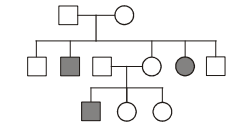
What does it show?
- Inheritance of a sex-linked inborn error of metabolism
- Inheritance of a condition like phenylketonuria as an
autosomal recessive trait - The pedigree chart is wrong as this is not possible
- Inheritance of a recessive sex-linked disease like
haemophilia
Show answer
Answer: (2) Inheritance of a condition like phenylketonuria as an
autosomal recessive trait
Q135 AIPMT 2009 Mendelian Disorders: Sickle Cell Anemia
Sickle cell anaemia is:
- an autosomal linked dominant trait
- caused by substitution of valine by glutamic acid
in the globin chain of haemoglobin - caused by a change in base pair of DNA
- characterized by elongated sickle like RBCs with
a nucleus
Show answer
Answer: (3) caused by a change in base pair of DNA
Why: Sickle cell anaemia is caused by a single base pair change in the DNA of the beta globin gene. This changes one codon so that glutamic acid is replaced by valine in the globin chain of haemoglobin.
Q136 AIPMT 2009 Mutation
Point mutation involves:
- insertion
- change in single base pair
- duplication
- deletion
Show answer
Answer: (2) change in single base pair
Why: A point mutation is a change affecting a single base pair of DNA, such as a substitution of one nucleotide for another. This is the option describing a change in a single base pair, whereas insertion, duplication and deletion involve addition or loss of longer stretches of nucleotides.
Q137 AIPMT 2009 Sex Linked Inheritance: Introduction
Select the incorrect statement from the following:
- linkage is an exception to the principle of
independent assortment in heredity - galactosemia is an inborn error of metabolism
- small population size result in random genetic
drift in a population - baldness is a sex-limited trait
Show answer
Answer: (4) baldness is a sex-limited trait
Why: Baldness is a sex-influenced trait, not a sex-limited trait, because its expression is influenced by sex hormones and it is more common in males, whereas sex-limited traits are expressed only in one sex. Option (4) is therefore the incorrect statement. The other statements about linkage, galactosemia as an inborn error of metabolism and genetic drift in small populations are correct.
Principles of Inheritance and Variation NEET PYQ 2008 (1 question)
Q138 AIPMT 2008 Sex Aneuploidy - Turner & Klinefelter Syndrome
Which one of the following conditions in humans is correctly matched with its chromosomal abnormality/linkage?
- Klinefelter's syndrome-44 autosomes + XXY
- Colourblindness – Y-linked
- Erythroblastosis foetalis-- X-linked
- Down syndrome--44 autosomes + XO
Show answer
Answer: (1) Klinefelter's syndrome-44 autosomes + XXY
Why: Klinefelter's syndrome results from an extra X chromosome in males, giving 44 autosomes plus XXY sex chromosomes. This karyotype correctly matches the condition named in the first option.
Principles of Inheritance and Variation NEET PYQ 2007 (6 questions)
Q139 AIPMT 2007 Dihybrid Cross Analysis
- higher number of the recombinant types
- segregation in the expected 9:3:3:1 ratio
- segregation in a 3:1 ratio
- higher number of the parental types
Show answer
Answer: (4) higher number of the parental types
Why: Since R and Y are closely linked on the same chromosome and the parents are RRYY and rryy, the F1 carries both dominant alleles on one chromosome and both recessive alleles on the other. Crossing over between such close genes is rare, so most F2 progeny inherit the parental combinations, which is why option (4), a higher number of parental types, is correct.
Q140 AIPMT 2007 Dihybrid Cross: Details
- AaBb
- AaBB
- AABb
- AABB
Show answer
Answer: (1) AaBb
Why: Sperm with the combinations AB, Ab, aB and ab in equal proportions arise only when the two genes assort independently and the man is heterozygous at both loci. Such a person has genotype AaBb, which is option (1).
Q141 AIPMT 2007 Non - Disjunction & Aneuploidy
- n=7 and x=21
- n=21 and x=21
- n=21 and x=14
- n=21 and x=7
Show answer
Answer: (4) n=21 and x=7
Why: The basic number x is the number of chromosomes in one monoploid genome set, and the haploid number n is the number of chromosomes in a gamete, which equals x multiplied by the ploidy level of the species. In hexaploid wheat the option stating n equals 21 and x equals 7 is consistent with this relationship.
Q142 AIPMT 2007 Monohybrid Cross: Further Understanding
- crossing of one F2 progeny with a male parent
- crossing of one F2 progeny with a female parent
- studying the sexual behaviour of F1 progenies
- crossing of one F1 progeny with a male parent
Show answer
Answer: (4) crossing of one F1 progeny with a male parent
Why: A test cross is used to determine the genotype of a hybrid, and it involves crossing the F1 progeny with a homozygous recessive parent. Crossing the F1 progeny with a male parent, as described in the correct option, is the procedure used for this test, and the offspring ratios reveal whether the hybrid is homozygous or heterozygous.
Q143 AIPMT 2007 Monohybrid Cross: Further Understanding
- 50:50
- 9:1
- 1:3
- 3:1
Show answer
Answer: (1) 50:50
Why: Yellow is dominant, so a heterozygous yellow plant (Yy) crossed with a green plant (yy) is a test cross. Half of the offspring receive the dominant allele and are yellow, while the other half receive two recessive alleles and are green, giving the 50:50 ratio of yellow to green seeded plants.
Q144 AIPMT 2007 Polygenic Inheritance & Pleiotropy
Inheritance of skin colour in humans is an example of:
- chromosomal aberration
- point mutation
- polygenic inheritance
- codominance
Show answer
Answer: (3) polygenic inheritance
Why: Human skin colour is controlled by several independent genes, each contributing a small additive effect to the amount of melanin produced, which gives a continuous range of shades. This pattern of many genes acting together is called polygenic inheritance.
Principles of Inheritance and Variation NEET PYQ 2006 (11 questions)
Q145 AIPMT 2006 Dihybrid Cross Analysis
- Three
- Four
- Nine
- Two
Show answer
Answer: (4) Two
Why: The genotype AABbCC has two heterozygous-free gene pairs (AA and CC are homozygous) and one heterozygous pair (Bb), so the number of gamete types equals 2 raised to the number of heterozygous pairs, which is 2 to the power 1. This gives two kinds of gametes, namely ABC and ABC with b, i.e. AB C and A b C.
Q146 AIPMT 2006 Introduction to Genetics
- mutations and linkages
- cytoplasmic effects and nutrition
- environmental changes and sexual dimorpgism
- genotype and environment interactions
Show answer
Answer: (4) genotype and environment interactions
Why: The phenotype is the observable expression of traits, and it arises from the genotype acting within a given environment, so both the inherited genetic makeup and environmental influences jointly determine it. This genotype-environment interaction is the correct explanation, while the other options name only single factors or unrelated effects.
Q147 AIPMT 2006 Monohybrid Cross: Further Understanding
Test cross involves:
- crossing between two genotypes with recessive trait
- crossing between two F1 hybrids
- crossing the F1 hybrid with a double recessive genotype
- crossing between two genotypes with the trait
Show answer
Answer: (3) crossing the F1 hybrid with a double recessive genotype
Why: A test cross is made by crossing the F1 hybrid with a double recessive genotype, which is the option describing that cross. Because the recessive parent contributes only recessive alleles, the phenotypes of the offspring reveal the genotype of the hybrid parent directly.
Q148 AIPMT 2006 Chromosomal Basis of Inheritance: Introduction
- Moist bread
- Agar agar
- Ripe banana
- Cow dung
Show answer
Answer: (3) Ripe banana
Why: Ripe banana is the most suitable culture medium for Drosophila melanogaster because it is soft, moist, rich in sugars and nutrients, and supports rapid growth of the larvae and yeast that they feed on. Its natural fermenting quality also attracts the flies for breeding in laboratory culture.
Q149 AIPMT 2006 Introduction to Genetics
In Mendel's experiments with garden peas, round seed shape (RR) was dominant over wrinkled seeds (rr), and yellow cotyledon (YY) was dominant over green cotyledon (yy). What are the expected phenotypes in the F2 generation of the cross RRYY x rryy?
- Only round seeds with green cotyledons
- Only wrinkled seeds with yellow cotyledons
- Only wrinkled seeds with green cotyledons
- Round seeds with yellow cotyledons and wrinkled
seeds with yellow cotyledons
Show answer
Answer: (4) Round seeds with yellow cotyledons and wrinkled
seeds with yellow cotyledons
Why: The F1 of the cross RRYY x rryy is all round and yellow (RrYy), and when these self-pollinate the F2 segregates into round and wrinkled seeds with yellow and green cotyledons in all combinations. Because the F2 also contains green-cotyledon seeds, option (4), which lists only yellow-cotyledon phenotypes, is incomplete for this cross as stated, so the question's keyed answer does not fully match standard Mendelian expectations.
Q150 AIPMT 2006 Mendelian Disorders: Sickle Cell Anemia
- bacteria-related diseases.
- congenital disorders
- pollutant-induced disorders
- virus-related diseases
Show answer
Answer: (2) congenital disorders
Why: Sickle cell anaemia and Huntington's chorea are both inherited genetic disorders caused by mutations passed from parents, so they are classed as congenital disorders. Neither is caused by bacteria, viruses, or pollutants.
Q151 AIPMT 2006 Sex Determination
- Autosomal
- Cytoplasmic
- Y-linked
- X-linked
Show answer
Answer: (2) Cytoplasmic
Why: Cytoplasmic inheritance is transmitted through the egg's cytoplasm, which carries mitochondria and chloroplasts, so the offspring show the maternal phenotype and the maternal influence is strongest. Autosomal, Y-linked and X-linked inheritance all involve nuclear chromosomes contributed equally by both parents, or are paternal in the case of Y-linked genes.
Q152 AIPMT 2006 Mendelian Disorders: Sickle Cell Anemia
- It is controlled by recessive genes
- It is not a fatal disease
- It provides immunity against malaria
- It is controlled by dominant genes
Show answer
Answer: (3) It provides immunity against malaria
Why: Individuals who are heterozygous carriers of the sickle cell allele have resistance to malaria, so the allele is maintained in populations where malaria is common. Homozygous individuals who have the disease are selected against, but the carriers' advantage keeps the allele from being eliminated.
Q153 AIPMT 2006 Polygenic Inheritance & Pleiotropy
- Flower colour in Mirabilis jalapa
- Production of male honey bee
- Pod shape in garden pea
- Skin colour in humans
Show answer
Answer: (4) Skin colour in humans
Why: Skin colour in humans is controlled by several genes acting together, each contributing a small additive effect, which produces a continuous range of shades. This is the defining feature of polygenic inheritance, unlike flower colour in Mirabilis jalapa or pod shape in garden pea, which follow simple Mendelian patterns with one gene controlling the trait.
Q154 AIPMT 2006 Sex Linked Recessive Inheritance
- all normal visioned
- one-half colourblind and one-half normal
- three-fourths colourblind and one-fourth normal
- all colourblind
Show answer
Answer: (4) all colourblind
Why: The colourblind allele is recessive and X-linked, so the mother carries it on both of her X chromosomes. Each son receives his only X chromosome from her and therefore inherits the colourblind allele, making all sons colourblind, as stated in option (4).
Q155 AIPMT 2006 Non - Disjunction & Aneuploidy
Cri-du-chat syndrome in humans is caused by the:
- fertilization of an XX egg by a normal y-bearing sperm
- loss of half of the short arm of chromosome 5
- loss of half of the long arm of chromosome 5
- trisomy of 21st chromosome
Show answer
Answer: (2) loss of half of the short arm of chromosome 5
Why: Cri-du-chat syndrome results from a deletion of part of the short arm of chromosome 5, which is the loss described in option (2). The deletion causes the characteristic cat-like cry and other developmental features.
Frequently asked questions
How many Principles of Inheritance and Variation questions have been asked in NEET?
This archive holds 155 Principles of Inheritance and Variation questions from 33 of 33 official NEET and AIPMT papers, 2006–2026. It counts every paper held here, including re-exam and regional papers.
Which topics of Principles of Inheritance and Variation are asked most often?
By topic tag: Monohybrid Cross (15), Sex Determination (12), Polygenic Inheritance & Pleiotropy (12), Non - Disjunction & Aneuploidy (12) and Dominance Deviation from Mendel (11).
When was Principles of Inheritance and Variation last asked?
The most recent paper in this archive with a question from this chapter is Re-NEET 2026.
Where do the answers come from?
Each answer is the option recorded as correct in the official answer key for that paper. Where a short explanation is shown, it was written separately and checked against the key; it is not part of the official paper. Questions marked NEET 2026 (3 May, cancelled) are from the cancelled first sitting: NTA issued no final key for it, so their answers are the key on record and have not been matched to an official key.
More Biology chapter-wise PYQs
← Sexual Reproduction in Flowering Plants Molecular Basis of Inheritance →
Botany, Class 11
- The Living World (25)
- Biological Classification (90)
- Plant Kingdom (88)
- Morphology of Flowering Plants (120)
- Anatomy of Flowering Plants (83)
- Cell: The Unit of Life (125)
- Cell Cycle and Cell Division (84)
- Photosynthesis in Higher Plants (69)
- Respiration in Plants (42)
- Plant Growth and Development (71)
Old syllabus (archive)
- Transport in Plants (39)
- Mineral Nutrition (49)
- Reproduction in Organisms (22)
- Environmental Issues (80)
- Digestion and Absorption (45)
Botany, Class 12
- Sexual Reproduction in Flowering Plants (118)
- Molecular Basis of Inheritance (172)
- Strategies for Enhancement in Food Production (36)
- Microbes in Human Welfare (66)
- Organisms and Populations (86)
- Ecosystem (87)
- Biodiversity and Conservation (86)
Zoology, Class 11
- Animal Kingdom (109)
- Structural Organisation in Animals (90)
- Biomolecules (100)
- Breathing and Exchange of Gases (56)
- Body Fluids and Circulation (68)
- Excretory Products and their Elimination (54)
- Locomotion and Movement (58)
- Neural Control and Coordination (53)
- Chemical Coordination and Integration (76)
Zoology, Class 12
- Human Reproduction (109)
- Reproductive Health (67)
- Evolution (101)
- Human Health and Disease (100)
- Biotechnology: Principles and Processes (118)
- Biotechnology and its Applications (101)
Want more than past papers? Practise all 2,449 Principles of Inheritance and Variation questions on NEETprep.