Principles of Inheritance and Variation (Class 12 Botany) has had 155 questions in 33 of the 33 official NEET and AIPMT papers from 2006 to 2026, and 43 in the last 10 main papers (2017 to 2026). The most-asked topics are Monohybrid Cross (15), Sex Determination (12) and Polygenic Inheritance & Pleiotropy (12). This page has a short guide to the chapter and its 12 most recent past-paper questions as a quiz you can take here, with the official answers and no login.
Start the 12-question quiz All 155 Principles of Inheritance and Variation PYQs Timed chapter test
What Principles of Inheritance and Variation covers
Principles of Inheritance and Variation covers how traits pass from parents to offspring: Mendelian crosses, deviations such as incomplete dominance and co-dominance, sex determination, linkage, sex-linked disorders, and chromosomal disorders. In the archive this chapter has 155 questions across the years 2006 to 2026, appearing in every one of the 33 official NEET and AIPMT papers.
Questions have concentrated on sex determination, polygenic inheritance and pleiotropy, and non-disjunction and aneuploidy, with monohybrid crosses also prominent. In the recent main papers from 2017 to 2026 there were 43 questions, and the most recent paper with a question from this chapter is Re-NEET 2026. The emphasis is on applying Mendelian ratios and reading pedigrees and karyotypes.
High-yield topics in Principles of Inheritance and Variation
Ranked by the number of past-paper questions carrying each topic tag.
- Sex Determination (12 PYQs): Learn the chromosome basis of sex in humans, birds and honey bees, and be able to work out the expected sex ratio of offspring from a given cross.
- Polygenic Inheritance & Pleiotropy (12 PYQs): Understand how several genes can shape one trait, and how a single gene can affect many traits, using the examples given in the syllabus.
- Non - Disjunction & Aneuploidy (12 PYQs): Know how failure of chromosomes to separate during meiosis produces Down's, Turner's and Klinefelter's syndromes, and recognise the karyotype of each.
- Mendelian Disorders: Sickle Cell Anemia (10 PYQs): Know the single gene basis of sickle cell anaemia, its pattern of inheritance in families, and how carriers differ from affected individuals.
- Monohybrid Cross: Further Understanding (10 PYQs): Go beyond the basic ratio to test-cross reasoning, back-crosses and identifying genotypes from phenotypes in single gene crosses.
- Dihybrid Cross Analysis (8 PYQs): Work through crosses involving pairs of genes by independent assortment, checking expected phenotype ratios and how linkage would alter them.
Common mistakes in Principles of Inheritance and Variation
- Students often treat incomplete dominance as ordinary dominance, so heterozygotes are scored as one parent's phenotype. Check whether the heterozygote shows a blended or intermediate trait before writing the ratio.
- Mixing up sex-linked and autosomal inheritance leads to wrong ratios. Always state which chromosome carries the gene and whether the trait is affected in males or females before solving the cross.
- Confusing crossing over with independent assortment makes linkage problems look like free assortment. Ask whether the genes lie on the same chromosome; if they are close, recombinants will be fewer than expected.
- Writing karyotypes without checking the sex chromosomes is a frequent slip. Write the full chromosome complement, count the sex chromosomes separately, and confirm the syndrome against the given sex and phenotype.
How to practise Principles of Inheritance and Variation
- Start by revising the basic Mendelian ratios and definitions from the NCERT chapter, writing each cross out fully with gametes, a Punnett square and phenotype ratio.
- Next, work through deviation problems such as incomplete dominance, co-dominance and blood group inheritance, saying aloud why each ratio differs from the classic pattern.
- Then practise linkage, sex-linked and chromosomal disorder questions, drawing pedigrees and karyotypes by hand so you can recognise patterns quickly under timed conditions.
- Finally, do timed sets from past papers and review every wrong answer, noting whether the mistake was in genetics reasoning, arithmetic or reading the question.
Principles of Inheritance and Variation NEET MCQs: 12 most recent PYQs
Click an option to check it. The correct option and the answer appear at once; nothing is stored or sent.
Q1 Re-NEET 2026 Mendel’s Laws of Inheritance
| Assertion (A): | In an experiment, Mendel observed that the F1 progeny plants are all tall and none are dwarf. |
| Reason (R): | Stem height is a contrasting trait, with tall being dominant and dwarf being recessive. |
- (A) is not correct but (R) is correct
- Both (A) and (R) are correct and (R) is the correct explanation of (A)
- Both (A) and (R) are correct but (R) is not the correct explanation of (A)
- (A) is correct but (R) is not correct
Answer: (2) Both (A) and (R) are correct and (R) is the correct explanation of (A)
Why: All F1 plants are tall because tall is the dominant trait and dwarf is recessive, so a single dominant allele is enough to express tallness. The reason correctly explains why the assertion's observation occurs, so both statements are correct and the reason is the explanation.
Q2 Re-NEET 2026 Dihybrid Cross Analysis
- Father: and Mother:
- Father: and Mother:
- Father: and Mother:
- Father: and Mother:
Answer: (1) Father: and Mother:
Why: A child with blood group O must receive the i allele from both parents, so the parents must each carry an i allele. The father with genotype IAIB has no i allele, so no child from that pairing can be group O, which makes this the impossible combination. The other three pairings each contain an i allele in both parents, so a group O child is possible.
Q3 Re-NEET 2026 Chromosomal Disorders
| Statement I: | Down's syndrome is caused by the absence of one of the X-chromosomes. |
| Statement II: | Turner's syndrome is caused by the presence of an additional copy of the chromosomes. |
- Statement I is incorrect but Statement II is correct
- Both Statement I and Statement II are correct
- Both Statement I and Statement II are incorrect
- Statement I is correct but Statement II is incorrect
Answer: (3) Both Statement I and Statement II are incorrect
Q4 NEET 2026 (3 May, cancelled) Mendelian Disorders: Sickle Cell Anemia
- Haemophilia
- Thalassemia
- Sickle-cell anaemia
- Phenylketonuria
Answer: (3) Sickle-cell anaemia
Why: Sickle-cell anaemia results from a single base change that replaces glutamic acid with valine in the beta globin chain of haemoglobin, producing abnormal sickle-shaped red blood cells. Haemophilia, thalassemia and phenylketonuria have different causes and do not involve this substitution.
Q5 NEET 2026 (3 May, cancelled)
| List-I | List-II | ||
| A. | Incomplete dominance | I. | Human skin colour |
| B. | Co-dominance | II. | Inheritance of flower colour in Antirrhinum sp. |
| C. | Pleiotropy | III. | Phenylketonuria disease in humans |
| D. | Polygenic inheritance | IV. | ABO blood groups |
- A-II, B-IV, C-III, D-I
- A-I, B-III, C-II, D-IV
- A-II, B-I, C-III, D-IV
- A-I, B-IV, C-III, D-II
Answer: (1) A-II, B-IV, C-III, D-I
Why: Incomplete dominance is seen in flower colour inheritance in Antirrhinum, where heterozygotes show an intermediate phenotype, so A matches II. Co-dominance is shown by the ABO blood groups, where both alleles are expressed fully in the heterozygote, so B matches IV. Pleiotropy, where one gene affects several traits, is exemplified by phenylketonuria, so C matches III. Polygenic inheritance, where many genes act together to give a continuous range of phenotypes such as human skin colour, matches D with I.
Q6 NEET 2026 (3 May, cancelled) Sex Determination
| A. | An offspring formed from the union of a sperm and an egg, develops as a female (queen or worker). |
| B. | An unfertilized egg develops as a male by parthenogenesis. |
| C. | A male has half the number of chromosomes than that of a female. |
| D. | Males produce sperm by meiosis. |
| E. | Honeybees have a haplodiploid sex-determination system. |
- B, C, D and E only
- A, B, C and D only
- A, B, D and E only
- A, B, C and E only
Answer: (4) A, B, C and E only
Why: In honeybees, a fertilised egg develops into a female (queen or worker) and an unfertilised egg develops into a male by parthenogenesis, so A and B are true. Males are haploid and so have half the chromosome number of females, and the system is haplodiploid, so C and E are true. Males produce sperm by mitosis rather than meiosis, so statement D is false.
Q7 NEET 2026 (3 May, cancelled) Mendelian Disorders: Sickle Cell Anemia
- CAG
- GUG
- AUG
- GAG
Answer: (2) GUG
Why: In sickle cell anaemia, the sixth codon of the beta globin gene changes from GAG, which codes for glutamic acid, to GUG, which codes for valine. This single substitution makes haemoglobin polymerise under low oxygen and distorts red blood cells into a sickle shape.
Q8 NEET 2026 (3 May, cancelled) Polygenic Inheritance & Pleiotropy
- 50%
- 0%
- 75%
- 25%
Answer: (4) 25%
Why: An O child needs to receive the recessive i allele from both parents. The mother, heterozygous for A, has IA i, and the father, heterozygous for B, has IB i, so each parent passes i with a probability of one half, and the combined probability is the product of these two independent chances, which equals 25%.
Q9 NEET 2026 (3 May, cancelled) Sex Determination
- all males
- all females
- females and males, respectively
- males and females, respectively
Answer: (4) males and females, respectively
Why: In grasshoppers the sex determination is of the XX-XO type, where males have one fewer sex chromosome than females. So the members with 23 chromosomes are males and those with 24 chromosomes are females, which matches the option males and females, respectively.
Q10 NEET 2026 (3 May, cancelled) Sex Determination
- Male honeybees
- Male grasshoppers
- Male earthworms
- Male frogs
Answer: (1) Male honeybees
Why: In male honeybees (drones), the cells are haploid because they develop parthenogenetically from unfertilised eggs, and they produce sperm by mitotic division without meiosis, so the option naming male honeybees is correct.
Q11 NEET 2025 Polygenic Inheritance & Pleiotropy
What is the pattern of inheritance for polygenic traits?
- Autosomal dominant pattern
- X-linked recessive inheritance pattern
- Mendelian inheritance pattern
- Non-Mendelian inheritance pattern
Answer: (4) Non-Mendelian inheritance pattern
Q12 NEET 2025 Pedigree Analysis: Problem Solving
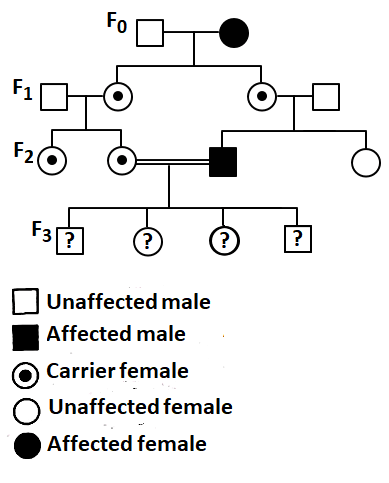
- 1/8
- Zero
- 1/4
- 1/2
Answer: (3) 1/4
That is 12 of the 155 Principles of Inheritance and Variation questions in the archive. See all 155 grouped by year or take a timed test drawn from the chapter.
Principles of Inheritance and Variation PYQs by year
| Year | Papers in archive | Questions |
|---|---|---|
| 2026 | 2 | 10 |
| 2025 | 1 | 3 |
| 2024 | 3 | 20 |
| 2023 | 2 | 11 |
| 2022 | 3 | 18 |
| 2021 | 1 | 2 |
| 2020 | 2 | 7 |
| 2019 | 2 | 9 |
| 2018 | 1 | 4 |
| 2017 | 1 | 5 |
| 2016 | 2 | 10 |
| 2015 | 2 | 12 |
| 2014 | 1 | 3 |
| 2013 | 2 | 9 |
| 2012 | 2 | 4 |
| 2011 | 1 | 1 |
| 2010 | 1 | 5 |
| 2009 | 1 | 4 |
| 2008 | 1 | 1 |
| 2007 | 1 | 6 |
| 2006 | 1 | 11 |
Frequently asked questions
How many questions come from Principles of Inheritance and Variation in NEET?
In the last 10 main papers (2017 to 2026) Principles of Inheritance and Variation had 43 questions in total. Across all 33 papers in this archive it has 155. NTA does not publish a chapter-wise weightage; these are counts of past papers.
Which Principles of Inheritance and Variation topics are most important for NEET?
By the number of past-paper questions per topic tag: Monohybrid Cross (15), Sex Determination (12), Polygenic Inheritance & Pleiotropy (12), Non - Disjunction & Aneuploidy (12) and Dominance Deviation from Mendel (11).
Are these Principles of Inheritance and Variation MCQs from real NEET papers?
Yes. Every question on this page is from an official NEET or AIPMT paper, and each one shows the paper it came from. The latest paper with a question from this chapter is Re-NEET 2026. Questions marked NEET 2026 (3 May, cancelled) are from the cancelled first sitting: NTA issued no final key for it, so their answers are the key on record and have not been matched to an official key.
What does the Principles of Inheritance and Variation chapter cover in NEET Biology?
It covers Mendel's laws and their deviations, sex determination, linkage and crossing over, sex-linked traits such as haemophilia and colour blindness, and chromosomal disorders such as Down's and Turner's syndromes. These are the areas of the NEET Biology syllabus that this chapter brings together.
How should I prepare for sex-linked inheritance questions in the Principles of Inheritance and Variation chapter?
Learn which genes are carried on the X chromosome, then practise crosses showing carriers and affected males and females. Haemophilia and colour blindness are standard examples. Work through pedigree diagrams until you can identify the inheritance pattern quickly from any family tree.
Is Mendelian genetics the same as the Principles of Inheritance and Variation chapter for NEET?
Mendelian genetics forms the core of this chapter, but it also covers deviations from Mendel's ratios, chromosome theory, sex determination and chromosomal disorders. Students should treat the chapter as a whole rather than only the basic monohybrid and dihybrid crosses.
What is the difference between linkage and independent assortment in the Principles of Inheritance and Variation chapter?
Independent assortment applies when genes sit on different chromosomes, so their alleles separate freely and produce the expected dihybrid ratios. Linkage applies when genes sit on the same chromosome, which reduces recombination; crossing over then produces fewer recombinant offspring than free assortment predicts.
More Biology chapters
← Sexual Reproduction in Flowering Plants Molecular Basis of Inheritance →
Botany, Class 11
- The Living World
- Biological Classification
- Plant Kingdom
- Morphology of Flowering Plants
- Anatomy of Flowering Plants
- Cell: The Unit of Life
- Cell Cycle and Cell Division
- Photosynthesis in Higher Plants
- Respiration in Plants
- Plant Growth and Development
Botany, Class 12
- Sexual Reproduction in Flowering Plants
- Molecular Basis of Inheritance
- Strategies for Enhancement in Food Production
- Microbes in Human Welfare
- Organisms and Populations
- Ecosystem
- Biodiversity and Conservation
Zoology, Class 11
- Animal Kingdom
- Structural Organisation in Animals
- Biomolecules
- Breathing and Exchange of Gases
- Body Fluids and Circulation
- Excretory Products and their Elimination
- Locomotion and Movement
- Neural Control and Coordination
- Chemical Coordination and Integration
Zoology, Class 12
- Human Reproduction
- Reproductive Health
- Evolution
- Human Health and Disease
- Biotechnology: Principles and Processes
- Biotechnology and its Applications
Want more than past papers? Practise all 2,449 Principles of Inheritance and Variation questions on NEETprep.