Structural Organisation in Animals (Class 11 Zoology) has had 90 questions in 33 of the 33 official NEET and AIPMT papers from 2006 to 2026, and 28 in the last 10 main papers (2017 to 2026). The most-asked topics are Connective Tissue (14), Glandular Epithelium & Cell Junction (13) and Simple Epithelium (12). This page has a short guide to the chapter and its 12 most recent past-paper questions as a quiz you can take here, with the official answers and no login.
Start the 12-question quiz All 90 Structural Organisation in Animals PYQs Timed chapter test
What Structural Organisation in Animals covers
Structural Organisation in Animals covers animal tissues, including epithelial, connective and muscle tissue, and the external and internal anatomy of the cockroach, with a brief account of the earthworm and frog. Tissues form the core of the chapter, so their types, locations and functions are the foundation for the organ-level questions that follow.
The chapter has been asked in all 33 official papers in the archive, from 2006 to 2026, with 90 questions in total. 28 of these fall in the last ten main papers from 2017 to 2026, and the most recent paper with a question from this chapter is Re-NEET 2026. Connective tissue, glandular epithelium with cell junctions, and simple epithelium have the highest counts, while the cockroach topics appear less often.
High-yield topics in Structural Organisation in Animals
Ranked by the number of past-paper questions carrying each topic tag.
- Connective Tissue (14 PYQs): Know the types of connective tissue, such as blood, bone and cartilage, with their matrix and functions; this topic has the highest count in the archive.
- Glandular Epithelium & Cell Junction (13 PYQs): Learn the difference between exocrine and endocrine glands and the types of cell junctions, such as tight junctions, desmosomes and gap junctions, with their roles.
- Simple Epithelium (12 PYQs): Know the squamous, cuboidal and columnar forms of simple epithelium, along with where each is found in the body and what each does.
- Cockroach: Intro & External Morphology (6 PYQs): Be able to identify the external parts of the cockroach, including head, thorax and abdomen, and the appendages attached to each region.
- Cardiac Muscle & Smooth Muscle (6 PYQs): Compare cardiac and smooth muscle on structure, location and control, noting that cardiac muscle is striated while smooth muscle is non-striated and involuntary.
- Cockroach: Digestive System (5 PYQs): Learn the parts of the cockroach digestive system, from mouth to anus, and the role of the gizzard, crop and gut regions in digestion.
Common mistakes in Structural Organisation in Animals
- Mixing up the three types of muscle tissue. Keep a table of striation, control and location for skeletal, cardiac and smooth muscle, and check each entry against NCERT.
- Confusing the epithelium types by shape alone. Remember that simple epithelium is one cell layer thick, while compound epithelium has several layers, and check the number of layers before naming it.
- Mislabelling cockroach body parts in diagrams. Draw the external morphology yourself, label head, thorax and abdomen first, then add appendages, so that you do not place structures in the wrong region.
- Memorising the names of cell junctions without their functions. Link each junction to its role, such as anchoring, sealing or communication, so that you can answer function-based questions.
How to practise Structural Organisation in Animals
- Start by reading the NCERT tissue chapter once, then make a one-page table of epithelial, connective and muscle tissues with their location and function.
- Draw and label the cockroach external morphology, digestive system and female reproductive system from memory, then check each label against the textbook diagram and correct gaps.
- Work through past questions topic by topic, grouping them under tissues and cockroach, and note which wording or structures repeat, so you can recognise patterns in the archive.
- Finish each session with a short self-test on the earthworm and frog summaries, then revisit any system you cannot describe in your own words within a few sentences.
Structural Organisation in Animals NEET MCQs: 12 most recent PYQs
Click an option to check it. The correct option and the answer appear at once; nothing is stored or sent.
Q1 Re-NEET 2026 Frogs: Anatomy (Respiratory System)
- trachea
- skin
- buccal cavity
- lungs
Answer: (2) skin
Why: Frogs can respire through their moist skin in water, a process called cutaneous respiration, which allows gas exchange directly with the surrounding water. Lungs are used mainly on land, while the buccal cavity lining assists only partially and trachea is absent in frogs.
Q2 Re-NEET 2026 Frogs: Anatomy (Nervous System)
- 12
- 6
- 9
- 10
Answer: (4) 10
Why: Frogs have 10 pairs of cranial nerves arising from the brain, so the option giving 10 pairs is correct.
Q3 NEET 2026 (3 May, cancelled) Frogs: Anatomy (Male Reproductive System)
A. Bulging eyes
B. Vocal sacs
C. Webbed digits in feet
D. Copulatory pad on first digit of fore limbs
E. Olive green-coloured skin with dark irregular spots
Choose the correct answer from the options given below:
- B and D only
- B and C only
- A and B only
- C and E only
Answer: (1) B and D only
Why: Male frogs have vocal sacs, which are throat pouches that amplify their mating calls, and a copulatory pad on the first digit of the fore limbs, which helps them grip the female during amplexus. Bulging eyes, webbed feet and skin colour do not distinguish the sexes, so the option pairing vocal sacs with the copulatory pad is correct.
Q4 NEET 2026 (3 May, cancelled) Frogs
| A. | Hepatic portal system is the special venous connection between liver and intestine. |
| B. | There are twelve pairs of cranial nerves arising from the brain. |
| C. | The ureters and oviducts open separately into the cloaca in female frogs. |
| D. | Hind-brain consists of cerebellum, medulla oblongata and optic lobes. |
| E. | Sinus venosus joins the right atrium of heart. |
- B and D only
- A, C and E only
- A, B and C only
- B and C only
Answer: (2) A, C and E only
Why: The hepatic portal system is the venous link carrying blood from the intestine to the liver, and in female frogs the ureters and oviducts open separately into the cloaca. The sinus venosus opens into the right atrium. The statement about twelve pairs of cranial nerves and the statement placing optic lobes in the hind-brain are both incorrect, since the optic lobes belong to the mid-brain.
Q5 NEET 2025 Frogs: Anatomy (Excretory System)
- Kidney and intestine
- Kidney and lower part of the body
- Liver and intestine
- Liver and kidney
Answer: (2) Kidney and lower part of the body
Q6 NEET 2025 Frogs
Choose the correct answer from the following:
- The statement is false for water but true for land
- The statement is false for both the environments
- The statement is true for water but false for land
- The statement is true for both the environments
Answer: (1) The statement is false for water but true for land
Q7 NEET 2025 Frogs: Anatomy (Circulatory System)
- Pulmonary vein
- Vena cava
- Aorta
- Pulmonary artery
Answer: (2) Vena cava
Why: In the frog, deoxygenated blood from the body returns to the heart through the venae cavae, which open into the right auricle. The pulmonary veins carry oxygenated blood from the lungs, the aorta carries oxygenated blood away from the heart, and the pulmonary artery carries deoxygenated blood to the lungs. The option naming the vena cava is correct.
Q8 NEET 2025 Frogs: Morphology
- Second digit of fore limb
- First digit of the fore limb
- First and Second digit of fore limb
- First digit of hind limb
Answer: (2) First digit of the fore limb
Q9 NEET 2024 (Jhajjar) Connective Tissue
| Statement I: | The ground substance of bone is solid, pliable and resists compression. |
| Statement II: | The bone marrow of all bones is the site of production of blood cells. |
- Both Statement I and Statement II are correct
- Both Statement I and Statement II are incorrect.
- Statement I is correct but Statement II is incorrect
- Statement I is incorrect but Statement II is correct
Answer: (2) Both Statement I and Statement II are incorrect.
Why: The ground substance of bone is hard and rigid, not pliable, which is why it resists compression, so Statement I is incorrect because pliability describes cartilage rather than bone. In adults, only the red marrow found in certain bones such as the flat bones and the ends of long bones produces blood cells, while the marrow in the shafts of long bones is yellow and fatty, so Statement II is also incorrect.
Q10 NEET 2024 (Jhajjar) Cockroach: Digestive System
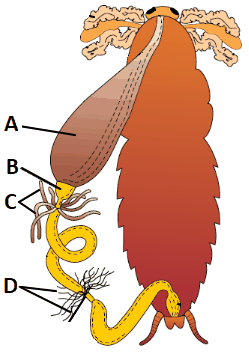
- A-Gizzard, B-Crop, C-Malpighian tubules, D-Hepatic caeca
- A-Oesophagus, B-Crop, C-salivary glands, D-Hepatic caeca
- A-Crop, B-Gizzard, C-Hepatic caeca, D-Malpighian tubules
- A-Gizzard, B-Hepatic caeca, C-Malpighian tubules, D- Cilia
Answer: (3) A-Crop, B-Gizzard, C-Hepatic caeca, D-Malpighian tubules
Q11 NEET 2024 (Jhajjar) Frogs: Anatomy (Respiratory System)
| List-I (Cockroach) |
List-II (Term Used) |
||
| A. | Metamorphosis | I. | Ommatidia |
| B. | Brain | II. | Paurometabolous |
| C. | Vision | III. | Spiracles |
| D. | Respiration | IV. | Supra oesophageal ganglion |
- A-II, B-I, C-IV, D-III
- A-I, B-III, C-IV, D-II
- A-III, B-II, C-I, D-IV
- A-II, B-IV, C-I, D-III
Answer: (4) A-II, B-IV, C-I, D-III
Why: In cockroach, metamorphosis is paurometabolous (option II for A), the brain is the supra-oesophageal ganglion (option IV for B), vision is by ommatidia in compound eyes (option I for C), and respiration occurs through spiracles (option III for D). This matches the pairing A-II, B-IV, C-I, D-III, which is the option with those four correct pairings.
Q12 NEET 2024 (Jhajjar) Simple Epithelium
| A. | Bear cilia on their free surface. |
| B. | Provides a lining for some parts of body. |
| C. | Compound epithelium is multi-layered, meant for limited role in secretion and absorption. |
| D. | Located in the tip of the nose. |
| E. | Exocrine glands possess epithelial tissue. |
- B, D and E only
- A, B and C only
- B, C and E only
- C, D and E only
Answer: (3) B, C and E only
Why: Epithelial tissue provides a lining for parts of the body, compound epithelium is multi-layered and protective rather than mainly for secretion and absorption, and exocrine glands are formed from epithelial tissue. Ciliated epithelium is not the defining feature of all epithelium, and the tip of the nose is not the correct location for this description, so the correct combination is B, C and E only.
That is 12 of the 90 Structural Organisation in Animals questions in the archive. See all 90 grouped by year or take a timed test drawn from the chapter.
Structural Organisation in Animals PYQs by year
| Year | Papers in archive | Questions |
|---|---|---|
| 2026 | 2 | 4 |
| 2025 | 1 | 4 |
| 2024 | 3 | 11 |
| 2023 | 2 | 8 |
| 2022 | 3 | 12 |
| 2021 | 1 | 4 |
| 2020 | 2 | 6 |
| 2019 | 2 | 4 |
| 2018 | 1 | 1 |
| 2017 | 1 | 2 |
| 2016 | 2 | 4 |
| 2015 | 2 | 4 |
| 2014 | 1 | 2 |
| 2013 | 2 | 4 |
| 2012 | 2 | 5 |
| 2011 | 1 | 3 |
| 2010 | 1 | 1 |
| 2009 | 1 | 6 |
| 2008 | 1 | 2 |
| 2007 | 1 | 1 |
| 2006 | 1 | 2 |
Frequently asked questions
How many questions come from Structural Organisation in Animals in NEET?
In the last 10 main papers (2017 to 2026) Structural Organisation in Animals had 28 questions in total. Across all 33 papers in this archive it has 90. NTA does not publish a chapter-wise weightage; these are counts of past papers.
Which Structural Organisation in Animals topics are most important for NEET?
By the number of past-paper questions per topic tag: Connective Tissue (14), Glandular Epithelium & Cell Junction (13), Simple Epithelium (12), Cockroach: Intro & External Morphology (6) and Cardiac Muscle & Smooth Muscle (6).
Are these Structural Organisation in Animals MCQs from real NEET papers?
Yes. Every question on this page is from an official NEET or AIPMT paper, and each one shows the paper it came from. The latest paper with a question from this chapter is Re-NEET 2026. Questions marked NEET 2026 (3 May, cancelled) are from the cancelled first sitting: NTA issued no final key for it, so their answers are the key on record and have not been matched to an official key.
What topics does Structural Organisation in Animals cover for NEET?
The chapter covers animal tissues, including epithelial, connective and muscle tissue, and the anatomy of the cockroach, with a brief account of the earthworm and frog. Students should know the structure, location and function of each tissue type and the main organ systems of the cockroach.
How should I start studying Structural Organisation in Animals for NEET?
Begin with tissues, since they underpin the cockroach and frog anatomy. Build a comparison table for each tissue type, then move on to the cockroach external morphology and digestive system. Use diagrams and self-tests to check recall, and link the cell junction and muscle topics to the NCERT text.
Which cockroach systems are included in the Structural Organisation in Animals chapter?
The archive tags cockroach questions under introduction and external morphology, digestive system, excretory system, female reproductive system and structure of the thorax. The syllabus asks for a brief account of the digestive, circulatory, respiratory, nervous and reproductive systems of the frog, so study these systems as well.
How do I learn connective tissue in Structural Organisation in Animals for NEET?
Connective tissue is the topic with the highest count in the archive, so it deserves close attention. Learn the main types, such as blood, bone, cartilage and adipose tissue, with their matrix and function. Make a table, then test yourself by naming the tissue from a short description of its features.
More Biology chapters
← Animal Kingdom Biomolecules →
Botany, Class 11
- The Living World
- Biological Classification
- Plant Kingdom
- Morphology of Flowering Plants
- Anatomy of Flowering Plants
- Cell: The Unit of Life
- Cell Cycle and Cell Division
- Photosynthesis in Higher Plants
- Respiration in Plants
- Plant Growth and Development
Botany, Class 12
- Sexual Reproduction in Flowering Plants
- Principles of Inheritance and Variation
- Molecular Basis of Inheritance
- Strategies for Enhancement in Food Production
- Microbes in Human Welfare
- Organisms and Populations
- Ecosystem
- Biodiversity and Conservation
Zoology, Class 11
- Animal Kingdom
- Biomolecules
- Breathing and Exchange of Gases
- Body Fluids and Circulation
- Excretory Products and their Elimination
- Locomotion and Movement
- Neural Control and Coordination
- Chemical Coordination and Integration
Zoology, Class 12
- Human Reproduction
- Reproductive Health
- Evolution
- Human Health and Disease
- Biotechnology: Principles and Processes
- Biotechnology and its Applications
Want more than past papers? Practise all 1,963 Structural Organisation in Animals questions on NEETprep.