Biotechnology: Principles and Processes (Class 12 Zoology) has had 118 questions in 30 of the 33 official NEET and AIPMT papers from 2006 to 2026, and 43 in the last 10 main papers (2017 to 2026). The most-asked topics are Restriction Enzymes - Main Enzymes (22), Separation and Isolation of DNA fragments (21) and Tools (19). This page has a short guide to the chapter and its 12 most recent past-paper questions as a quiz you can take here, with the official answers and no login.
Start the 12-question quiz All 118 Biotechnology: Principles and Processes PYQs Timed chapter test
What Biotechnology: Principles and Processes covers
Biotechnology: Principles and Processes covers the tools and methods of genetic engineering, including restriction enzymes, vectors, DNA separation, and the polymerase chain reaction. Students should understand how these tools combine to make recombinant DNA and how host cells are transformed. The chapter sits within the biotechnology unit of the syllabus, alongside its health and agriculture applications.
The archive holds 118 questions from this chapter across 30 of the 33 official papers, from 2006 to 2026. In the last ten main papers, from 2017 to 2026, 43 questions came from it. The most recent paper with a question from this chapter is Re-NEET 2026. Questions have concentrated on restriction enzymes, DNA fragment separation and vector-related tools, so the counts show where past papers have focused.
High-yield topics in Biotechnology: Principles and Processes
Ranked by the number of past-paper questions carrying each topic tag.
- Restriction Enzymes - Main Enzymes (22 PYQs): Know what restriction endonucleases do, how they cut palindromic sequences to produce sticky or blunt ends, and why EcoRI is the classic example.
- Separation and Isolation of DNA fragments (21 PYQs): Learn how gel electrophoresis separates DNA fragments by size and how the separated fragments are visualised and recovered for further use.
- Tools (19 PYQs): Know the basic tools of recombinant DNA technology, including enzymes and vectors, and be able to state what job each one does in a cloning experiment.
- Cloning Vector (16 PYQs): Know the features a cloning vector needs, such as an origin of replication, a selectable marker and cloning sites, and why plasmids are the usual vectors in practice.
- Polymerase Chain Reaction: PCR (14 PYQs): Learn the steps of PCR, namely denaturation, primer annealing and extension, and what each step needs. Be clear on why heat-stable polymerase is used and what PCR amplifies.
- Tools: Enzymes (9 PYQs): Focus on the enzymes used in gene cloning beyond restriction enzymes, such as ligases and polymerases, and what each one catalyses in the cloning workflow.
Common mistakes in Biotechnology: Principles and Processes
- Confusing restriction enzymes with ligases. Restriction enzymes cut DNA at specific sites, while ligases join fragments together. Keep the cutting and joining roles separate in your notes and check each one against a diagram.
- Treating the vector as optional. A recombinant DNA molecule needs a vector to carry the foreign gene into the host cell. Remember that the vector must have a selectable marker to identify transformed cells.
- Mixing up the steps of PCR. Students often confuse denaturation with extension. Write the three steps in order, and link each one to what happens to the DNA strands.
- Memorising restriction enzyme names without the recognition sequence. Questions often test whether the enzyme cuts within a specific palindromic sequence. Learn a few examples with their recognition sites and practise predicting fragment ends.
How to practise Biotechnology: Principles and Processes
- Start by drawing the cloning workflow from cutting the vector and the foreign DNA through to selection of transformed cells. Label each enzyme and each tool at the step where it acts.
- Next, work through the PCR cycle and gel electrophoresis separately, writing a short explanation in your own words for each stage. Check you can say what the separation depends on.
- Then answer past questions on restriction enzymes, vectors and DNA separation, grouping them by topic. Note which mistakes you made and rewrite the reasoning for each wrong answer.
- Finish by writing a one-page summary from memory of the tools and their roles, then check it against NCERT. Revisit any gaps after a few days.
Biotechnology: Principles and Processes NEET MCQs: 12 most recent PYQs
Click an option to check it. The correct option and the answer appear at once; nothing is stored or sent.
Q1 Re-NEET 2026 Separation and Isolation of DNA fragments
| Assertion (A): | In recombinant DNA technology, lysozyme is used for disrupting bacterial cells while cellulase is for plant cells. |
| Reason (R): | Isolation of genetic material needs disruption of cells. |
In the light of the above statements, choose the most appropriate answer from the options given below:
- (A) is not correct but (R) is correct
- Both (A) and (R) are correct and (R) is the correct explanation of (A)
- Both (A) and (R) are correct but (R) is not the correct explanation of (A)
- (A) is correct but (R) is not correct
Answer: (2) Both (A) and (R) are correct and (R) is the correct explanation of (A)
Why: Lysozyme breaks down bacterial cell walls and cellulase breaks down plant cell walls, so both enzymes are correctly described in the assertion. Isolating genetic material requires disrupting cells first, which is exactly why these enzymes are used, so the reason correctly explains the assertion.
Q2 Re-NEET 2026 Cloning Vector
| List-I | List-II | ||
| A. | Transformation | I. | Restriction enzyme |
| B. | Cloning site | II. | Transfer DNA to host bacteria |
| C. | Selection | III. | Replication |
| D. | Ori | IV. | Antibiotic |
- A-IV, B-I, C-III, D-II
- A-II, B-I, C-IV, D-III
- A-I, B-II, C-IV, D-III
- A-III, B-IV, C-II, D-I
Answer: (2) A-II, B-I, C-IV, D-III
Why: Transformation is the transfer of foreign DNA into host bacteria (A-II), the cloning site is where a restriction enzyme cuts the vector (B-I), selection uses an antibiotic resistance marker (C-IV), and the ori is the origin of replication that allows DNA to replicate (D-III).
Q3 Re-NEET 2026 Cloning Vector
| Statement I: | Plasmids are autonomously replicating DNA. |
| Statement II: | Plasmids are extrachromosomal DNA. |
In the light of the above statements, choose the most appropriate answer from the options given below:
- Statement I is incorrect but Statement II is correct
- Both Statement I and Statement II are correct
- Both Statement I and Statement II are incorrect
- Statement I is correct but Statement II is incorrect
Answer: (2) Both Statement I and Statement II are correct
Why: Plasmids are small circular DNA molecules that replicate autonomously using their own origin of replication, and they exist outside the chromosomal DNA as extrachromosomal DNA. Both statements are therefore correct.
Q4 Re-NEET 2026 Polymerase Chain Reaction: PCR
- ligation
- denaturation
- extension
- annealing
Answer: (4) annealing
Why: In PCR, the primers are short single-stranded DNA sequences that bind complementary regions of the template strands during the annealing step, which follows denaturation of the double helix. DNA polymerase then extends the primers in the extension step.
Q5 NEET 2026 (3 May, cancelled) Restriction Enzymes - Main Enzymes
| A. | They are called molecular scissors. |
| B. | These are the enzymes responsible for restricting the growth of bacteriophages in E. coli. |
| C. | They cut the DNA only at the centre of the palindromic sites. |
| D. | They remove nucleotides only from the ends of DNA fragments. |
| E. | They recognise specific palindromic base-pair sequences. |
Choose the answer from the options given below:
- A and B only
- D and E only
- C and D only
- A and E only
Answer: (3) C and D only
Why: The false statements are that restriction endonucleases always cut DNA exactly at the centre of the palindromic site, and that they only remove nucleotides from the ends of DNA fragments. In fact they cleave the phosphodiester bonds at specific positions within the recognition sequence, which can be central or offset, and they cut internal bonds rather than trimming ends. The statements about molecular scissors, bacterial defence against phages, and recognising palindromic sequences are true.
Q6 NEET 2026 (3 May, cancelled) Process of Biotech
| List-I | List-II | ||
| A. | Genetically modified organism | I. | Agrobacterium tumefaciens |
| B. | Thermostable DNA Polymerase | II. | Bt cotton |
| C. | Ti plasmid | III. | Thermus aquaticus |
| D. | pBR322 | IV. | Escherichia coli |
- A-II, B-I, C-IV, D-III
- A-I, B-IV, C-III, D-II
- A-II, B-III, C-I, D-IV
- A-I, B-II, C-IV, D-III
Answer: (3) A-II, B-III, C-I, D-IV
Why: Bt cotton is the classic genetically modified organism, Thermus aquaticus is the source of the thermostable DNA polymerase used in PCR, the Ti plasmid comes from Agrobacterium tumefaciens and is used as a vector, and pBR322 is a cloning vector originally derived from Escherichia coli.
Q7 NEET 2026 (3 May, cancelled) Polymerase Chain Reaction: PCR
- Denaturation → Annealing → Extension
- Denaturation → Extension → Annealing
- Extension → Annealing → Denaturation
- Annealing → Denaturation → Extension
Answer: (1) Denaturation → Annealing → Extension
Why: Each PCR cycle begins with denaturation, where heating separates the double-stranded DNA into single strands. The temperature is then lowered so that primers anneal to the complementary sites on the single strands. Finally, DNA polymerase extends the primers along the template during the extension step.
Q8 NEET 2026 (3 May, cancelled) Separation and Isolation of DNA fragments
| A. | The cutting of DNA is done by molecular scissors. |
| B. | The DNA fragments separate according to their size in an agarose gel, upon electrophoresis. |
| C. | The separated DNA fragments can be seen without staining when exposed to UV light. |
| D. | The separated DNA fragments, when stained with ethidium bromide, can be seen in visible light. |
- A and D only
- B and D only
- B and C only
- A and B only
Answer: (4) A and B only
Why: DNA is cut into specific fragments by molecular scissors, which are restriction enzymes, so statement A is correct. On electrophoresis in an agarose gel, DNA fragments migrate and separate according to their size, so statement B is correct. Statement C is wrong because the DNA is not visible without staining, and statement D is wrong because ethidium bromide-stained DNA is seen under UV light rather than visible light.
Q9 NEET 2026 (3 May, cancelled) Cloning Vector
- Gentamycin
- Ampicillin and tetracycline
- Tetracycline
- Ampicillin
Answer: (3) Tetracycline
Why: The BamHI site in pBR322 lies within the tetracycline resistance gene, so inserting foreign DNA there inactivates that gene. The ampicillin resistance gene is unaffected, which means the recombinant bacteria lose tetracycline resistance but keep ampicillin resistance.
Q10 NEET 2025 Cloning Vector
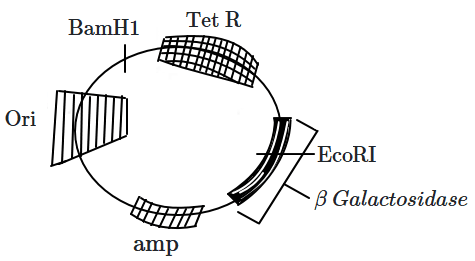
In the above-represented plasmid, an alien piece of DNA is inserted at EcoRI site. Which of the following strategies will be chosen to select the recombinant colonies?
- White color colonies will be selected.
- Blue color colonies grown on ampicillin plates can be selected.
- Using an ampicillin- & tetracycline-containing medium plate.
- Blue color colonies will be selected.
Answer: (1) White color colonies will be selected.
Q11 NEET 2025 Polymerase Chain Reaction: PCR
Answer: (4)
Q12 NEET 2025 Bioreactors/Downstream Processing
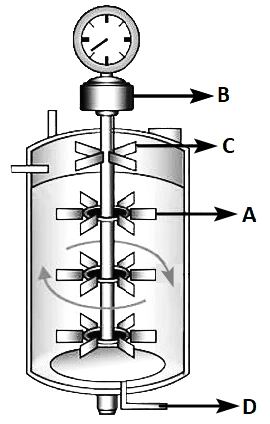
- D
- C
- A
- B
Answer: (2) C
That is 12 of the 118 Biotechnology: Principles and Processes questions in the archive. See all 118 grouped by year or take a timed test drawn from the chapter.
Biotechnology: Principles and Processes PYQs by year
| Year | Papers in archive | Questions |
|---|---|---|
| 2026 | 2 | 9 |
| 2025 | 1 | 6 |
| 2024 | 3 | 14 |
| 2023 | 2 | 9 |
| 2022 | 3 | 17 |
| 2021 | 1 | 6 |
| 2020 | 2 | 10 |
| 2019 | 2 | 8 |
| 2018 | 1 | 1 |
| 2017 | 1 | 5 |
| 2016 | 2 | 7 |
| 2015 | 2 | 3 |
| 2014 | 1 | 1 |
| 2013 | 2 | 4 |
| 2012 | 2 | 8 |
| 2011 | 1 | 4 |
| 2010 | 1 | 3 |
| 2008 | 1 | 2 |
| 2006 | 1 | 1 |
Frequently asked questions
How many questions come from Biotechnology: Principles and Processes in NEET?
In the last 10 main papers (2017 to 2026) Biotechnology: Principles and Processes had 43 questions in total. Across all 33 papers in this archive it has 118. NTA does not publish a chapter-wise weightage; these are counts of past papers.
Which Biotechnology: Principles and Processes topics are most important for NEET?
By the number of past-paper questions per topic tag: Restriction Enzymes - Main Enzymes (22), Separation and Isolation of DNA fragments (21), Tools (19), Cloning Vector (16) and Polymerase Chain Reaction: PCR (14).
Are these Biotechnology: Principles and Processes MCQs from real NEET papers?
Yes. Every question on this page is from an official NEET or AIPMT paper, and each one shows the paper it came from. The latest paper with a question from this chapter is Re-NEET 2026. Questions marked NEET 2026 (3 May, cancelled) are from the cancelled first sitting: NTA issued no final key for it, so their answers are the key on record and have not been matched to an official key.
What is the Biotechnology: Principles and Processes chapter about for NEET?
The chapter covers the principles of genetic engineering and the tools used to build recombinant DNA, including restriction enzymes, ligases, vectors and PCR. It is part of the biotechnology section of the syllabus, and students should be able to explain how each tool is used in a cloning experiment.
How should I study Biotechnology: Principles and Processes for NEET Zoology?
Start with the tools of recombinant DNA technology, then move to PCR and gel electrophoresis. Draw the cloning workflow from memory, label each step, and practise past questions grouped by topic. Use NCERT as your main reference for the definitions and processes.
Which enzymes are covered in the Biotechnology: Principles and Processes chapter?
The chapter covers restriction enzymes, which cut DNA at specific recognition sequences, and ligases, which join DNA fragments. Students should also know the polymerase used in PCR, which is heat stable and copies the target sequence during extension.
Does the Biotechnology: Principles and Processes chapter include applications like Bt crops and gene therapy?
The syllabus places Bt crops, gene therapy, transgenic animals and biosafety under the wider biotechnology unit, alongside the principles of genetic engineering. Check the official syllabus text for how these applications are grouped with this chapter's tools and processes.
More Biology chapters
← Human Health and Disease Biotechnology and its Applications →
Botany, Class 11
- The Living World
- Biological Classification
- Plant Kingdom
- Morphology of Flowering Plants
- Anatomy of Flowering Plants
- Cell: The Unit of Life
- Cell Cycle and Cell Division
- Photosynthesis in Higher Plants
- Respiration in Plants
- Plant Growth and Development
Botany, Class 12
- Sexual Reproduction in Flowering Plants
- Principles of Inheritance and Variation
- Molecular Basis of Inheritance
- Strategies for Enhancement in Food Production
- Microbes in Human Welfare
- Organisms and Populations
- Ecosystem
- Biodiversity and Conservation
Zoology, Class 11
- Animal Kingdom
- Structural Organisation in Animals
- Biomolecules
- Breathing and Exchange of Gases
- Body Fluids and Circulation
- Excretory Products and their Elimination
- Locomotion and Movement
- Neural Control and Coordination
- Chemical Coordination and Integration
Zoology, Class 12
- Human Reproduction
- Reproductive Health
- Evolution
- Human Health and Disease
- Biotechnology and its Applications
Want more than past papers? Practise all 1,670 Biotechnology: Principles and Processes questions on NEETprep.