Current Electricity has 107 questions in this archive of official NEET and AIPMT papers, asked between 2006 and 2026. It appeared in 33 of the 33 papers held here (AIPMT 2006 to Re-NEET 2026); the most recent paper with a question from it is Re-NEET 2026. The most-asked topics by tag are Heating Effects of Current (17), Derivation of Ohm's Law (15) and Combination of Resistors (14). In the last 10 main papers (2017 to 2026) it had 32 questions.
Current Electricity practice hub Take the chapter test
Current Electricity PYQs year by year
| Year | Papers in archive | Questions | By paper |
|---|---|---|---|
| 2026 | 2 | 5 | NEET 2026: 4, Re-NEET 2026: 1 |
| 2025 | 1 | 3 | NEET 2025: 3 |
| 2024 | 3 | 13 | NEET 2024: 3, NEET 2024 Re-exam (1,563 candidates): 6, NEET 2024 (Jhajjar): 4 |
| 2023 | 2 | 9 | NEET 2023: 5, NEET 2023 (Manipur): 4 |
| 2022 | 3 | 11 | NEET 2022: 3, NEET 2022 (Abroad): 4, NEET 2022 (Ganganagar): 4 |
| 2021 | 1 | 4 | NEET 2021: 4 |
| 2020 | 2 | 8 | NEET 2020: 4, NEET 2020 (Covid Re-exam): 4 |
| 2019 | 2 | 5 | NEET 2019: 3, NEET 2019 (Odisha): 2 |
| 2018 | 1 | 3 | NEET 2018: 3 |
| 2017 | 1 | 3 | NEET 2017: 3 |
| 2016 | 2 | 4 | NEET 2016 Phase 1: 2, NEET 2016 Phase 2: 2 |
| 2015 | 2 | 6 | AIPMT 2015: 3, AIPMT 2015 Re-exam: 3 |
| 2014 | 1 | 3 | AIPMT 2014: 3 |
| 2013 | 2 | 6 | NEET 2013: 3, NEET 2013 (Karnataka): 3 |
| 2012 | 2 | 5 | AIPMT 2012: 3, AIPMT 2012 Mains: 2 |
| 2011 | 1 | 3 | AIPMT 2011: 3 |
| 2010 | 1 | 2 | AIPMT 2010: 2 |
| 2009 | 1 | 3 | AIPMT 2009: 3 |
| 2008 | 1 | 5 | AIPMT 2008: 5 |
| 2007 | 1 | 2 | AIPMT 2007: 2 |
| 2006 | 1 | 4 | AIPMT 2006: 4 |
Most-asked topics
| Topic | PYQs |
|---|---|
| Heating Effects of Current | 17 |
| Derivation of Ohm's Law | 15 |
| Combination of Resistors | 14 |
| Kirchhoff's Voltage Law | 13 |
| EMF & Terminal Voltage | 9 |
| Wheatstone Bridge | 7 |
| Current & Current Density | 7 |
| Meter Bridge | 5 |
| Grouping of Cells | 4 |
| Kirchhoff's Current Law | 2 |
16 of the 107 questions carry no topic tag and are not counted in this table.
Current Electricity NEET PYQ 2026 (5 questions)
Q1 Re-NEET 2026 Derivation of Ohm's Law
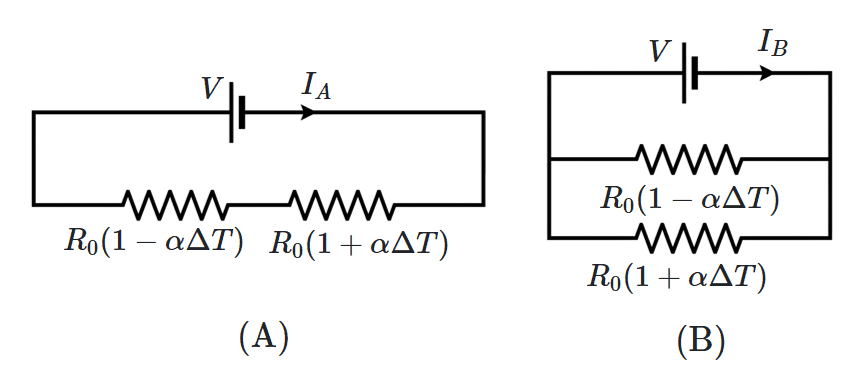
- both and remain constant
- remains constant while increases
- decreases while increases
- increases while decreases
Show answer
Answer: (2) remains constant while increases
Q2 NEET 2026 (3 May, cancelled) Wheatstone Bridge
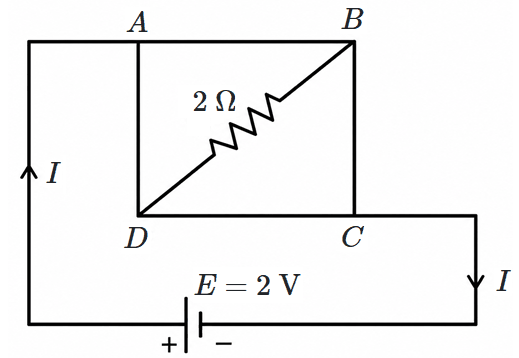
Show answer
Answer: (1)
Q3 NEET 2026 (3 May, cancelled) Meter Bridge
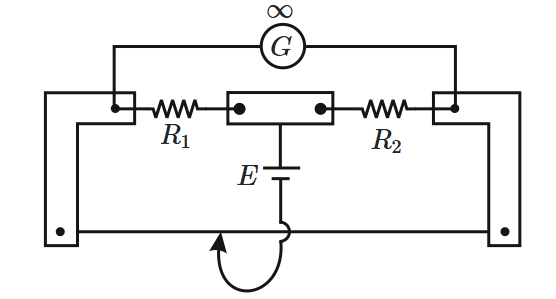
- Only the right-sided deflection.
- Only the left-sided deflection.
- There will be no deflection irrespective of the position of the jockey.
- Both right-sided and left-sided deflection and, at balance point, no deflection.
Show answer
Answer: (4) Both right-sided and left-sided deflection and, at balance point, no deflection.
Q4 NEET 2026 (3 May, cancelled) EMF & Terminal Voltage
Show answer
Answer: (2)
Why: The terminal voltage of a cell is its EMF minus the voltage drop across its internal resistance, that is, EMF minus current times internal resistance. Using the given EMF, current and internal resistance in this formula gives the option of 10.8 V.
Q5 NEET 2026 (3 May, cancelled) Heating Effects of Current
Show answer
Answer: (2)
Why: For a fixed heater resistance, power is proportional to the square of the applied voltage, since P equals V squared over R. The new power is therefore the rated 400 W multiplied by the square of the ratio of 200 V to 220 V, which comes to about 331 W, the option stated as 331 W.
Current Electricity NEET PYQ 2025 (3 questions)
Q6 NEET 2025 Wheatstone Bridge
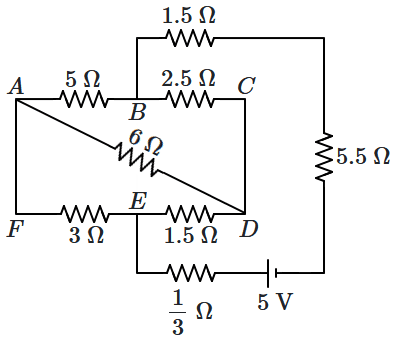
Show answer
Answer: (4)
Q7 NEET 2025 Combination of Resistors
Show answer
Answer: (1)
Q8 NEET 2025 Kirchhoff's Voltage Law
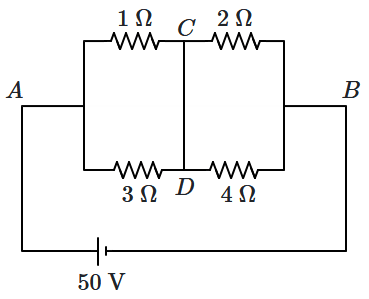
Show answer
Answer: (4)
Current Electricity NEET PYQ 2024 (13 questions)
Q9 NEET 2024 (Jhajjar) Wheatstone Bridge
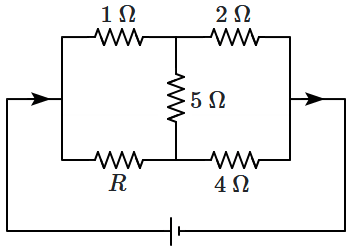
Show answer
Answer: (4)
Q10 NEET 2024 (Jhajjar) Combination of Resistors
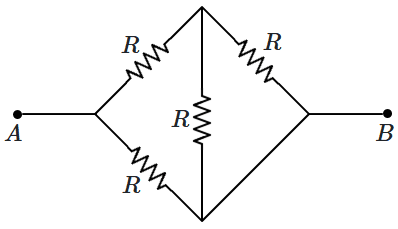
Show answer
Answer: (2)
Q11 NEET 2024 (Jhajjar) Heating Effects of Current
Show answer
Answer: (2)
Why: For a fixed supply voltage, the heating time is proportional to the heater's resistance, since the heat needed is fixed and the power is the square of the voltage divided by the resistance. In series the resistances add, so the total resistance is the sum of the two, and the boiling time for the combination is the sum t1 plus t2, option (2).
Q12 NEET 2024 (Jhajjar) Derivation of Ohm's Law
| A. | ( to ) ranged ammeter. |
| B. | ( to ) ranged milli-ammeter. |
| C. | ( to ) ranged micro-ammeter. |
| D. | ( to ) ranged voltmeter. |
Choose the correct answer from the options given below:
Show answer
Answer: (2)
Why: A voltmeter is a galvanometer with a large series resistance, so it has the highest resistance, and among ammeters a lower full-scale current requires a larger shunt resistance is not the case; instead a lower full-scale current means a higher series resistance is needed for the galvanometer, so the micro-ammeter has the largest resistance among the ammeters, then the milli-ammeter, then the 1 A ammeter with the smallest resistance. Hence the voltmeter is greatest and the 1 A ammeter is smallest, giving the order in the option D greater than C greater than B greater than A.
Q13 NEET 2024 Re-exam (1,563 candidates) Current & Current Density
Show answer
Answer: (2)
Why: The current is I = n e A v, where n and e are the same for the same material and A is the cross-sectional area. Area scales with the square of the diameter, so halving the diameter cuts the area by the square of that ratio, and the current doubles from 100 mA to 200 mA. Solving for the new drift velocity gives 8v (option 2).
Q14 NEET 2024 Re-exam (1,563 candidates) Derivation of Ohm's Law
Show answer
Answer: (2)
Why: The resistance is R = V / I, which gives 10 ohms from the nominal values of 200 V and 20 A. For a quotient, the percentage errors in V and I add to give the percentage error in R, and applying that to 10 ohms gives an absolute error of 0.3 ohms, so the result is (10 plus or minus 0.3) ohms (option 2).
Q15 NEET 2024 Re-exam (1,563 candidates) Current & Current Density
Show answer
Answer: (1)
Why: Stretching the wire to twice its length at constant volume halves its cross-sectional area, so its resistance grows with the square of the length ratio, to 40 ohms in total. When bent into a circle and measured across any diameter, the two semicircular halves each have half the total resistance and are connected in parallel, which reduces the net resistance by a further factor of four and returns it to 10 ohms (option 1).
Q16 NEET 2024 Re-exam (1,563 candidates) Wheatstone Bridge
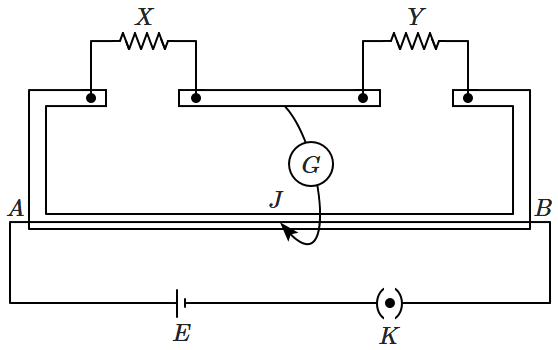
The given circuit shows a uniform straight wire of length fixed at both ends. In order to get zero reading in the galvanometer the free end of is to be placed from the end at:
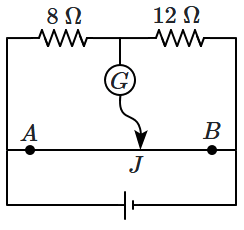
Show answer
Answer: (4)
Q17 NEET 2024 Re-exam (1,563 candidates)
Show answer
Answer: (2)
Why: Setting Q equal to half of Q0 gives e^(-Rt/2L) = 1/2, so Rt/(2L) = ln 2 and t = 2L ln 2 / R. Substituting L in henries (from the mH value) and R = 1.5 ohm gives about 11.09 ms, which is the option in milliseconds.
Q18 NEET 2024 Re-exam (1,563 candidates) Derivation of Ohm's Law
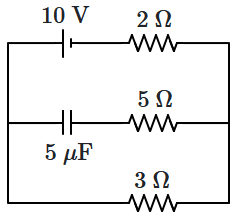
Show answer
Answer: (3)
Q19 NEET 2024 EMF & Terminal Voltage
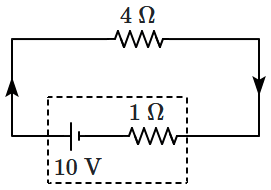
Show answer
Answer: (2)
Q20 NEET 2024 Combination of Resistors
Show answer
Answer: (1)
Why: Each of the 10 equal parts has resistance 100 ohms divided by 10. Five such parts in series give five times that per-part resistance, while five identical parts in parallel give one fifth of the per-part resistance. Adding these two combinations in series gives a total of 52 ohms, which is the option 52 ohms.
Q21 NEET 2024 Heating Effects of Current
Show answer
Answer: (1)
Why: Each heater's resistance is V squared divided by its power rating, so the resistances are in the inverse ratio of the ratings. Series power is V squared over the sum of the two resistances, while parallel power is V squared over their parallel equivalent resistance. Substituting these gives a series to parallel power ratio of 2:9, which is option (1).
Current Electricity NEET PYQ 2023 (9 questions)
Q22 NEET 2023 (Manipur) Derivation of Ohm's Law
- Germanium
- Silver
- Glass
- Silicon
Show answer
Answer: (2) Silver
Why: Silver is a good metallic conductor with a very large number of free electrons, so it has the lowest resistivity among the listed materials. Germanium and silicon are semiconductors with much higher resistivity, and glass is an insulator with the highest resistivity of all.
Q23 NEET 2023 (Manipur) Derivation of Ohm's Law
Show answer
Answer: (2)
Why: Resistance is R equals rho times length divided by area, and the cross-sectional area is proportional to the square of the diameter, so the resistance is inversely proportional to the square of the diameter. Tripling the diameter divides the resistance by the square of three relative to wire A's 81 ohms, giving the 9 ohm value in option (2).
Q24 NEET 2023 (Manipur) Current & Current Density
(Given, charge on electron = C)
- m/s
- m/s
- m/s
- m/s
Show answer
Answer: (2) m/s
Why: The drift velocity is the current divided by the product of electron density, electron charge and wire cross-sectional area, v = I / (n e π r²), with the radius from the question converted to metres. Substituting the given current, electron density and electron charge yields the option (2) 6.25/π × 10^3 m/s.
Q25 NEET 2023 (Manipur)
Show answer
Answer: (1)
Why: On a potentiometer the balancing length is proportional to the terminal voltage, not the emf, since the emf is balanced only on open circuit. The terminal voltage with an external resistance R is E × R / (R + r), so the new length is the original 330 cm multiplied by R / (R + r), which gives the option (1) 220 cm.
Q26 NEET 2023
- Yellow
- Red
- Green
- Orange
Show answer
Answer: (4) Orange
Why: The first two bands of a 22000 ohm resistor are red and red, giving twenty-two, and the third band is the multiplier that turns twenty-two into twenty-two thousand. That multiplier is orange, while the ±5% tolerance is indicated by a separate fourth band, so the third band must be orange.
Q27 NEET 2023 Kirchhoff's Voltage Law
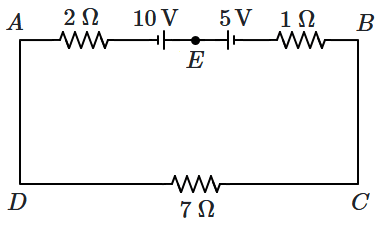
- from to through
- from to through
- from to through
- from to through
Show answer
Answer: (3) from to through
Q28 NEET 2023 Kirchhoff's Voltage Law
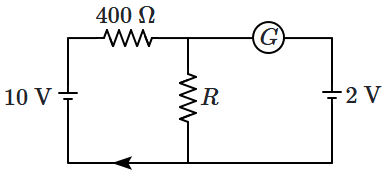
Show answer
Answer: (4)
Q29 NEET 2023 Combination of Resistors
Show answer
Answer: (3)
Why: In series the total resistance is ten times R, and in parallel it is R divided by ten, so the current ratio equals the square of the ratio of series to parallel resistance, which gives 100. Hence the current increases 100 times, matching the option 100.
Q30 NEET 2023 Derivation of Ohm's Law
Show answer
Answer: (4)
Why: The temperature coefficient of resistance is alpha = (R_t - R_0) / (R_0 × t), where R_0 is the resistance at 0 °C, R_t is the resistance at temperature t, and t is the temperature rise. Substituting the given resistances and the 80 °C rise gives 3 × 10^-2 per °C, which is option (4).
Current Electricity NEET PYQ 2022 (11 questions)
Q31 NEET 2022 (Ganganagar) EMF & Terminal Voltage
Show answer
Answer: (1)
Why: The current in the circuit is the EMF divided by the sum of the external and internal resistances, and the terminal potential difference equals the EMF minus the product of this current and the internal resistance, which simplifies to EMF times the external resistance divided by the sum of both resistances. Evaluating this with the given values gives 3.75 V, which is option (1).
Q32 NEET 2022 (Ganganagar) Combination of Resistors
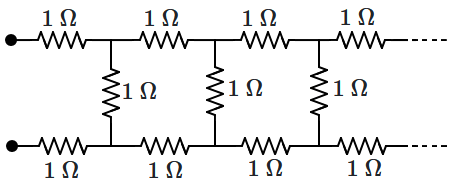
Show answer
Answer: (3)
Q33 NEET 2022 (Ganganagar) Derivation of Ohm's Law
- reactance
- mobility
- conductivity
- conductance
Show answer
Answer: (4) conductance
Why: Conductance is defined as the reciprocal of resistance, measured in siemens, so the reciprocal of resistance is conductance.
Q34 NEET 2022 (Ganganagar)
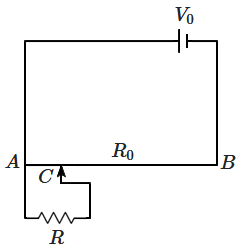
Show answer
Answer: (1)
Q35 NEET 2022 (Abroad) Derivation of Ohm's Law
The plot of current flowing through a metallic conductor versus the applied voltage across the ends of a conductor is:
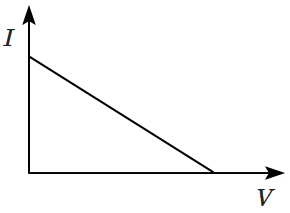
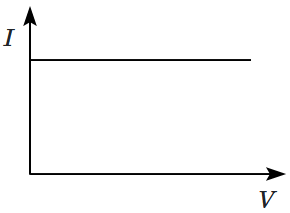
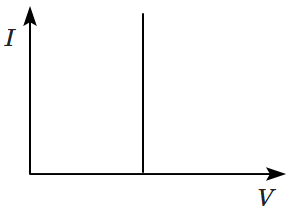
Show answer
Answer: (1) 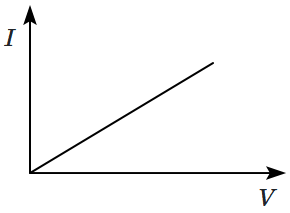
Q36 NEET 2022 (Abroad) Combination of Resistors
A network of resistors is connected across a battery with an internal resistance of as shown in the circuit diagram. The equivalent resistance of the circuit is:
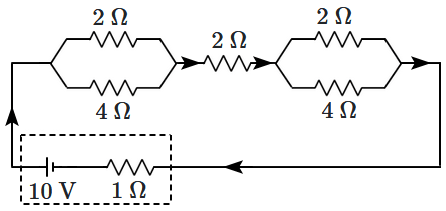
Show answer
Answer: (1)
Q37 NEET 2022 (Abroad)
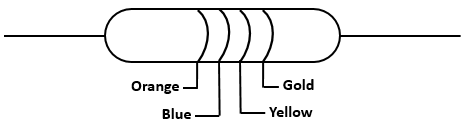
Show answer
Answer: (4)
Q38 NEET 2022 (Abroad) Meter Bridge
In a meter bridge experiment, the null point is at a distance of from If a resistance of is connected in parallel with resistance , the null point occurs at from The value of the resistance is:
Show answer
Answer: (3)
Q39 NEET 2022 Heating Effects of Current
Show answer
Answer: (3)
Why: Resistors in parallel have the same voltage across them, and the heat developed in time is proportional to the square of the voltage divided by resistance, so heat is inversely proportional to resistance. The 100 ohm resistor therefore develops heat in the ratio of the 200 ohm to the 100 ohm resistance, which is the option giving 2:1.
Q40 NEET 2022 Current & Current Density
- A/m2
- A/m2
- A/m2
- A/m2
Show answer
Answer: (1) A/m2
Why: Current density equals conductivity times electric field, and conductivity equals the wire's length divided by the product of its resistance and cross-sectional area. The area comes from the radius, and the factor of pi in the radius expression cancels against the pi in the circle area formula, so substituting the given length, resistance, field and radius gives the value in option (1).
Q41 NEET 2022 Wheatstone Bridge
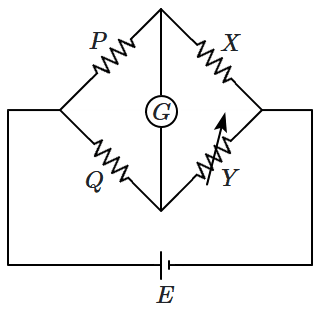
- do not play any significant role.
- should be approximately equal to .
- should be approximately equal and are small.
- should be very large and unequal.
Show answer
Answer: (3) should be approximately equal and are small.
Current Electricity NEET PYQ 2021 (4 questions)
Q42 NEET 2021 Current & Current Density
Match Column-I and Column-II with appropriate relations.
| Column-I | Column-II | ||
| Drift Velocity | |||
| Electrical Resistivity | |||
| Relaxation Period | |||
| Current Density |
- — — —
- — — —
- — — —
- — — —
Show answer
Answer: (3) — — —
Why: Drift velocity equals e E tau divided by m, which matches the option e E tau / m. Electrical resistivity equals E divided by J, the electric field divided by current density, which matches the option E/J. Relaxation period equals m divided by n e squared rho, which matches the option m/(n e^2 rho), and current density equals n e v_d, which matches the option n e v_d. Pairing these gives A with R, B with S, C with P and D with Q, which is the option R, S, P, Q.
Q43 NEET 2021
- 64 cm
- 62 cm
- 60 cm
- 21.6 cm
Show answer
Answer: (3) 60 cm
Why: In a potentiometer, the balance length is directly proportional to the emf of the cell. The new balance length therefore equals the original 36 cm multiplied by the ratio of the new emf to the original emf, which gives the option of 60 cm.
Q44 NEET 2021 Combination of Resistors
Show answer
Answer: (2)
Why: Four identical wires in parallel give an equivalent resistance equal to one wire's resistance divided by four, so each wire is four times the given parallel value. When the same four wires are joined in series, their resistances add, and the total works out to the number of wires squared times the parallel resistance, which gives 4 Ω.
Q45 NEET 2021 Kirchhoff's Voltage Law
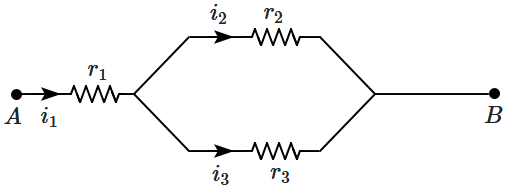
Show answer
Answer: (4)
Current Electricity NEET PYQ 2020 (8 questions)
Q46 NEET 2020 (Covid Re-exam) Grouping of Cells
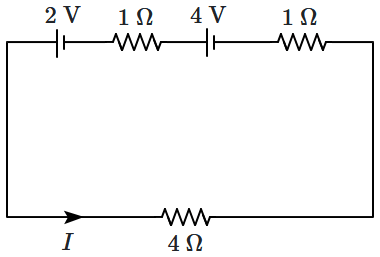
For the circuit shown in the figure, the current will be:
Show answer
Answer: (2)
Q47 NEET 2020 (Covid Re-exam) Derivation of Ohm's Law
Show answer
Answer: (2)
Why: Resistance is given by R equals rho times L divided by A, where rho is the resistivity, L the length and A the cross-sectional area. Since both conductors have the same material, the same length and the same resistance, their cross-sectional areas must be equal, so the ratio A1 divided by A2 is 1.
Q48 NEET 2020 (Covid Re-exam) Kirchhoff's Voltage Law
For the circuit given below, Kirchhoff's loop rule for the loop is given by the equation:
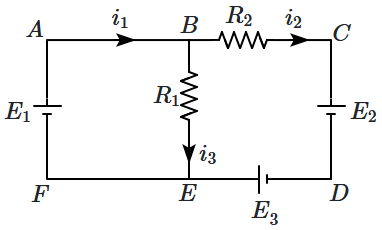
Show answer
Answer: (2)
Q49 NEET 2020 (Covid Re-exam) Combination of Resistors
The equivalent resistance between and for the mesh shown in the figure is:
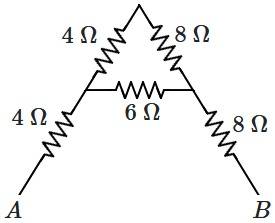
Show answer
Answer: (2)
Q50 NEET 2020 Derivation of Ohm's Law
Which of the following graph represents the variation of resistivity () with temperature () for copper?
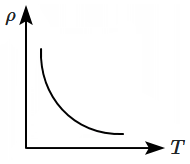
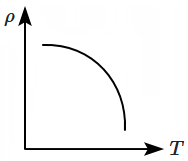
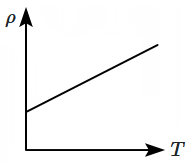
Show answer
Answer: (2) 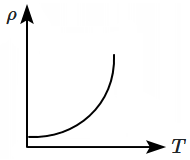
Q51 NEET 2020 Current & Current Density
Show answer
Answer: (1)
Why: Mobility is defined as the drift velocity divided by the electric field, so the drift velocity of 7.5 × 10^-4 m/s is divided by the field of 3 × 10^-10 V/m. The result is 2.5 × 10^6 m^2 V^-1 s^-1, which is option (1).
Q52 NEET 2020 Meter Bridge
A resistance wire connected in the left gap of a meter bridge balances a resistance in the right gap at a point which divides the bridge wire in the ratio . lf the length of the resistance wire is , then the length of of the resistance wire will be:
Show answer
Answer: (1)
Why: At balance the ratio of the unknown resistance to the known 10 ohm resistance equals the ratio of the two wire segments, which is given as 3:2. So the resistance wire's total resistance is 10 times 3 divided by 2, and the length per ohm is the total wire length divided by that resistance, giving 1.0 × 10^-1 m as in option (1).
Q53 NEET 2020
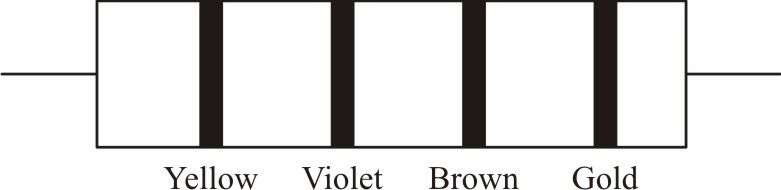
The values of resistance and tolerance, respectively are:
- 47 k, 10%
- 4.7 k, 5%
- 470 , 5%
- 470 k, 5%
Show answer
Answer: (3) 470 , 5%
Current Electricity NEET PYQ 2019 (5 questions)
Q54 NEET 2019 (Odisha) Kirchhoff's Voltage Law
The reading of an ideal voltmeter in the circuit shown is:
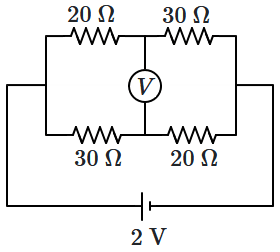
Show answer
Answer: (4)
Q55 NEET 2019 (Odisha) Meter Bridge
The metre bridge shown is in a balanced position with . If we now interchange the position of the galvanometer and the cell, will the bridge work? If yes, what will be the balanced condition?
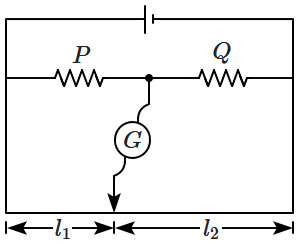
- Yes,
- No, no null point
- Yes,
- Yes,
Show answer
Answer: (4) Yes,
Q56 NEET 2019 Heating Effects of Current
Which of the following acts as a circuit protection device?
- Fuse
- Conductor
- Inductor
- Switch
Show answer
Answer: (1) Fuse
Why: A fuse is a thin wire that melts and breaks the circuit when the current exceeds a safe value, which protects the circuit from damage. Conductors, inductors and switches do not provide this protective function, so option (1) Fuse is correct.
Q57 NEET 2019 Kirchhoff's Voltage Law
In the circuits shown below, the readings of the voltmeters and the ammeters will be:
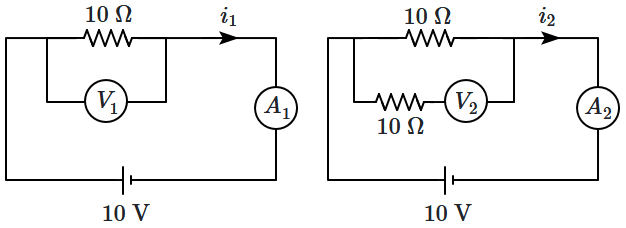
Show answer
Answer: (3)
Q58 NEET 2019 Heating Effects of Current
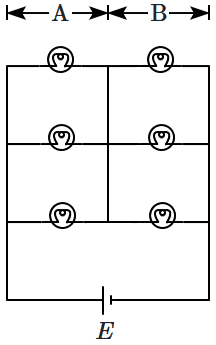
Show answer
Answer: (3)
Current Electricity NEET PYQ 2018 (3 questions)
Q59 NEET 2018
- Violet - Yellow - Orange - Silver
- Yellow - Violet - Orange - Silver
- Yellow - Green - Violet - Gold
- Green - Orange - Violet - Gold
Show answer
Answer: (2) Yellow - Violet - Orange - Silver
Why: The digits 4 and 7 of 47 kilohm are coded yellow and violet, the multiplier of one thousand is orange, and the tolerance of 4.7 out of 47 is indicated by silver. The option Yellow - Violet - Orange - Silver gives this sequence.
Q60 NEET 2018 EMF & Terminal Voltage
Show answer
Answer: (1)
Why: In series the current is E divided by the total resistance of the n resistors plus the internal resistance, while in parallel the external resistance is R divided by n, so the ratio of parallel current to series current works out to n. Since the parallel current is 10I, n equals 10, which is option (1).
Q61 NEET 2018 Grouping of Cells
A battery consists of a variable number of identical cells (having internal resistance each) which are connected in series. The terminals of the battery are short-circuited and the current is measured. Which of the graphs shows the correct relationship between and
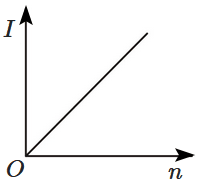
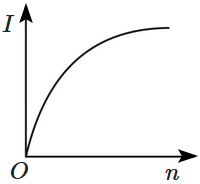
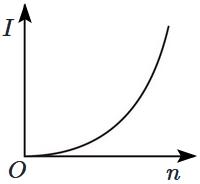
Show answer
Answer: (1) 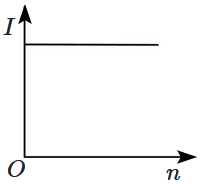
Current Electricity NEET PYQ 2017 (3 questions)
Q62 NEET 2017 Combination of Resistors
The resistance of a wire is . If it is melted and stretched times its original length, its new resistance will be:
Show answer
Answer: (2)
Why: Resistance is R equal to rho times length over area. When the wire is melted and stretched to n times its length, its volume stays constant, so its area becomes the original area divided by n while its length becomes n times the original length. The new resistance is therefore rho times n L divided by (A over n), which equals n squared times R, as in option 2.
Q63 NEET 2017
A potentiometer is an accurate and versatile device to make electrical measurements of E.M.F. because the method involves:
- the potential gradients.
- a condition of no current flow through the galvanometer.
- a condition of cells, galvanometer, and resistances.
- the cells.
Show answer
Answer: (2) a condition of no current flow through the galvanometer.
Q64 NEET 2017
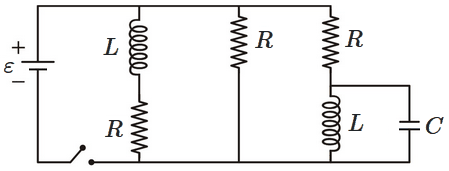
Show answer
Answer: (3)
Current Electricity NEET PYQ 2016 (4 questions)
Q65 NEET 2016 Phase 2 Kirchhoff's Voltage Law
The potential difference between the points and in the given figure is:

Show answer
Answer: (4)
Q66 NEET 2016 Phase 2 Heating Effects of Current
A filament bulb is to be used in a main supply. When a resistance is connected in series, the bulb works perfectly and consumes The value of is:
Show answer
Answer: (3)
Why: The bulb's resistance is found from R_b = V²/P using its rated 100 V and 500 W, and its rated current is P/V. For the bulb to work at its rating on the 230 V supply, the total series resistance must equal the 230 V supply voltage divided by that rated current, and R is this total minus R_b. This gives the option 26 Ω.
Q67 NEET 2016 Phase 1 Heating Effects of Current
The charge flowing through a resistance varies with time as where and are positive constants. The total heat produced in is:
Show answer
Answer: (4)
Why: The heat is the integral of I squared times R over the time the current flows, where the current is I = dQ/dt = a - 2bt and the charge returns to zero at t = a/b. Evaluating this integral gives a cubed times R divided by 6b, which matches option (4), a^3R/6b.
Q68 NEET 2016 Phase 1
- 5 : 4
- 3 : 4
- 3 : 2
- 5 : 1
Show answer
Answer: (3) 3 : 2
Why: When the cells aid each other, their combined emf balances the potentiometer at 50 cm, and when they oppose each other, the difference in emfs balances it at 10 cm. Since the emf is proportional to the balancing length, the ratio of the two emfs is (50 + 10) : (50 - 10), which simplifies to the 3 : 2 given in option (3).
Current Electricity NEET PYQ 2015 (6 questions)
Q69 AIPMT 2015 Re-exam Derivation of Ohm's Law
Show answer
Answer: (1)
Why: In series the resistances add, and each wire's resistance is its length divided by (conductivity times cross-section). With identical dimensions, the combined length is doubled while the cross-section is unchanged, so the effective conductivity is twice the product of the two conductivities divided by their sum, which is option (1).
Q70 AIPMT 2015 Re-exam Derivation of Ohm's Law
Show answer
Answer: (1)
Why: The ammeter's effective resistance is found by combining the coil and the shunt in parallel, using the product of the two divided by their sum. This equivalent is then added in series to the given 40.8 Ω resistance to get the total circuit resistance. By Ohm's law, the current is the battery voltage divided by this total resistance, which gives the reading of 0.5 A in option (1).
Q71 AIPMT 2015 Re-exam
Show answer
Answer: (2)
Why: The same current flows through the potentiometer wire and the series resistance, equal to the battery EMF divided by the total resistance r plus r1. The potential drop across a length l of the wire is that current times the resistance of length l, which is r times l over L, so the unknown EMF equals the battery EMF times r over the total resistance, times l over L, as in option (2).
Q72 AIPMT 2015 Current & Current Density
- current density
- current
- drift velocity
- electric field
Show answer
Answer: (2) current
Why: In a steady current through a conductor, charge cannot accumulate at any point, so the same current flows through every cross-section even though the cross-sectional area varies. Current density, drift velocity and electric field all change along the conductor because they depend on the area, so option (2), current, is the quantity that stays constant.
Q73 AIPMT 2015
Show answer
Answer: (1)
Why: The required potential gradient fixes the potential drop across the full wire length, and dividing that drop by the wire's resistance gives the current through the circuit. The emf divided by this current gives the total circuit resistance, and subtracting the wire's resistance leaves the series resistance, which equals option (1) 32 ohm.
Q74 AIPMT 2015 Kirchhoff's Voltage Law
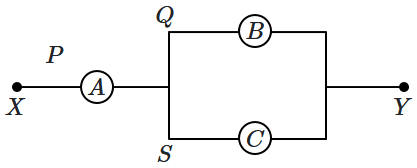
are voltmeters of resistance and respectively as shown in the figure above. When some potential difference is applied between and the voltmeter readings are and respectively. Then:
Show answer
Answer: (1)
Current Electricity NEET PYQ 2014 (3 questions)
Q75 AIPMT 2014 Meter Bridge
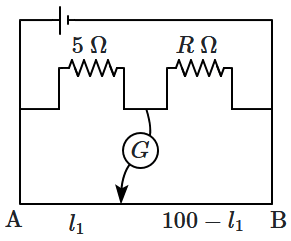
The figure given below shows a circuit when resistances in the two arms of the meter bridge are and , respectively. When the resistance is shunted with equal resistance, the new balance point is at . The resistance is:
Show answer
Answer: (2)
Q76 AIPMT 2014 Heating Effects of Current
Two cities are apart. The electric power is sent from one city to another city through copper wires. The fall of potential per km is and the average resistance per is The power loss in the wire is:
Show answer
Answer: (2)
Why: The current in the wire equals the potential fall per km divided by the resistance per km. The power loss is that current squared multiplied by the total resistance, which is the resistance per km times the full 150 km length, and this gives the option of 19.2 kW.
Q77 AIPMT 2014
Show answer
Answer: (3)
Why: For a potentiometer measuring a cell's internal resistance, r = R × (l1/l2 − 1), where l1 is the balancing length with infinite external resistance (open circuit) and l2 is the balancing length with resistance R connected. Substituting the two balancing lengths and the value of R from the question gives the option 0.5 ohm.
Current Electricity NEET PYQ 2013 (6 questions)
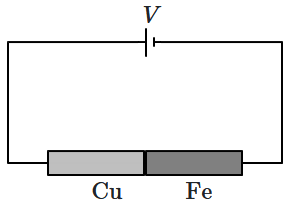
Q78 NEET 2013 (Karnataka) Derivation of Ohm's Law
Show answer
Answer: (4)
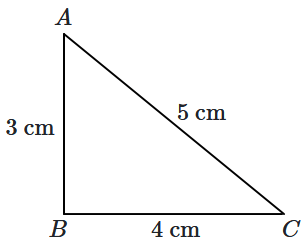
Q79 NEET 2013 (Karnataka) Combination of Resistors
Show answer
Answer: (2)
Q80 NEET 2013 (Karnataka) Grouping of Cells
Show answer
Answer: (1)
Why: The heat supplied is (nE)² t / R, where n cells of emf E are in series and the wire resistance R is proportional to length divided by the square of radius. The heat needed is proportional to the mass, which is proportional to length times the square of radius, times the temperature rise. Equating these shows that the square of the number of cells is proportional to the square of the length, so doubling the length needs double the cells, which is option (1) twenty.
Q81 NEET 2013 Derivation of Ohm's Law
Show answer
Answer: (3)
Why: Resistance is proportional to length divided by cross-sectional area, and the volume stays constant when stretched, so doubling the length halves the area and quadruples the resistance. Starting from 4 ohm, this gives the option of 16 ohm.
Q82 NEET 2013 EMF & Terminal Voltage
Show answer
Answer: (1)
Why: The terminal voltage across the external resistance equals current times that resistance, and the emf minus this voltage equals current times internal resistance. Hence internal resistance equals emf divided by current, minus the external resistance, which gives 0.5 ohm.
Q83 NEET 2013 Wheatstone Bridge
Show answer
Answer: (1)
Why: The bridge is balanced because the ratio of P to Q equals the ratio of R to S, so no current flows through the galvanometer and its resistance does not matter. The external resistance is the parallel combination of the series pairs P+Q and R+S, and the current equals the emf divided by the sum of this external resistance and the internal resistance, which gives 0.2 A.
Current Electricity NEET PYQ 2012 (5 questions)
Q84 AIPMT 2012 Mains Heating Effects of Current
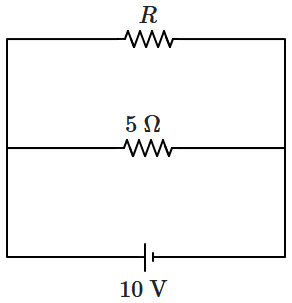
Show answer
Answer: (2)
Q85 AIPMT 2012 Mains EMF & Terminal Voltage
A cell having an emf and internal resistance is connected across a variable external resistance . As the resistance is increased, the plot of potential difference across is given by:
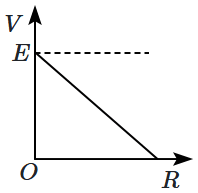
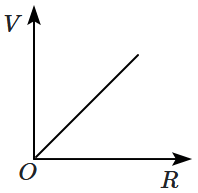
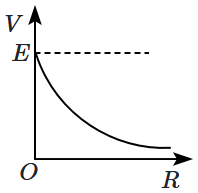
Show answer
Answer: (2) 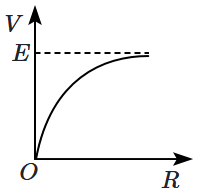
Q86 AIPMT 2012 Heating Effects of Current
Show answer
Answer: (3)
Why: Power in a fixed resistance is P = V squared divided by R, so the fractional change in power is approximately twice the fractional change in voltage. A 2.5 percent drop in voltage relative to the rated value therefore gives a power decrease of about 5 percent, which matches the third option.
Q87 AIPMT 2012 Combination of Resistors
A ring is made of a wire having a resistance of . Find points and , as shown in the figure, at which a current-carrying conductor should be connected so that the resistance of the subcircuit between these points equals
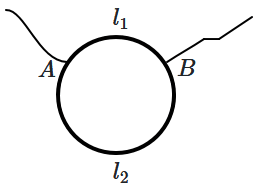
Show answer
Answer: (4)
Q88 AIPMT 2012 Kirchhoff's Voltage Law
In the circuit shown cells, and have negligible resistance. For and the galvanometer shows no deflection. The value of is:
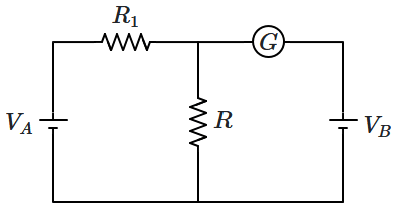
Show answer
Answer: (2)
Current Electricity NEET PYQ 2011 (3 questions)
Q89 AIPMT 2011 Heating Effects of Current
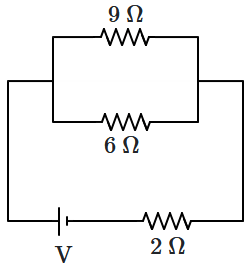
- V
- V
- V
- V
Show answer
Answer: (2) V
Q90 AIPMT 2011 EMF & Terminal Voltage
A current of flows through a resistor when connected across a battery. The same battery supplies a current of when connected across a resistor. The internal resistance of the battery is:
Show answer
Answer: (1)
Why: The battery's EMF is the same in both circuits, so the current times the external resistance plus the internal resistance r gives the same EMF in each case. Equating the two expressions and solving the resulting linear equation for r gives the value 1/3 ohm in option (1).
Q91 AIPMT 2011 Heating Effects of Current
The rate of increase of thermo-emf with the temperature at the neutral temperature of a thermocouple:
- is zero.
- depends upon the choice of the two materials of the thermocouple.
- is negative.
- is positive.
Show answer
Answer: (1) is zero.
Why: The thermo-emf of a thermocouple reaches its maximum at the neutral temperature, where its variation with temperature momentarily stops. Therefore the rate of change of thermo-emf with temperature at that point is zero.
Current Electricity NEET PYQ 2010 (2 questions)
Q92 AIPMT 2010 Kirchhoff's Current Law
| Statement I: | Kirchhoff’s junction law follows the conservation of charge. |
| Statement II: | Kirchhoff’s loop law follows the conservation of energy. |
- Both Statement I and Statement II are incorrect.
- Statement I is correct but Statement II is incorrect.
- Statement I is incorrect and Statement II is correct.
- Both Statement I and Statement II are correct.
Show answer
Answer: (4) Both Statement I and Statement II are correct.
Why: Kirchhoff's junction law states that the total current entering a junction equals the total current leaving it, which is a statement of conservation of charge. Kirchhoff's loop law states that the sum of potential changes around any closed loop is zero, which reflects conservation of energy, so both statements are correct as in option (4).
Q93 AIPMT 2010
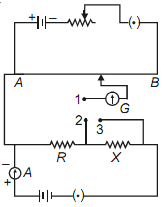
Show answer
Answer: (2)
Current Electricity NEET PYQ 2009 (3 questions)
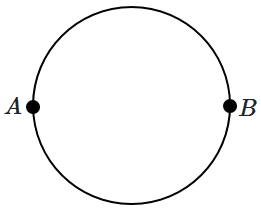
Q94 AIPMT 2009 Combination of Resistors
A wire of resistance is bent to form a complete circle of radius . The resistance between its two diametrically opposite points, and as shown in the figure, is:
Show answer
Answer: (1)
Q95 AIPMT 2009 EMF & Terminal Voltage
- and
- and
- and
- and
Show answer
Answer: (2) and
Why: The terminal voltage is V = E - Ir, which is a straight line in the form y = mx + c with V as y and I as x. Its slope is therefore -r and its intercept on the voltage axis is E, which matches the option giving slope -r and intercept E.
Q96 AIPMT 2009 Kirchhoff's Voltage Law
See the electrical circuit shown in this figure. Which of the following is a correct equation for it?
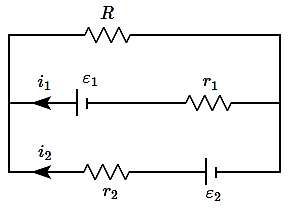
Show answer
Answer: (1)
Current Electricity NEET PYQ 2008 (5 questions)
Q97 AIPMT 2008 Heating Effects of Current
An electric kettle takes current at . How much time will it take to boil kg of water at a temperature of ? The temperature of boiling water is .
- min
- min
- min
- min
Show answer
Answer: (1) min
Why: The electrical power supplied is the voltage multiplied by the current, and the heat needed is the mass of water times its specific heat times the temperature rise from 20 to 100 degrees Celsius. The time is the heat required divided by the power, which gives the 6.3 minutes in option (1).
Q98 AIPMT 2008 Heating Effects of Current
A current of flows through the resistor shown in the circuit. The power dissipated in the resistor is:
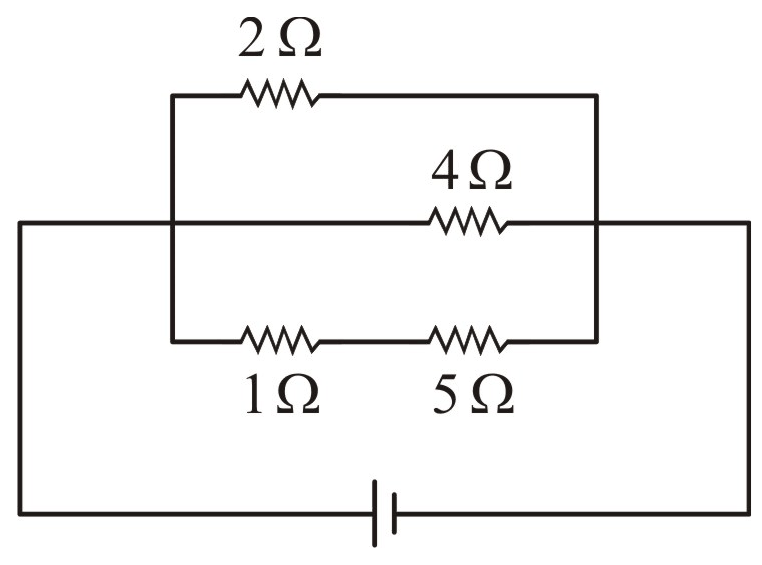
Show answer
Answer: (4)
Q99 AIPMT 2008 Combination of Resistors
- 1.2 times, 1.1 times
- 1.21 times, same
- both remain the same
- 1.1 times, 1.1 times
Show answer
Answer: (2) 1.21 times, same
Why: Stretching keeps the volume constant, so the length increases by the factor 1.1 and the cross-sectional area decreases by the reciprocal of that factor. Since resistance R = rho times L divided by A, the new resistance is 1.1 squared, which is 1.21 times the original. Specific resistance depends only on the material and temperature, so it stays the same.
Q100 AIPMT 2008
- 1.0 Ω
- 0.5 Ω
- 2.0 Ω
- zero
Show answer
Answer: (1) 1.0 Ω
Why: Without the shunt, the balancing length gives the emf E, and with the 10 Ω shunt, it gives the terminal voltage V. Since E/V = (R + r)/R, the internal resistance is r = R times (E/V minus 1). Using R = 10 Ω and the two balancing lengths 110 cm and 100 cm gives the option 1.0 Ω.
Q101 AIPMT 2008 Combination of Resistors
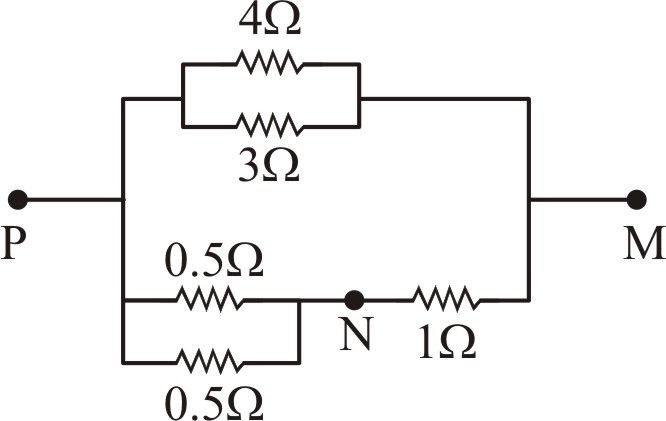
- 1.5 V
- 1.0 V
- 0.5 V
- 3.2 V
Show answer
Answer: (4) 3.2 V
Current Electricity NEET PYQ 2007 (2 questions)
Q102 AIPMT 2007 Heating Effects of Current
The total power dissipated in watts in the circuit shown below is:
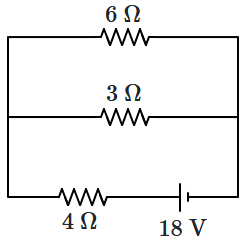
- W
- W
- W
- W
Show answer
Answer: (3) W
Q103 AIPMT 2007 Wheatstone Bridge
Three resistances , , and , each of and an unknown resistance form the four arms of a Wheatstone bridge circuit. When the resistance of is connected in parallel to , the bridge gets balanced. What is the value of ?
Show answer
Answer: (2)
Why: At balance, the ratio of the arms P/Q must equal the ratio R/S', where S' is S in parallel with 6 ohm. Since P, Q and R are each 2 ohm, S' must equal 2 ohm, and solving the parallel-combination equation for S gives 3 ohm, which is the correct option.
Current Electricity NEET PYQ 2006 (4 questions)
Q104 AIPMT 2006 Kirchhoff's Voltage Law
In the circuit shown below, if a conducting wire is connected between points and , the current in this wire will: (All resistances are given in ohms)
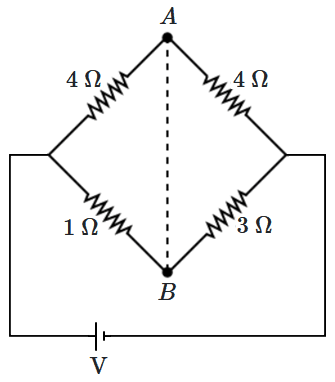
- flow from to
- flow in the direction which will be
decided by the value of - be zero
- flow from to
Show answer
Answer: (4) flow from to
Q105 AIPMT 2006 Grouping of Cells
Show answer
Answer: (1)
Why: If the cells oppose each other the net emf is zero and the current is zero, so they must aid each other, giving current equal to the total emf divided by (R + r1 + r2). The terminal potential difference of the first cell is its emf minus the current times r1, and setting this to zero gives R = r1 - r2.
Q106 AIPMT 2006 Heating Effects of Current
The power dissipated across the resistor in the circuit shown here is . The power dissipated in watts across the resistor is:
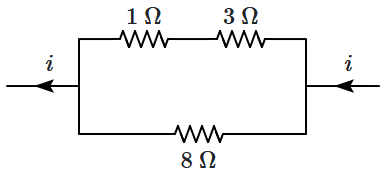
Show answer
Answer: (4)
Q107 AIPMT 2006 Kirchhoff's Voltage Law
Kirchhoff’s first and second laws for electrical circuits are consequences of:
- conservation of energy.
- conservation of electric charge and energy respectively.
- conservation of electric charge.
- conservation of energy and electric charge respectively.
Show answer
Answer: (2) conservation of electric charge and energy respectively.
Why: Kirchhoff's junction rule, that the currents entering a junction equal those leaving, follows from conservation of electric charge, while the loop rule, that the potential changes around a closed loop sum to zero, follows from conservation of energy. So the correct option is conservation of electric charge and energy respectively.
Frequently asked questions
How many Current Electricity questions have been asked in NEET?
This archive holds 107 Current Electricity questions from 33 of 33 official NEET and AIPMT papers, 2006–2026. It counts every paper held here, including re-exam and regional papers.
Which topics of Current Electricity are asked most often?
By topic tag: Heating Effects of Current (17), Derivation of Ohm's Law (15), Combination of Resistors (14), Kirchhoff's Voltage Law (13) and EMF & Terminal Voltage (9).
When was Current Electricity last asked?
The most recent paper in this archive with a question from this chapter is Re-NEET 2026.
Where do the answers come from?
Each answer is the option recorded as correct in the official answer key for that paper. Where a short explanation is shown, it was written separately and checked against the key; it is not part of the official paper. Questions marked NEET 2026 (3 May, cancelled) are from the cancelled first sitting: NTA issued no final key for it, so their answers are the key on record and have not been matched to an official key.
More Physics chapter-wise PYQs
← Electrostatic Potential and Capacitance Moving Charges and Magnetism →
Class 11
- Units and Measurement (56)
- Mathematical Tools (10)
- Motion in a Straight Line (44)
- Motion in a Plane (32)
- Laws of Motion (56)
- Work, Energy and Power (65)
- Systems of Particles and Rotational Motion (82)
- Gravitation (60)
- Mechanical Properties of Solids (14)
- Mechanical Properties of Fluids (40)
- Thermal Properties of Matter (39)
- Thermodynamics (50)
- Kinetic Theory of Gases (34)
- Oscillations (51)
- Waves (49)
Class 12
- Electric Charges and Fields (39)
- Electrostatic Potential and Capacitance (69)
- Moving Charges and Magnetism (73)
- Magnetism and Matter (35)
- Electromagnetic Induction (45)
- Alternating Current (53)
- Electromagnetic Waves (46)
- Ray Optics and Optical Instruments (76)
- Wave Optics (46)
- Dual Nature of Radiation and Matter (72)
- Atoms (47)
- Nuclei (54)
- Semiconductor Electronics (99)
Want more than past papers? Practise all 1,646 Current Electricity questions on NEETprep.