Current Electricity (Class 12 Physics) has had 107 questions in 33 of the 33 official NEET and AIPMT papers from 2006 to 2026, and 32 in the last 10 main papers (2017 to 2026). The most-asked topics are Heating Effects of Current (17), Derivation of Ohm's Law (15) and Combination of Resistors (14). This page has a short guide to the chapter and its 12 most recent past-paper questions as a quiz you can take here, with the official answers and no login.
Start the 12-question quiz All 107 Current Electricity PYQs Timed chapter test
What Current Electricity covers
Current Electricity covers electric current, drift velocity and mobility, Ohm's law, resistance and resistivity, series and parallel resistor networks, and the emf and internal resistance of cells. It also includes Kirchhoff's laws, the Wheatstone bridge and the metre bridge. Across the archive, questions from this chapter have appeared in every official paper, with the most recent in Re-NEET 2026.
Questions from this chapter number 107 across the archive, from 2006 to 2026. Heating effects of current, Ohm's law derivations and combinations of resistors have been the most frequently tested tags. In the last ten main papers, from 2017 to 2026, the chapter contributed 32 questions, so it remains a regular part of the paper.
High-yield topics in Current Electricity
Ranked by the number of past-paper questions carrying each topic tag.
- Heating Effects of Current (17 PYQs): Know Joule's heating law, electrical power and energy in terms of current, voltage and resistance, and how these relate to everyday appliances and fuse ratings.
- Derivation of Ohm's Law (15 PYQs): Understand how drift velocity and mobility lead to current proportional to voltage, and be able to state the conditions under which Ohm's law holds for conductors.
- Combination of Resistors (14 PYQs): Practise equivalent resistance for series and parallel networks, including mixed arrangements, and check that the answer is smaller than the smallest resistor in a parallel group.
- Kirchhoff's Voltage Law (13 PYQs): Apply the loop rule with consistent sign conventions for emf and potential drops, choosing a direction for each loop and marking currents before writing any equation.
- EMF & Terminal Voltage (9 PYQs): Separate emf from terminal voltage, remembering that terminal voltage falls below emf when the cell supplies current because of its internal resistance.
- Wheatstone Bridge (7 PYQs): Learn the balance condition and use it to find an unknown resistance, noting that no current flows through the galvanometer when the bridge is balanced.
Common mistakes in Current Electricity
- Mixing up emf and terminal voltage in cell problems. Students often use emf where the question gives terminal voltage. Write the relation with internal resistance explicitly before substituting values.
- Applying Kirchhoff's loop rule with inconsistent signs. Pick a traversal direction for each loop, record the sign of every emf and potential drop as you pass it, and keep the same convention throughout the solution.
- Using the balance condition without checking the bridge is balanced. Confirm zero galvanometer deflection first, and in a metre bridge use wire lengths, valid for uniform wire of the same cross-section.
- Mixing up power and energy in heating problems, or forgetting to convert hours into seconds for joules. Write units beside every quantity and check the final unit matches what the question asks.
How to practise Current Electricity
- Start by deriving the key relations from first principles: Ohm's law from drift velocity, then series and parallel rules. Write each derivation once in your notebook without looking at the book.
- Work through the NCERT worked examples for Kirchhoff's laws, circuit reduction and the Wheatstone bridge, then solve similar problems with changed values until each method feels routine.
- Practise past questions by topic tag, timing yourself and reviewing every wrong answer. Sort errors into conceptual, algebra and unit mistakes so you can see which category needs more work.
- Build a one-page summary of formulas and sign conventions for emf, internal resistance and the metre bridge, and revise it weekly. Redo one problem from each topic every few days to keep methods fresh.
Current Electricity NEET MCQs: 12 most recent PYQs
Click an option to check it. The correct option and the answer appear at once; nothing is stored or sent.
Q1 Re-NEET 2026 Derivation of Ohm's Law
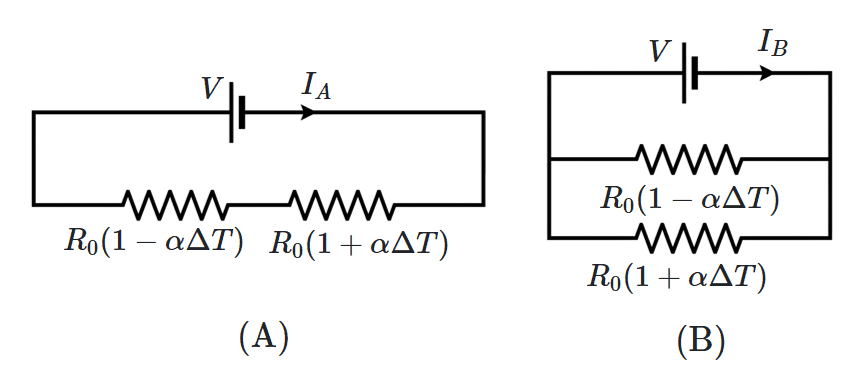
- both and remain constant
- remains constant while increases
- decreases while increases
- increases while decreases
Answer: (2) remains constant while increases
Q2 NEET 2026 (3 May, cancelled) Wheatstone Bridge
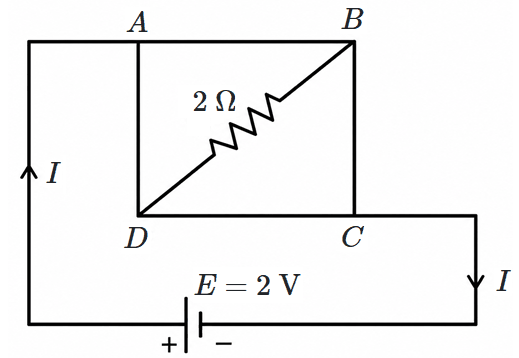
Answer: (1)
Q3 NEET 2026 (3 May, cancelled) Meter Bridge
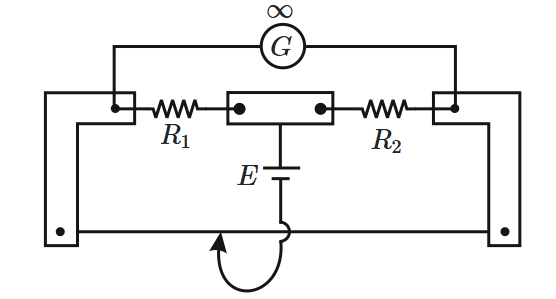
- Only the right-sided deflection.
- Only the left-sided deflection.
- There will be no deflection irrespective of the position of the jockey.
- Both right-sided and left-sided deflection and, at balance point, no deflection.
Answer: (4) Both right-sided and left-sided deflection and, at balance point, no deflection.
Q4 NEET 2026 (3 May, cancelled) EMF & Terminal Voltage
Answer: (2)
Why: The terminal voltage of a cell is its EMF minus the voltage drop across its internal resistance, that is, EMF minus current times internal resistance. Using the given EMF, current and internal resistance in this formula gives the option of 10.8 V.
Q5 NEET 2026 (3 May, cancelled) Heating Effects of Current
Answer: (2)
Why: For a fixed heater resistance, power is proportional to the square of the applied voltage, since P equals V squared over R. The new power is therefore the rated 400 W multiplied by the square of the ratio of 200 V to 220 V, which comes to about 331 W, the option stated as 331 W.
Q6 NEET 2025 Wheatstone Bridge
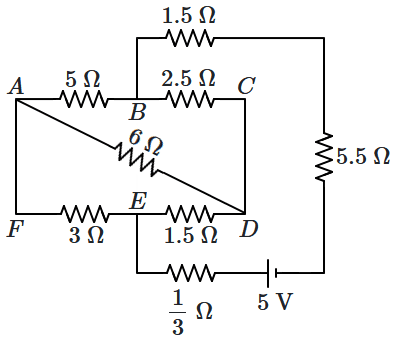
Answer: (4)
Q7 NEET 2025 Combination of Resistors
Answer: (1)
Q8 NEET 2025 Kirchhoff's Voltage Law
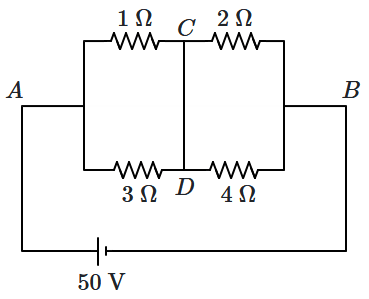
Answer: (4)
Q9 NEET 2024 (Jhajjar) Wheatstone Bridge
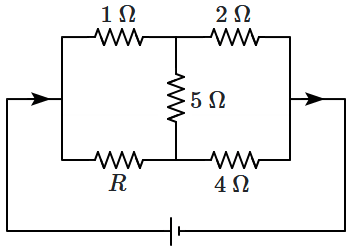
Answer: (4)
Q10 NEET 2024 (Jhajjar) Combination of Resistors
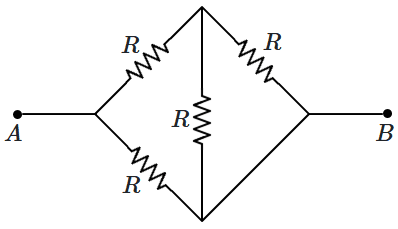
Answer: (2)
Q11 NEET 2024 (Jhajjar) Heating Effects of Current
Answer: (2)
Why: For a fixed supply voltage, the heating time is proportional to the heater's resistance, since the heat needed is fixed and the power is the square of the voltage divided by the resistance. In series the resistances add, so the total resistance is the sum of the two, and the boiling time for the combination is the sum t1 plus t2, option (2).
Q12 NEET 2024 (Jhajjar) Derivation of Ohm's Law
| A. | ( to ) ranged ammeter. |
| B. | ( to ) ranged milli-ammeter. |
| C. | ( to ) ranged micro-ammeter. |
| D. | ( to ) ranged voltmeter. |
Choose the correct answer from the options given below:
Answer: (2)
Why: A voltmeter is a galvanometer with a large series resistance, so it has the highest resistance, and among ammeters a lower full-scale current requires a larger shunt resistance is not the case; instead a lower full-scale current means a higher series resistance is needed for the galvanometer, so the micro-ammeter has the largest resistance among the ammeters, then the milli-ammeter, then the 1 A ammeter with the smallest resistance. Hence the voltmeter is greatest and the 1 A ammeter is smallest, giving the order in the option D greater than C greater than B greater than A.
That is 12 of the 107 Current Electricity questions in the archive. See all 107 grouped by year or take a timed test drawn from the chapter.
Current Electricity PYQs by year
| Year | Papers in archive | Questions |
|---|---|---|
| 2026 | 2 | 5 |
| 2025 | 1 | 3 |
| 2024 | 3 | 13 |
| 2023 | 2 | 9 |
| 2022 | 3 | 11 |
| 2021 | 1 | 4 |
| 2020 | 2 | 8 |
| 2019 | 2 | 5 |
| 2018 | 1 | 3 |
| 2017 | 1 | 3 |
| 2016 | 2 | 4 |
| 2015 | 2 | 6 |
| 2014 | 1 | 3 |
| 2013 | 2 | 6 |
| 2012 | 2 | 5 |
| 2011 | 1 | 3 |
| 2010 | 1 | 2 |
| 2009 | 1 | 3 |
| 2008 | 1 | 5 |
| 2007 | 1 | 2 |
| 2006 | 1 | 4 |
Frequently asked questions
How many questions come from Current Electricity in NEET?
In the last 10 main papers (2017 to 2026) Current Electricity had 32 questions in total. Across all 33 papers in this archive it has 107. NTA does not publish a chapter-wise weightage; these are counts of past papers.
Which Current Electricity topics are most important for NEET?
By the number of past-paper questions per topic tag: Heating Effects of Current (17), Derivation of Ohm's Law (15), Combination of Resistors (14), Kirchhoff's Voltage Law (13) and EMF & Terminal Voltage (9).
Are these Current Electricity MCQs from real NEET papers?
Yes. Every question on this page is from an official NEET or AIPMT paper, and each one shows the paper it came from. The latest paper with a question from this chapter is Re-NEET 2026. Questions marked NEET 2026 (3 May, cancelled) are from the cancelled first sitting: NTA issued no final key for it, so their answers are the key on record and have not been matched to an official key.
What topics does the Current Electricity chapter cover for NEET Physics?
The chapter covers electric current, drift velocity and mobility, Ohm's law, resistance and resistivity, series and parallel combinations, temperature dependence of resistance, emf and internal resistance of cells, Kirchhoff's laws, the Wheatstone bridge and the metre bridge. Heating effects of current and electrical power are also part of the unit.
What is the best way to study Current Electricity for NEET Physics?
Start with the derivations of Ohm's law and resistor combinations, then move to cells, Kirchhoff's laws and bridges. Solve problems by hand, checking units and signs at each step. Revise the formulas regularly, because the same circuit ideas recur across the chapter's questions.
What is the difference between emf and terminal voltage in Current Electricity?
EMF is the energy supplied per unit charge by a cell when no current is drawn. Terminal voltage is the potential difference across the cell's terminals when current flows, and it is smaller than emf by the drop across the internal resistance. The two are equal only on open circuit.
How do I use a Wheatstone bridge to find an unknown resistance in Current Electricity?
Arrange the four resistances in the bridge and connect the galvanometer across the two midpoints. Adjust the variable arm until the galvanometer shows zero deflection. At balance, the ratio of the two arms on one side equals the ratio on the other, so the unknown resistance follows directly.
More Physics chapters
← Electrostatic Potential and Capacitance Moving Charges and Magnetism →
Class 11
- Units and Measurement
- Mathematical Tools
- Motion in a Straight Line
- Motion in a Plane
- Laws of Motion
- Work, Energy and Power
- Systems of Particles and Rotational Motion
- Gravitation
- Mechanical Properties of Solids
- Mechanical Properties of Fluids
- Thermal Properties of Matter
- Thermodynamics
- Kinetic Theory of Gases
- Oscillations
- Waves
Class 12
- Electric Charges and Fields
- Electrostatic Potential and Capacitance
- Moving Charges and Magnetism
- Magnetism and Matter
- Electromagnetic Induction
- Alternating Current
- Electromagnetic Waves
- Ray Optics and Optical Instruments
- Wave Optics
- Dual Nature of Radiation and Matter
- Atoms
- Nuclei
- Semiconductor Electronics
Want more than past papers? Practise all 1,646 Current Electricity questions on NEETprep.