Semiconductor Electronics (Class 12 Physics) has had 99 questions in 33 of the 33 official NEET and AIPMT papers from 2006 to 2026, and 30 in the last 10 main papers (2017 to 2026). The most-asked topics are Logic gates (31), PN junction (19) and Applications of PN junction (12). This page has a short guide to the chapter and its 12 most recent past-paper questions as a quiz you can take here, with the official answers and no login.
Start the 12-question quiz All 99 Semiconductor Electronics PYQs Timed chapter test
What Semiconductor Electronics covers
Semiconductor Electronics covers how semiconductors conduct electricity, the energy band picture that explains it, and the behaviour of the PN junction diode under forward and reverse bias. It also covers special devices such as the Zener diode, LED, photodiode and solar cell, along with diode rectifiers and the basic logic gates: OR, AND, NOT, NAND and NOR. The NEET syllabus unit for electronic devices defines the scope.
The chapter has appeared in 33 official papers from 2006 to 2026, with 99 questions in total and 30 in the last ten main papers from 2017 to 2026. The most recent appearance was Re-NEET 2026. Logic gates account for the largest group, 31 questions, followed by PN junction with 19 and applications of the PN junction with 12.
High-yield topics in Semiconductor Electronics
Ranked by the number of past-paper questions carrying each topic tag.
- Logic gates (31 PYQs): Know the truth table and symbol for each of OR, AND, NOT, NAND and NOR, and be able to combine them to produce a required output.
- PN junction (19 PYQs): Understand depletion layer formation, and how the diode conducts in forward bias but blocks current in reverse bias, using its I-V characteristic curve.
- Applications of PN junction (12 PYQs): Know how the LED, photodiode and solar cell work, their I-V characteristics, and how the Zener diode acts as a voltage regulator.
- Types of Semiconductors (7 PYQs): Distinguish intrinsic and extrinsic semiconductors, and n-type from p-type doping with pentavalent and trivalent impurities.
- Energy Band theory (6 PYQs): Learn how valence and conduction bands, and the energy gap between them, separate conductors, semiconductors and insulators.
- Rectifier (4 PYQs): Know how a diode passes current in one direction only, and how half-wave and full-wave rectifiers convert alternating current to direct current.
Common mistakes in Semiconductor Electronics
- Confusing forward and reverse bias: students often connect the positive terminal to the n-side. Forward bias connects positive to p-side and negative to n-side, which lowers the barrier. Draw the battery each time.
- Mixing up NAND and NOR outputs, or forgetting that NAND is AND followed by NOT. Write the truth table for each gate before combining them, and check every input combination.
- Treating the Zener diode as an ordinary diode in reverse bias. A Zener works in reverse breakdown to hold a fixed voltage, so check whether the applied voltage exceeds its breakdown voltage before deciding.
- Assuming a semiconductor has no current at all at room temperature. Some electrons gain enough energy to cross the energy gap, so the conduction band is partly populated and conduction occurs.
How to practise Semiconductor Electronics
- Read the NCERT chapter once for the device descriptions, then draw the I-V curves for the diode, LED, photodiode and Zener from memory and check them against the text.
- Build truth tables for OR, AND, NOT, NAND and NOR, then combine two gates to produce a given output. Work through each problem without looking at the answer until you can predict the output.
- Practise past questions by topic, starting with logic gates and the PN junction, since these carry the most counts. Time yourself, then review each wrong answer and note which concept caused it.
- Write a one-page summary of the chapter from memory, covering band theory, doping, the diode, rectifiers and logic gates, then compare it with your notes and fill the gaps.
Semiconductor Electronics NEET MCQs: 12 most recent PYQs
Click an option to check it. The correct option and the answer appear at once; nothing is stored or sent.
Q1 Re-NEET 2026 Applications of PN junction
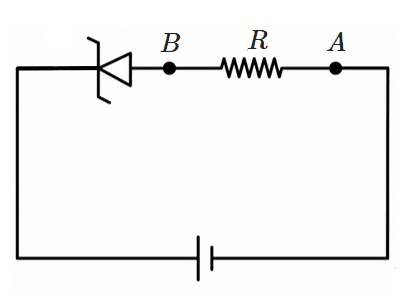
- V
- V
- V
- V
Answer: (3) V
Q2 Re-NEET 2026 PN junction
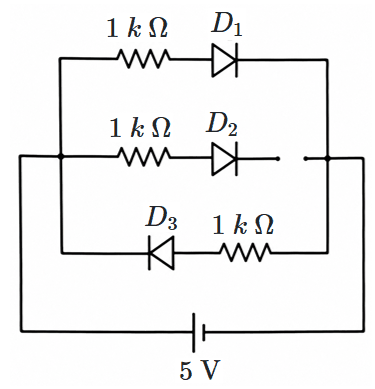
Answer: (4)
Q3 NEET 2026 (3 May, cancelled) PN junction
(All diodes are ideal and identical.)
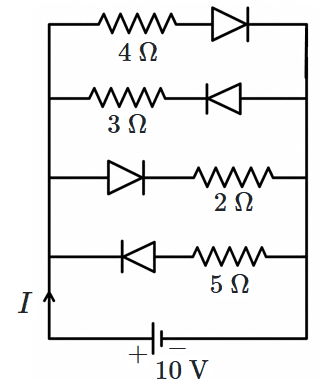
Answer: (2)
Q4 NEET 2026 (3 May, cancelled) PN junction
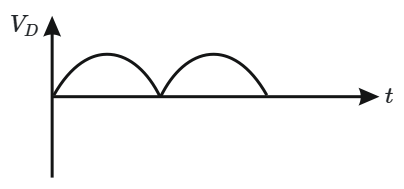
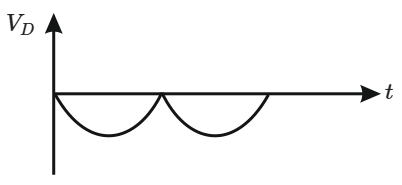
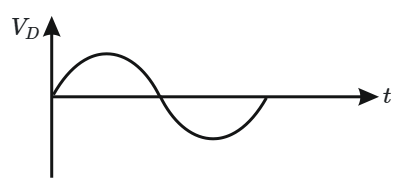
Answer: (2) 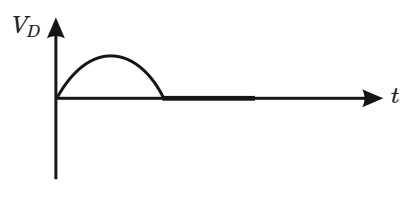
Q5 NEET 2026 (3 May, cancelled) PN junction
| When the forward bias voltage across a junction diode increases above a certain threshold voltage, the diode current increases significantly. | |
| This current is called reverse saturation current. |
- Both Statements and are False.
- Statement is True, but Statement is False.
- Both Statements and are True.
- Statement is False, but Statement is True.
Answer: (2) Statement is True, but Statement is False.
Why: Statement A is true, since a forward-biased p-n junction conducts strongly once the voltage exceeds the threshold (knee) voltage. Statement B is false because the current described in statement B is the reverse saturation current, which flows under reverse bias rather than forward bias.
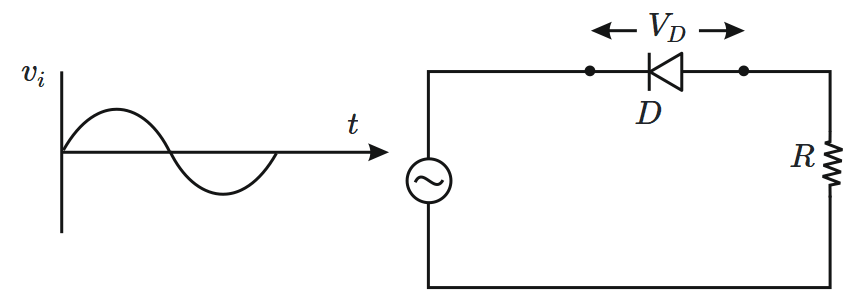
Q6 NEET 2025 Rectifier
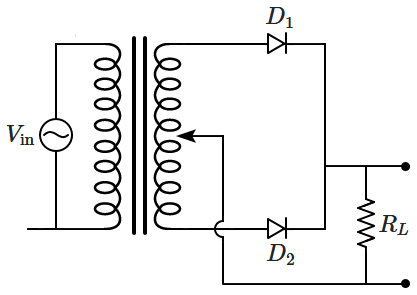
- and both are forward biased
- and both are reverse biased
- Neither nor conducts at any time
- is reverse biased, is forward biased
Answer: (4) is reverse biased, is forward biased
Q7 NEET 2025 Logic gates
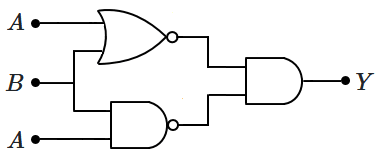
- OR
- NOR
- AND
- NAND
Answer: (2) NOR
Q8 NEET 2024 (Jhajjar) Applications of PN junction
- in forward bias only.
- in reverse bias only.
- as a voltage regulator in forward bias and as a simple pn junction diode in reverse bias.
- as a voltage regulator in reverse bias and as a simple pn junction diode in forward bias.
Answer: (4) as a voltage regulator in reverse bias and as a simple pn junction diode in forward bias.
Why: A Zener diode is designed to be used in reverse bias, where it maintains a nearly constant voltage across its terminals and acts as a voltage regulator. In forward bias it conducts like an ordinary pn junction diode, which is option (4).
Q9 NEET 2024 (Jhajjar) Applications of PN junction
- forward biased Zener diode.
- type of light-emitting diode.
- diode working on the principle of photo-voltaic effect.
- type of photo-diode with external biasing.
Answer: (3) diode working on the principle of photo-voltaic effect.
Why: A solar cell is a diode that converts light energy directly into an electromotive force by the photovoltaic effect, and it works without any external bias. This matches option (3), the diode working on the principle of the photovoltaic effect.
Q10 NEET 2024 (Jhajjar) Logic gates
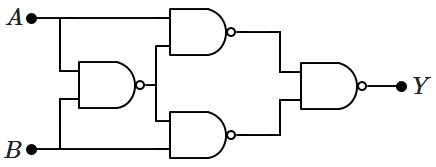
Answer: (2)
Q11 NEET 2024 Re-exam (1,563 candidates) Applications of PN junction
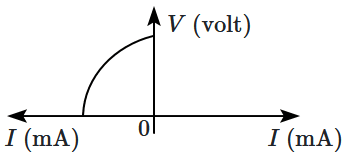
- Light-emitting diode
- Zener diode
- Photodiode
- Solar cell
Answer: (4) Solar cell
Q12 NEET 2024 Re-exam (1,563 candidates) Logic gates
- NAND gate
- NOR gate
- AND gate
- OR gate
Answer: (2) NOR gate
Why: An OR gate followed by a NOT gate inverts the OR output, which is the definition of a NOR gate. So the combination acts as the NOR gate option.
That is 12 of the 99 Semiconductor Electronics questions in the archive. See all 99 grouped by year or take a timed test drawn from the chapter.
Semiconductor Electronics PYQs by year
| Year | Papers in archive | Questions |
|---|---|---|
| 2026 | 2 | 5 |
| 2025 | 1 | 2 |
| 2024 | 3 | 10 |
| 2023 | 2 | 6 |
| 2022 | 3 | 10 |
| 2021 | 1 | 3 |
| 2020 | 2 | 8 |
| 2019 | 2 | 4 |
| 2018 | 1 | 3 |
| 2017 | 1 | 3 |
| 2016 | 2 | 6 |
| 2015 | 2 | 4 |
| 2014 | 1 | 2 |
| 2013 | 2 | 6 |
| 2012 | 2 | 7 |
| 2011 | 1 | 4 |
| 2010 | 1 | 4 |
| 2009 | 1 | 3 |
| 2008 | 1 | 3 |
| 2007 | 1 | 3 |
| 2006 | 1 | 3 |
Frequently asked questions
How many questions come from Semiconductor Electronics in NEET?
In the last 10 main papers (2017 to 2026) Semiconductor Electronics had 30 questions in total. Across all 33 papers in this archive it has 99. NTA does not publish a chapter-wise weightage; these are counts of past papers.
Which Semiconductor Electronics topics are most important for NEET?
By the number of past-paper questions per topic tag: Logic gates (31), PN junction (19), Applications of PN junction (12), Types of Semiconductors (7) and Energy Band theory (6).
Are these Semiconductor Electronics MCQs from real NEET papers?
Yes. Every question on this page is from an official NEET or AIPMT paper, and each one shows the paper it came from. The latest paper with a question from this chapter is Re-NEET 2026. Questions marked NEET 2026 (3 May, cancelled) are from the cancelled first sitting: NTA issued no final key for it, so their answers are the key on record and have not been matched to an official key.
How should I study Semiconductor Electronics for NEET Physics?
Start with the NCERT text on semiconductors and the PN junction, since it defines the concepts used in later questions. Then practise the diode characteristics, the special diodes and the logic gates with truth tables. Finish with timed practice on past questions by topic, reviewing every mistake.
What is the difference between a PN junction diode and a Zener diode in Semiconductor Electronics?
A PN junction diode is normally used in forward bias to pass current and in reverse bias it blocks current until breakdown. A Zener diode is designed to operate in reverse breakdown, where it keeps a nearly fixed voltage across its terminals, which is why it is used as a voltage regulator.
How do I solve logic gate questions in Semiconductor Electronics quickly?
Write the inputs in a column, list every combination, then work the output through each gate in order, starting from the innermost gate. Keep a truth table for NAND and NOR ready, because they are often combined with other gates. Check the final column against the question before choosing an option.
Why does a semiconductor conduct better at higher temperature in Semiconductor Electronics?
At higher temperature more electrons gain enough thermal energy to cross the energy gap from the valence band into the conduction band. This increases the number of charge carriers, so conductivity rises. Metals behave differently, because their conduction band is already partly filled.
More Physics chapters
← Nuclei
Class 11
- Units and Measurement
- Mathematical Tools
- Motion in a Straight Line
- Motion in a Plane
- Laws of Motion
- Work, Energy and Power
- Systems of Particles and Rotational Motion
- Gravitation
- Mechanical Properties of Solids
- Mechanical Properties of Fluids
- Thermal Properties of Matter
- Thermodynamics
- Kinetic Theory of Gases
- Oscillations
- Waves
Class 12
- Electric Charges and Fields
- Electrostatic Potential and Capacitance
- Current Electricity
- Moving Charges and Magnetism
- Magnetism and Matter
- Electromagnetic Induction
- Alternating Current
- Electromagnetic Waves
- Ray Optics and Optical Instruments
- Wave Optics
- Dual Nature of Radiation and Matter
- Atoms
- Nuclei
Want more than past papers? Practise all 1,481 Semiconductor Electronics questions on NEETprep.