Chemical Bonding and Molecular Structure (Class 11 Chemistry) has had 105 questions in 33 of the 33 official NEET and AIPMT papers from 2006 to 2026, and 24 in the last 10 main papers (2017 to 2026). The most-asked topics are M.O.T (29), Hybridisation (26) and V.S.E.P.R & V.B.T (25). This page has a short guide to the chapter and its 12 most recent past-paper questions as a quiz you can take here, with the official answers and no login.
Start the 12-question quiz All 105 Chemical Bonding and Molecular Structure PYQs Timed chapter test
What Chemical Bonding and Molecular Structure covers
This chapter covers the Kossel-Lewis approach, ionic and covalent bonds, electronegativity, dipole moment, VSEPR shapes, valence bond theory with hybridisation, resonance, molecular orbital theory, bond order, and hydrogen bonding. Across the archive, 105 questions from this chapter have appeared in 33 official papers, spanning 2006 to 2026. The most recent paper with a question from this chapter is Re-NEET 2026.
Molecular orbital theory is the most frequently tagged topic, with 29 questions, followed by hybridisation with 26 and the VSEPR and valence bond theory tag with 25. In the last ten main papers, from 2017 to 2026, 24 questions came from this chapter. Students should treat these figures as a record of past questions, not a forecast.
High-yield topics in Chemical Bonding and Molecular Structure
Ranked by the number of past-paper questions carrying each topic tag.
- M.O.T (29 PYQs): Know LCAOs, bonding and antibonding orbitals, and the electronic configurations of homonuclear diatomic molecules, which feed directly into bond order.
- Hybridisation (26 PYQs): Be able to assign hybrid orbitals involving s, p and d orbitals, and link each hybridisation to the geometry it produces in simple molecules.
- V.S.E.P.R & V.B.T (25 PYQs): Use VSEPR to predict shapes from lone pairs and bonding pairs, and use valence bond theory with hybridisation to explain how bonds form in simple molecules.
- Polarity (11 PYQs): Understand electronegativity differences, bond polarity and dipole moment, and how molecular shape decides whether individual bond dipoles cancel out.
- Types of Chemical Bond (9 PYQs): Distinguish ionic, covalent and metallic bonding, and be able to explain factors that favour ionic bond formation, including lattice enthalpy.
- Octate, Isoelectronic Species, Lewis Structure & Formal Charge (7 PYQs): Draw Lewis structures, calculate formal charge, and recognise octet exceptions and isoelectronic species, which help you check electron counts quickly.
Common mistakes in Chemical Bonding and Molecular Structure
- Assuming all molecules with polar bonds are polar. Check the geometry: symmetrical shapes can cancel bond dipoles, so the molecule ends up non-polar despite polar bonds.
- Counting bond order from the number of electrons without filling molecular orbitals in increasing energy order. Write the configuration first, then count bonding minus antibonding electrons and halve the result.
- Assigning hybridisation by counting atoms rather than electron domains. Count bonding pairs plus lone pairs around the central atom, and remember that lone pairs count toward the hybridisation.
- Mixing up resonance with isomerism. Resonance structures differ only in electron placement while the atoms stay in the same positions, so the actual molecule is a hybrid, not a rapidly switching mixture.
How to practise Chemical Bonding and Molecular Structure
- Start by drawing Lewis structures for a set of simple molecules, then assign VSEPR geometry and hybridisation. Check each answer against the shape before moving on.
- Write molecular orbital configurations for the homonuclear diatomic molecules in the first two periods, then calculate bond order and compare bond length and bond energy across the series.
- Work through past questions by topic tag, sorting each by its topic, then explain the answer aloud in a sentence to check you understand the reasoning, not just the result.
- Keep a short error log of wrong answers, noting whether the mistake was in geometry, electron counting or theory, and revisit those entries before each practice session.
Chemical Bonding and Molecular Structure NEET MCQs: 12 most recent PYQs
Click an option to check it. The correct option and the answer appear at once; nothing is stored or sent.
Q1 Re-NEET 2026 M.O.T
- σ*2p
- π2p
- σ2p
- π*2p
Answer: (1) σ*2p
Why: When the molecular orbitals of Ne2 are filled in order of increasing energy, the last orbital to receive electrons is the antibonding sigma orbital formed from the 2p atomic orbitals. That orbital is therefore the highest occupied molecular orbital.
Q2 Re-NEET 2026 V.S.E.P.R & V.B.T
| List-I | List-II | ||
| A. | PCl5 | I. | Tetrahedral |
| B. | BrF5 | II. | Square Planar |
| C. | BF4- | III. | Trigonal bipyramidal |
| D. | [Ni(CN)4]2- | IV. | Square Pyramidal |
Choose the correct answer from the options given below:
- A-III, B-II, C-I, D-IV
- A-IV, B-III, C-I, D-II
- A-III, B-IV, C-I, D-II
- A-III, B-I, C-II, D-IV
Answer: (3) A-III, B-IV, C-I, D-II
Why: PCl5 is trigonal bipyramidal because it has five bonded pairs and no lone pairs on phosphorus. BrF5 is square pyramidal because bromine carries a lone pair in addition to its bonded fluorines, BF4- is tetrahedral, and [Ni(CN)4]2- is square planar due to the dsp hybridised nickel with strong field cyanide ligands.
Q3 NEET 2026 (3 May, cancelled) V.S.E.P.R & V.B.T
- It has a trigonal pyramidal geometry with two lone pairs on Cl atom
- It has T-shaped geometry with two lone pairs on Cl atom
- It has a trigonal planar geometry with two lone pairs on Cl atom
- It has T-shaped geometry with three lone pairs on Cl atom
Answer: (2) It has T-shaped geometry with two lone pairs on Cl atom
Why: In ClF3 the central Cl has 3 bonding pairs and 2 lone pairs, giving five electron domains arranged as a trigonal bipyramid, and the lone pairs occupy equatorial positions so the molecule is T-shaped. This is the content of option (2).
Q4 NEET 2026 (3 May, cancelled) Types of Chemical Bond
| List-I | List-II | ||
| A. | C2H4 | I. | 3 σ bonds, 2 π bonds |
| B. | C2H2 | II. | 3 σ bonds, one lone pair |
| C. | CH4 | III. | 4 σ bonds |
| D. | NH3 | IV. | 5 σ bonds, 1 π bond |
Choose the correct answer from the options given below :
- A-IV, B-I, C-III, D-II
- A-III, B-IV, C-II, D-I
- A-I, B-II, C-IV, D-III
- A-II, B-III, C-I, D-IV
Answer: (1) A-IV, B-I, C-III, D-II
Why: C2H4 (ethene) has five sigma bonds and one pi bond, so A matches IV. C2H2 (ethyne) has three sigma bonds and two pi bonds, so B matches I. CH4 (methane) has four sigma bonds, so C matches III. NH3 has three sigma bonds and one lone pair on nitrogen, so D matches II.
Q5 NEET 2026 (3 May, cancelled) Octate, Isoelectronic Species, Lewis Structure & Formal Charge
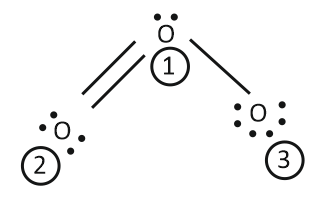
The correct formal charges on oxygen atoms numbered 2, 1 and 3 respectively are:
- -1, 0, +1
- 0, +1, -1
- 0, 0, 0
- +1, 0, -1
Answer: (2) 0, +1, -1
Q6 NEET 2025 M.O.T
| Statement I: | A hypothetical diatomic molecule with bond order zero is quite stable. |
| Statement II: | As bond order increases, the bond length increases. |
- Statement I is True but Statement II is False.
- Statement I is False but Statement II is True.
- Both Statement I and Statement II are True.
- Both Statement I and Statement II are False.
Answer: (4) Both Statement I and Statement II are False.
Q7 NEET 2025 V.S.E.P.R & V.B.T
| List-I | List-II | ||
| A. | I. | linear | |
| B. | II. | pyramidal | |
| C. | III. | distorted octahedral | |
| D. | IV. | square pyramidal |
- A-IV, B-II, C-III, D-I
- A-IV, B-II, C-I, D-III
- A-II, B-I, C-IV, D-III
- A-II, B-I, C-III, D-IV
Answer: (3) A-II, B-I, C-IV, D-III
Q8 NEET 2025 M.O.T
| A. | dipole moment |
| B. | number of lone pairs on central atom |
| C. | bond length |
| D. | bond enthalpy |
- A and C only
- B and C only
- A and D only
- B and D only
Answer: (3) A and D only
Why: Water has a larger dipole moment than ammonia, which is larger than chloroform, so the order in statement A holds. The bond enthalpy order N2 > O2 > H2 in statement D is also correct, because the triple bond in nitrogen is the strongest of these. Statement B is wrong because XeF2 has the most lone pairs on xenon and XeO3 has the fewest, and statement C is wrong because the N-O bond is the longest of the three, not the shortest.
Q9 NEET 2024 (Jhajjar) M.O.T
- Hydrogen (H₂)
- Lithium (Li₂)
- Carbon (C₂)
- Oxygen (O₂)
Answer: (4) Oxygen (O₂)
Why: According to molecular orbital theory, the oxygen molecule has unpaired electrons in its antibonding pi* orbitals, which makes it paramagnetic. The hydrogen, lithium and carbon molecules have all their electrons paired in molecular orbitals and are therefore diamagnetic.
Q10 NEET 2024 (Jhajjar) V.S.E.P.R & V.B.T
A.
B.
C.
D.
Choose the correct answer from the options given below:
- B > A > D > C
- B > A > C > D
- D > C > B > A
- A > C > B > D
Answer: (3) D > C > B > A
Why: Bond angle decreases down the group as the central atom becomes larger and less electronegative, so the bond pairs sit farther apart and repel less. Nitrogen, the smallest and most electronegative, has the largest angle, followed by phosphorus, arsenic and antimony, so the order is NH3 > PH3 > AsH3 > SbH3, which is the option D > C > B > A.
Q11 NEET 2024 (Jhajjar) V.S.E.P.R & V.B.T
Answer: (1)
Why: In SF4 and BrF5 the central atom carries exactly one lone pair: sulfur in SF4 has four bonding pairs plus one lone pair (seesaw shape), and bromine in BrF5 has five bonding pairs plus one lone pair (square pyramidal shape). ClF3 and XeF4 each have two lone pairs on the central atom, so they do not qualify.
Q12 NEET 2024 (Jhajjar) V.S.E.P.R & V.B.T
- Square pyramidal and
- Square pyramidal and
- Trigonal bipyramidal and
- Trigonal bipyramidal and
Answer: (1) Square pyramidal and
Why: In BrF5, bromine forms five bonds to fluorine and retains one lone pair, giving six electron domains and sp3d2 hybridisation with octahedral electron geometry. The lone pair occupies one octahedral position, so the molecular shape is square pyramidal.
That is 12 of the 105 Chemical Bonding and Molecular Structure questions in the archive. See all 105 grouped by year or take a timed test drawn from the chapter.
Chemical Bonding and Molecular Structure PYQs by year
| Year | Papers in archive | Questions |
|---|---|---|
| 2026 | 2 | 5 |
| 2025 | 1 | 3 |
| 2024 | 3 | 10 |
| 2023 | 2 | 4 |
| 2022 | 3 | 6 |
| 2021 | 1 | 4 |
| 2020 | 2 | 9 |
| 2019 | 2 | 5 |
| 2018 | 1 | 2 |
| 2017 | 1 | 2 |
| 2016 | 2 | 8 |
| 2015 | 2 | 6 |
| 2014 | 1 | 2 |
| 2013 | 2 | 10 |
| 2012 | 2 | 7 |
| 2011 | 1 | 2 |
| 2010 | 1 | 5 |
| 2009 | 1 | 4 |
| 2008 | 1 | 3 |
| 2007 | 1 | 2 |
| 2006 | 1 | 6 |
Frequently asked questions
How many questions come from Chemical Bonding and Molecular Structure in NEET?
In the last 10 main papers (2017 to 2026) Chemical Bonding and Molecular Structure had 24 questions in total. Across all 33 papers in this archive it has 105. NTA does not publish a chapter-wise weightage; these are counts of past papers.
Which Chemical Bonding and Molecular Structure topics are most important for NEET?
By the number of past-paper questions per topic tag: M.O.T (29), Hybridisation (26), V.S.E.P.R & V.B.T (25), Polarity (11) and Types of Chemical Bond (9).
Are these Chemical Bonding and Molecular Structure MCQs from real NEET papers?
Yes. Every question on this page is from an official NEET or AIPMT paper, and each one shows the paper it came from. The latest paper with a question from this chapter is Re-NEET 2026. Questions marked NEET 2026 (3 May, cancelled) are from the cancelled first sitting: NTA issued no final key for it, so their answers are the key on record and have not been matched to an official key.
What is the difference between VSEPR and valence bond theory in Chemical Bonding and Molecular Structure?
VSEPR predicts the shape of a molecule by treating electron pairs around the central atom as repelling each other, with lone pairs repelling more than bonding pairs. Valence bond theory explains how bonds form through overlap of atomic orbitals and uses hybridisation to account for the geometry. Use VSEPR for shape and valence bond theory for bonding.
How do I calculate bond order in molecular orbital theory for Chemical Bonding and Molecular Structure?
Bond order equals half the difference between the number of electrons in bonding molecular orbitals and the number in antibonding molecular orbitals. Fill orbitals in increasing energy order, then count carefully. A higher bond order generally means a shorter, stronger bond. A bond order of zero suggests the molecule is unlikely to exist as a stable species.
Why does Fajan's rule matter in Chemical Bonding and Molecular Structure?
Fajan's rule explains when an ionic bond shows covalent character. Small, highly charged cations and large, easily polarised anions increase covalent character. This affects properties such as solubility and melting point, and it is listed in the syllabus alongside the discussion of ionic and covalent bonds.
Is hydrogen bonding part of Chemical Bonding and Molecular Structure for NEET?
Yes. The syllabus includes hydrogen bonding and its applications, and van der Waals forces and hydrogen bonding is a tagged topic in the archive. Hydrogen bonding is relevant to boiling points and to the structure of water. Check the question phrasing carefully, since it is easy to confuse with van der Waals forces.
More Chemistry chapters
← Classification of Elements and Periodicity in Properties Thermodynamics →
Class 11
- Some Basic Concepts of Chemistry
- Structure of Atom
- Classification of Elements and Periodicity in Properties
- Thermodynamics
- Equilibrium
- Redox Reactions
- The p-Block Elements (Class 11)
- Organic Chemistry: Some Basic Principles and Techniques
- Hydrocarbons
Class 12
- Solutions
- Electrochemistry
- Chemical Kinetics
- The p-Block Elements (Class 12)
- The d and f Block Elements
- Coordination Compounds
- Haloalkanes and Haloarenes
- Alcohols, Phenols and Ethers
- Aldehydes, Ketones and Carboxylic Acids
- Amines
- Biomolecules
Want more than past papers? Practise all 1,434 Chemical Bonding and Molecular Structure questions on NEETprep.